125
days
06
hours
20
min
05
sec
Till BFCM

The Edit

The Attentive Consumer Pulse: Meet the 2026 BFCM Shopper

Early, deliberate, and AI-assisted—600 shoppers on how they plan to shop the year's biggest sale

Table of contents

The 2026 BFCM shopper starts early, compares carefully, and responds to relevance and value. Reaching them is less about deep cuts and more about being present across Q4.

Shoppers start their holiday shopping well before they expect the deals to arrive.

We surveyed 600 US consumers who plan to shop BFCM sales this year. The picture they paint runs from late summer through the end of December. They plan months out, buy well before Black Friday, and keep shopping long after Cyber Monday.

They’re deliberate about it, too—comparing prices, making lists, and waiting for the right moment to buy.

The good news for brands: reaching this shopper doesn’t require deep discounts or a season-long sale. It means showing up earlier, staying relevant, and giving them reasons to buy across the whole quarter.

Here’s the 2026 BFCM shopper in six defining behaviors, and what each one means for your program.

Editor's notes: 6 recommendations for BFCM 2026

Here are the six things we recommend to meet BFCM shoppers where they are.

  1. Plan for the full season, not the week. 46% of shoppers start buying before November even begins—and after last BFCM, 83% still had shopping left to do. Build a calendar that runs from September through December.
  2. Anchor your offer on a moderate discount. 4 in 5 shoppers can be won over at 40% off or less. Keep the core deal simple, then layer on value-adds like free shipping and use tiered offers and thresholds to lift carts instead of cutting deeper.
  3. Turn on triggered messages. 90% say price-drop alerts would make them more likely to buy, 88% say a discount on something they viewed or carted. Turn those flows on before the season starts.
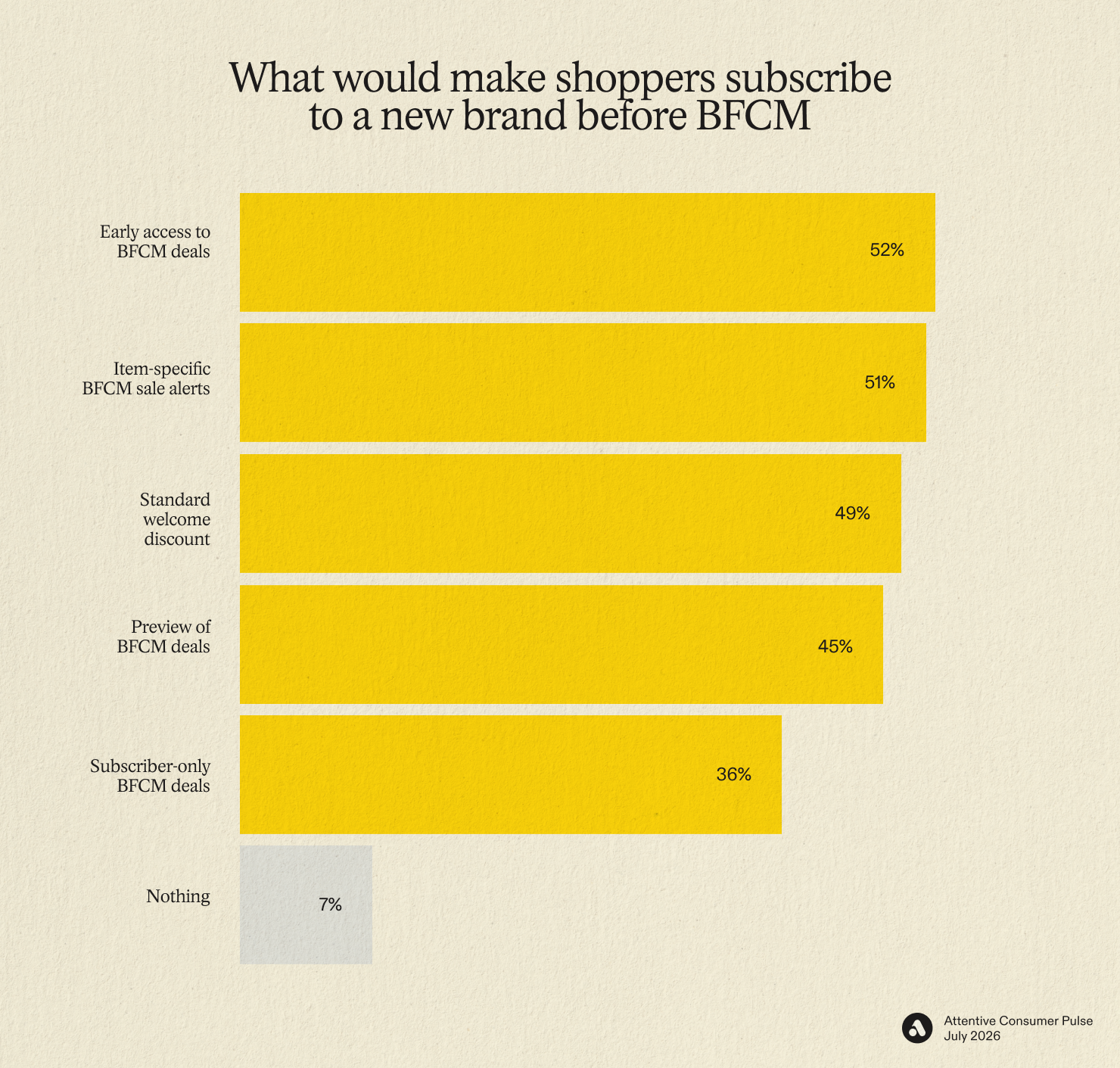
  4. Add BFCM-specific hooks to your sign-up units. 93% of BFCM shoppers would subscribe to a new brand before Cyber Week—and early access and item-level sale alerts pull as much weight as the standard welcome discount.
  5. Grow your multichannel tier—and message it more. 22% of email and SMS subscribers plan to spend more this BFCM vs. 14% of email-only. Collect both an email and a phone number at sign-up, invite single-channel subscribers to a second channel, and message your multichannel tier more during Cyber Week.
  6. Make your brand legible to AI chatbots. 67% of shoppers now use AI chatbots for shopping, and last BFCM, AI users outspent their plans more often than non-users. Structure your product content so chatbots can recommend it accurately.

1. Starts early—and keeps shopping after BFCM

This year, 71% of consumers plan to start purchasing before Black Friday—and 46% before November even begins.
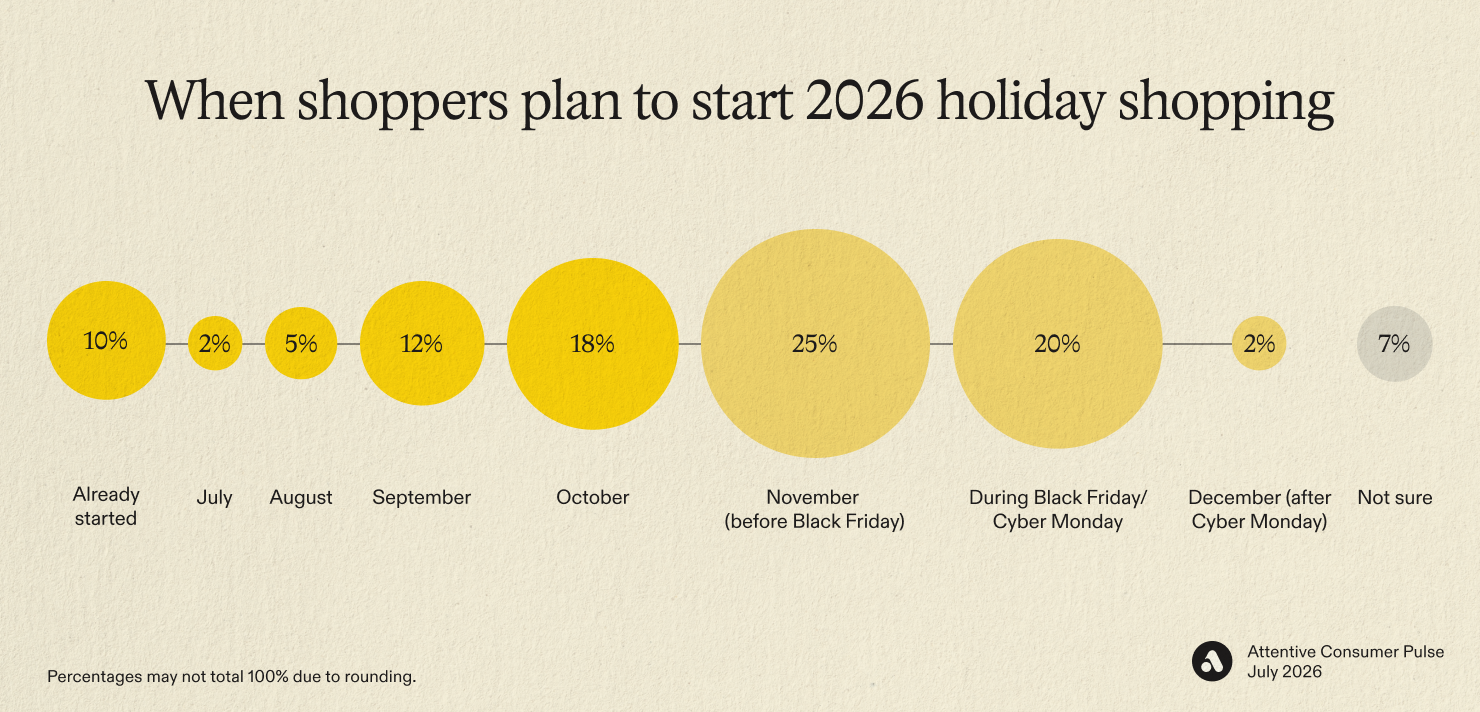
When shoppers plan to start 2026 holiday shopping

And the season doesn’t close on Cyber Monday, either. 83% of shoppers still had end-of-year purchases left to make after BFCM 2025—40% had “lots” left. But some brands don’t plan for that.

This year, we're taking a different approach, focusing on Q4 holistically vs. zooming in on BFCM specifically. How can we make the best of the lead-in, the strong weekend, and the lead-out?

– Logan England, Head of Ecommerce, Thread

Demand arrives before the deals

Shoppers may start early, but they don’t expect brands to launch their deals until later.

84% expect BFCM deals to start before Black Friday itself—but almost entirely in November.

That gap is an opportunity to show up for the demand with less competition.

“We’re looking at engaging shoppers earlier this year, possibly 2 weeks before Thanksgiving. This is really from seeing how our competitors communicated BFCM last year and we feel like we missed the boat. With shoppers more concerned about the economy, we’re trying to get their dollars earlier this year, before BFCM is in full swing.”

– VP at premium apparel brand

Showing up early doesn’t require deep discounts

Shoppers are buying earlier than they expect deals to launch, so meeting them there doesn’t mean launching your best deals of the year in September.

A value add or relevant reason to buy—product launch, inventory alert, seasonal need—can get them shopping too.

Some shoppers will wait for discounts, but nearly half say they’ll shop before BFCM if they find a good deal—so a modest offer at your calendar’s built-in sale moments can convert without touching BFCM-level discounts.

Shoppers come in ready with a plan

Even those who aren’t buying yet are getting ready:

  • 42% will make lists of specific items they want to buy during BFCM.
  • 62% will start planning their holiday purchases before November.

Brands that help shoppers plan in advance secure their spot on the shortlist.

The recommendation: Plan for the full shopping season

To make the most of Q4’s opportunities, build an arc that carries your brand through the end of the year:

  • Help shoppers build their lists: Last year, shoppers told us they wanted brands’ help finding the right products. Personalized recommendations, curated gift guides, and lists of trending or bestselling items topped the list.
  • Give reasons to buy in early Q4 that don’t require a markdown: Product launches, low-inventory notices, and speaking to genuine seasonal-need moments.
  • Sweeten early purchases with value-adds: Perks that don’t eat directly into product margins—gift with purchase, free shipping, free product personalization, extra loyalty points.
  • Run modest deals at the calendar’s built-in sale moments: Labor Day, Prime Big Deal Days, Veterans Day, Singles’ Day—and treat each one as a test of your BFCM offers, segments, and messaging.
  • Plan for after Cyber Monday: Reach the shoppers still buying in December with modest deals, value-adds, and messaging that speaks to end-of-year needs.

Go deeper:

{{callout-1}}

2. Responds to value, not just discount depth

Brands are feeling pressured to go deep on discounting during BFCM, but it’s not a requirement for many shoppers.
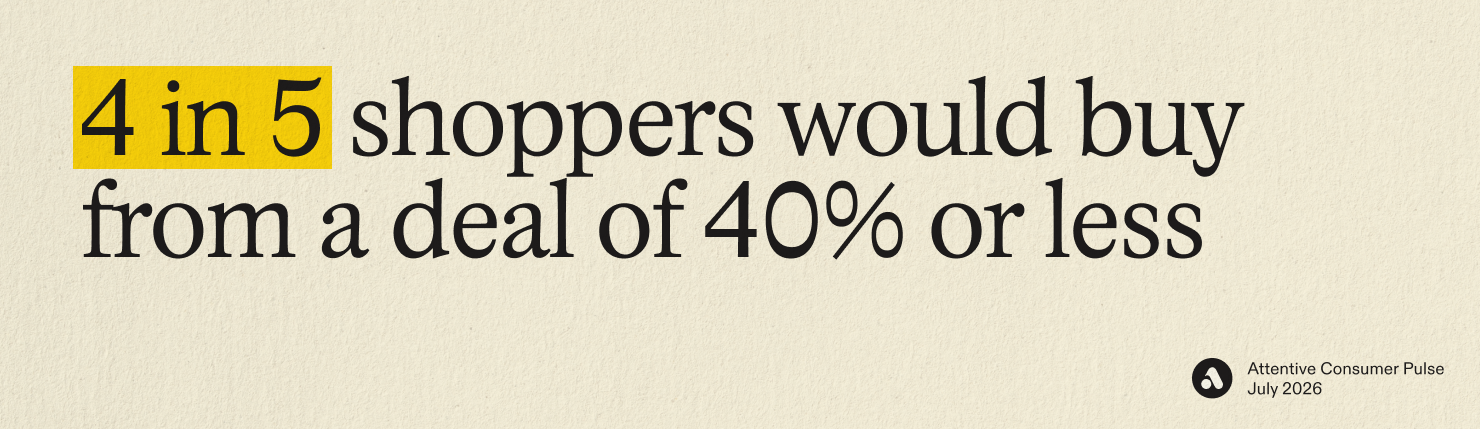
4 in 5 shoppers would buy from a deal of 40% or less

When asked the smallest discount that would get them to buy something they want during BFCM:

  • 21% said they need more than 40% off
  • 45% are moved by a moderate discount (20–40%)
  • 25% by a small one (under 20%)
  • 10% will buy with no discount at all

Add it up: 4 in 5 shoppers would buy at 40% off or less—many for far less.
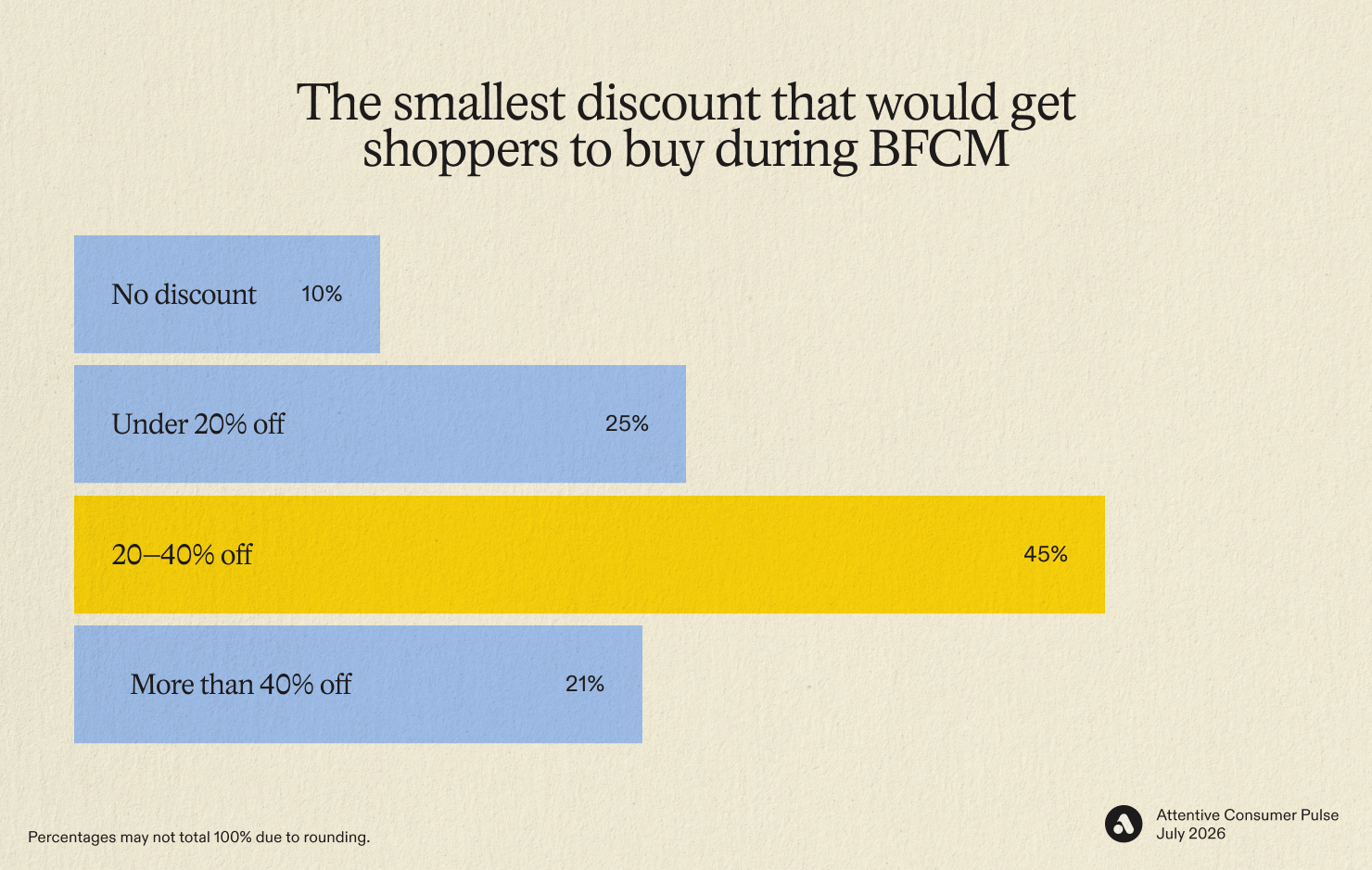
The smallest discount that would get shoppers to buy during BFCM

For most shoppers, the deal is the assurance they're not paying full price—not a precisely calculated threshold.

The right offer structure rewards bigger carts

Our 2025 post-BFCM survey reveals an opportunity for brands to rethink their deal structure.

Last BFCM, 56% of shoppers spent more than they planned. Among those who overspent, a couple of the reasons map directly to offer design:

  • 43% got better deals by buying more.
  • 27% added items to reach a free shipping threshold.

It showed up in the brand data too: Marketers who used tiered discounts in 2025 were 29% more likely to report improved performance.

Tiered discounts, bundles, and spend thresholds give shoppers a reason to spend more, raising your AOV instead of giving away the same flat discount no matter the cart size.

Non-discount perks move shoppers, too

Layering on additional motivators can help differentiate your deals when everything is on sale.

When asked what would make them most likely to purchase from a brand beyond a discount, shoppers said their top motivators are:

  • 68%: Free shipping
  • 42%: Gift with purchase
  • 39%: Price match guarantee
  • 35%: Extra loyalty points or perks
Non-discount motivators to buy during BFCM

Free shipping may already be standard in your program—but during BFCM, shoppers are actively weighing it. So make it clear in your campaigns rather than leaving it in the fine print.

{{callout-2}}

The recommendation: Build your offer around value

  • Keep the deal simple: One clear offer beats a complex, stacked one.
  • Anchor on a moderate discount: Most shoppers are in play at 20–40%. If you want to go deeper, save it for Cyber Week itself.
  • Use structure to lift AOV: Tiered offers, free-shipping thresholds, and bundles reward bigger carts.
  • Layer on non-discount motivators: Make them explicit without complicating your message—free shipping, gift with purchase, price match guarantee, loyalty points, payment plan options, and extended return policies.

Go deeper: Your Pre-BFCM Messaging Tune-Up

3. Buys deliberately—and responds to relevance

The economy is setting the terms again this year.

87% of consumers say the economy will change how they shop BFCM.

The biggest shifts:

  • 42% will compare brands and retailers more before buying.
  • 41% will focus on needs over wants.
  • 39% will stock up on things they use regularly while they're discounted.
  • 26% will save purchases for BFCM instead of buying at other times of the year.
How the economy is changing the way shoppers approach BFCM

Careful doesn’t necessarily mean spending less

None of this is new. Shoppers came into BFCM 2025 under similar economic pressure—and that season still delivered a record-breaking Cyber Week.

This year’s BFCM budgets are holding steady, too:

  • 23% plan to spend more than last year
  • 45% plan to spend about the same
  • 25% plan to spend less

This is a slightly brighter outlook than August 2025, when 29% planned to spend less and 21% more for last year’s BFCM.
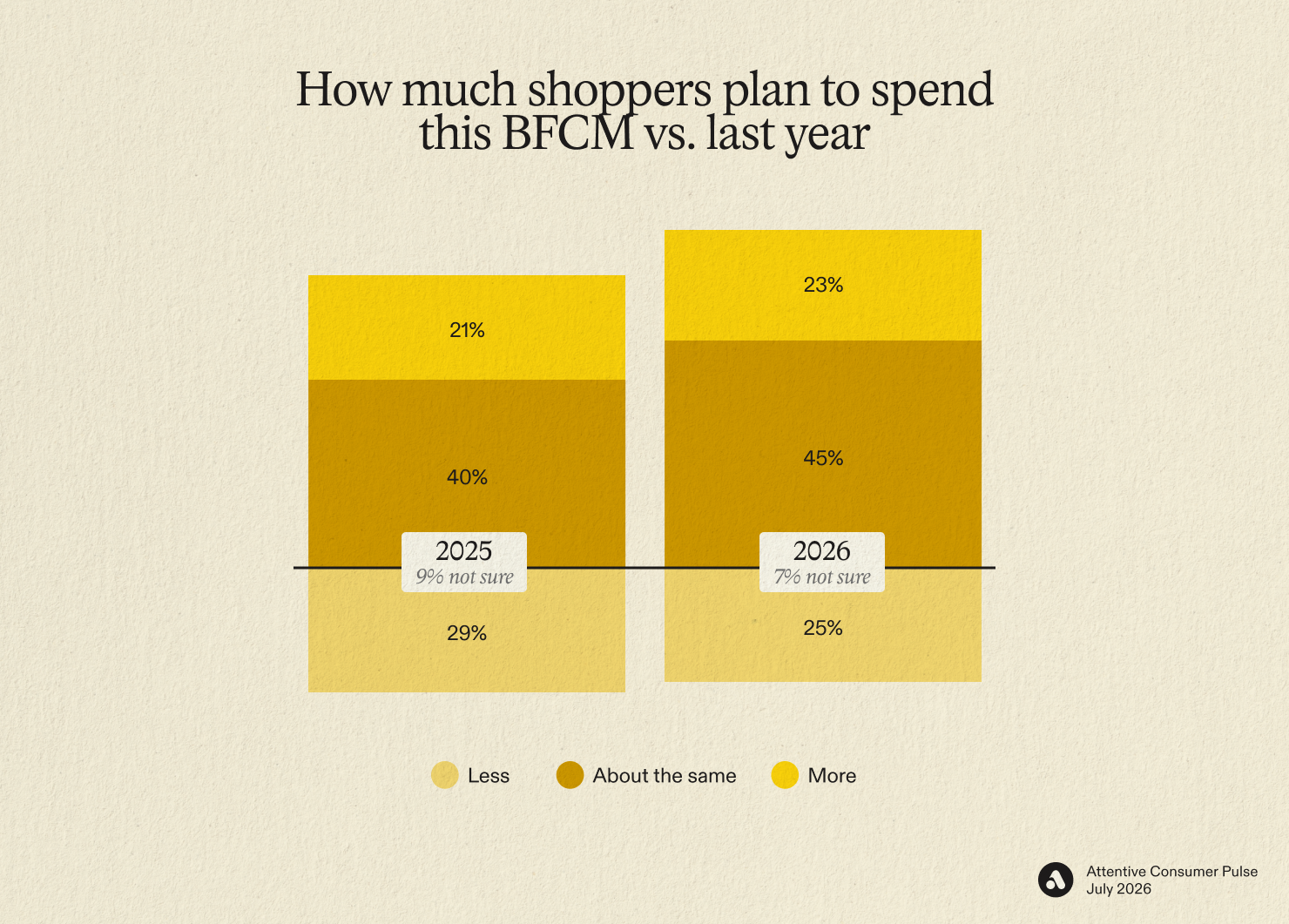
How much shoppers plan to spend this BFCM vs. last year

Economic pressure impacts what’s in the cart

Overall, 77% plan to make non-gift and non-holiday purchases during BFCM—and 71% plan to buy gifts for others.
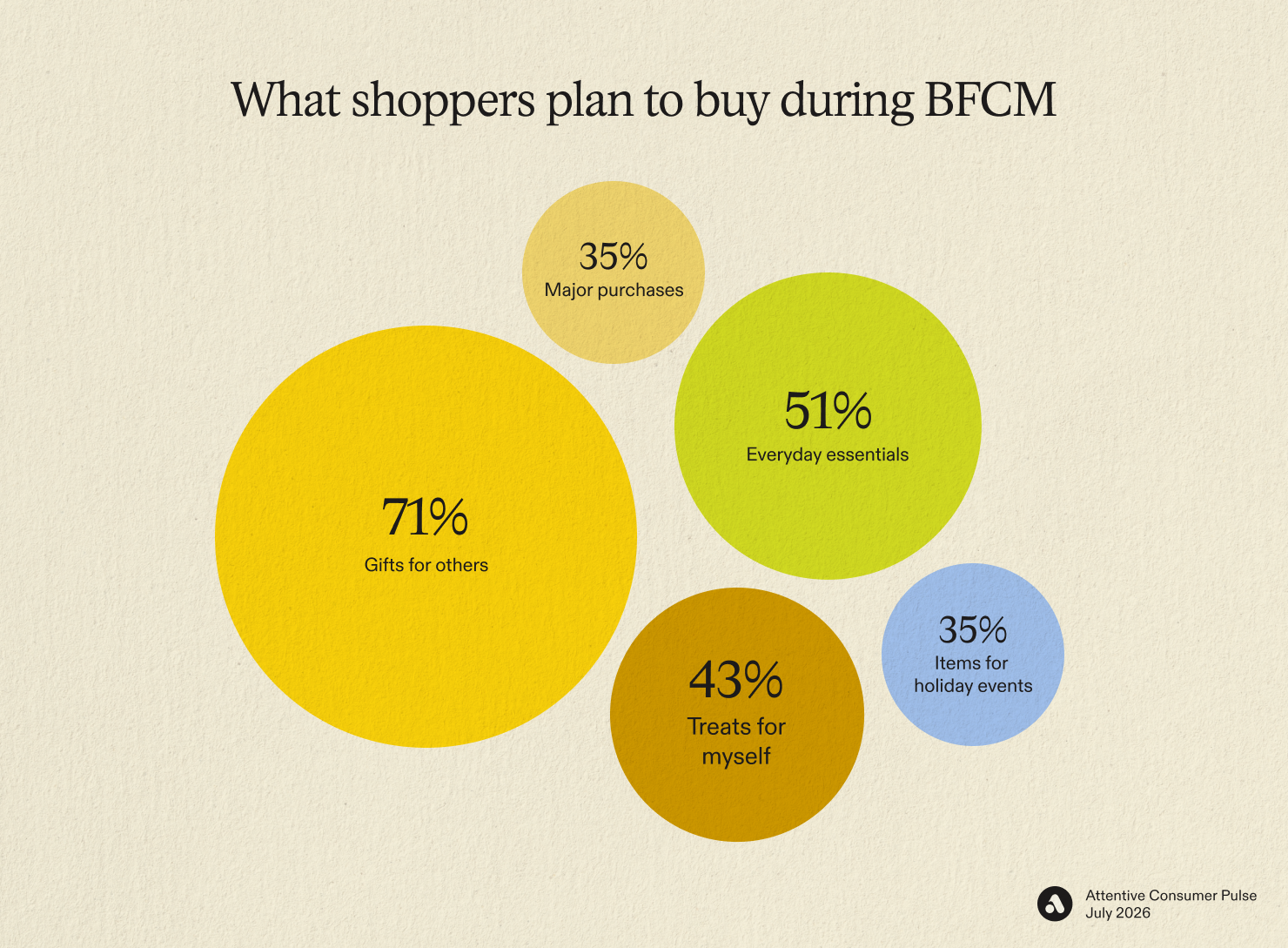
What shoppers plan to buy during BFCM

But shoppers whose BFCM shopping is impacted by the economy are more likely than unimpacted shoppers to buy:

  • Everyday essentials (53% vs. 33%)
  • Major purchases (37% vs. 26%)

Pressure is leading shoppers to be practical.

Personalization converts careful shoppers

When customers are considering every purchase, relevance wins out over generic messages. Shoppers say these would make them more likely to buy during BFCM:

  • 90%: Price drop alerts on items they're interested in
  • 88%: A discount on something they recently viewed or added to their cart
  • 73%: Product recommendations that feel relevant to them
  • 68%: Messages featuring relevant products instead of generic promos

[Chart Q20]

Price drops, browse abandonment, and cart abandonment flows can serve the first two by responding to a shopper’s actions during Cyber Week. And segmenting your sale announcements—so you can feature products each group is likely to want—makes them more relevant than a single generic blast.

{{callout-3}}

The recommendation: Match the message to the mission

  • Turn on the triggered flows deliberate shoppers respond to: Price drop and browse/cart reminders map exactly to the two message types shoppers named most likely to prompt a purchase.
  • Segment by shopping mission: Use conversational text and sign-up unit questions to find out what, or who, your customers are shopping for. Then respond with product recommendations and gift guides, and use those answers to segment your next campaign.
  • Sell to needs, not just wants: Lead with practical value for the 41% who are planning to focus on needs over wants—everyday essentials, restockable items, and big-ticket purchases they’ve been putting off.
  • Help shoppers choose your brand: With 42% planning to compare across brands and retailers, give them what they’re weighing: clear pricing, strong reviews, product details, and what sets your product apart.

Go deeper:

4. Ready to subscribe before Cyber Week

The right incentive can encourage BFCM shoppers to subscribe in advance of your sales. 93% of BFCM shoppers would subscribe to a new brand before Cyber Week.
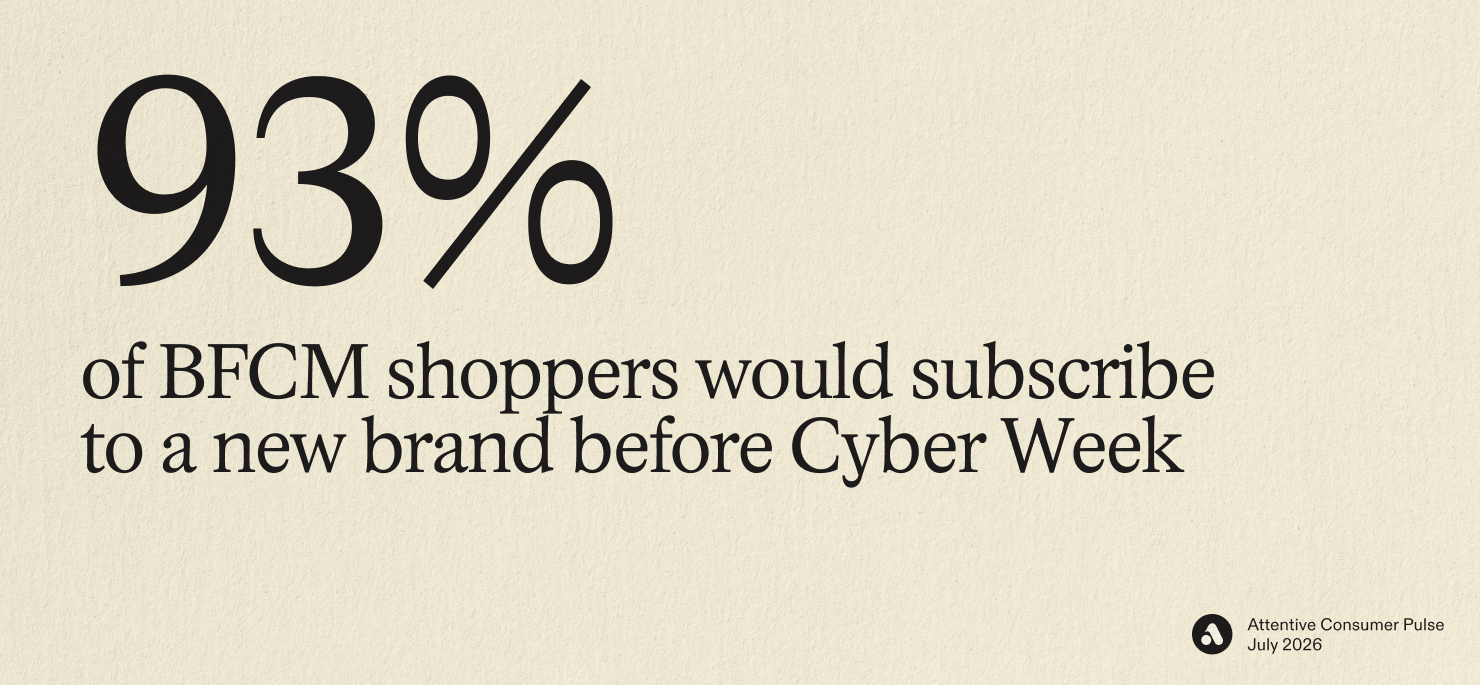
93% of BFCM shoppers would subscribe to a new brand before Cyber Week

The payoff shows up in spend, too: Subscribers who join between June and mid-November have historically posted higher AOVs during Cyber Week than prior subscribers.

BFCM-specific hooks rival the welcome discount

What draws them in:

  • 52%: Early access to BFCM deals before they're public
  • 51%: Alerts when specific items they want go on sale during BFCM
  • 49%: A standard welcome discount on their first order
  • 45%: A preview of the BFCM deals coming
What would make shoppers subscribe to a new brand before BFCM

During BFCM 2025, 73% of shoppers signed up for emails or texts from at least one new brand specifically to get notified about deals.

The recommendation: Grow your BFCM audience intentionally

  • Start your list growth efforts early: List growth compounds—every subscriber added now sees your full season arc, from early-access teases to Cyber Week itself.
  • Shift your sign-up hooks as BFCM approaches: Add BFCM-specific draws to your sign-up units—early access to your deals, item-level sale alerts, and a preview of what's coming.

Go deeper: 7 Ways to Grow a Higher-Value List Before BFCM

5. Multichannel—and higher intent

Shoppers who sign up for a second channel sit in a different tier—meaningfully more valuable than single-channel subscribers.

And 65% of BFCM shoppers subscribe to at least two channels across email, SMS, and push—so some of your single-channel list may just be waiting for you to ask.

More channels come with bigger spend plans

14% of email-only subscribers plan to spend more during BFCM this year compared to last year. Among subscribers to email and SMS, it's 22%—and 26% for those who add push notifications to the mix.
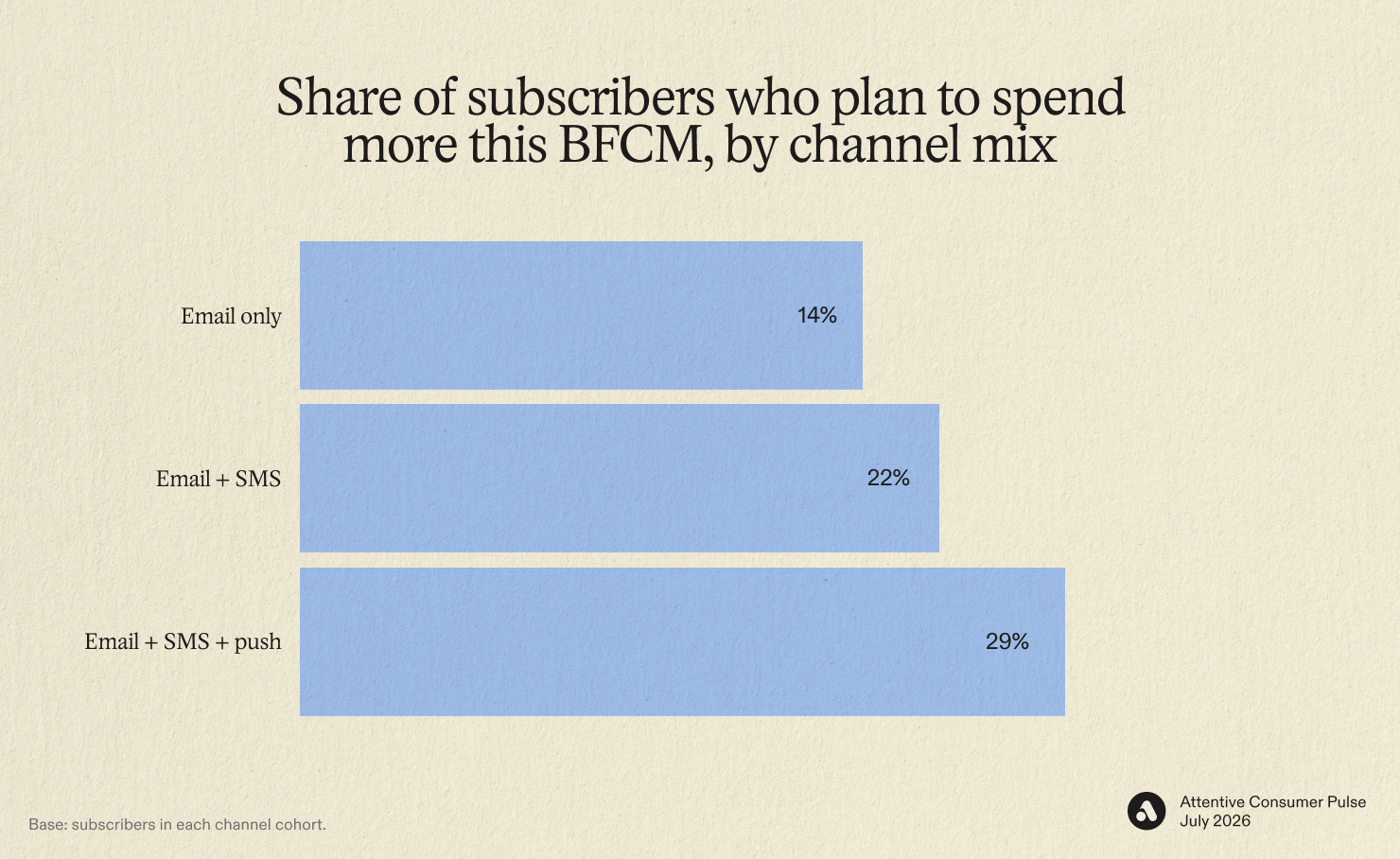
Share of subscribers who plan to spend more this BFCM, by channel mix

They lean on brand messages to shop, too: 60% of email and SMS subscribers plan to find BFCM deals through brand emails or texts, versus 39% of email-only subscribers. So your multichannel list isn't just reachable in more places—it's actively watching those places for your deals.

Last BFCM, multichannel shoppers spent more

We saw the proof last BFCM.

Additional data from the December 2025 Attentive Consumer Pulse reveals that 79% of shoppers who recalled purchasing after seeing campaigns on two or more channels said they spent more than planned—compared to 53% of those who bought after seeing messages on one channel.

[Chart Dec Q1 x Q6]

The recommendation: Grow and activate your multichannel audience

  • Message them like the high-intent audience they are: Shoppers who sign up for two or three channels are open to higher message frequency when it's relevant to their needs, preferences, and style. So test a higher volume for multichannel subscribers.
  • Capture both channels at sign-up: Ask for email and SMS together, and give shoppers a reason to opt into both—clear benefits and perks for each channel.
  • Promote a second channel to single-channel subscribers: Invite email-only subscribers to SMS with a concrete reason to join—like first access to Black Friday deals—and promote email to SMS-only subscribers in return.

Go deeper:

6. Uses AI to compare and decide

Shoppers are putting AI chatbots like ChatGPT, Gemini, and Perplexity to work on their purchases—and the behavior is now the norm.

67% of shoppers have used an AI chatbot to help with their shopping in the past three months—rising to 80% of Gen Z.

67% of shoppers have used an AI chatbot to shop in the past three months

That's consistent with what we saw during BFCM 2025, when 72% of shoppers used AI tools for the sale.

AI use shows up in higher-spend journeys

Last BFCM, 68% of AI users spent more than they planned, compared with 25% of those who didn't use AI. That's correlation—higher-intent shoppers are likely also heavier AI users—but it puts AI squarely inside higher-spend journeys.

Adobe's data points in the same direction: AI referrals converted 38% higher on Black Friday compared to other traffic sources.

Product research is the primary AI use case

So what are these high-intent shoppers actually asking AI to help them with? Among those who use AI, the top uses read like a deliberate shopper's checklist:

  • 58% ask questions about a specific product.
  • 51% compare brands, products, or features.
  • 45% get product recommendations.
  • 43% find deals, coupons, or the best price.
% of shoppers AI use case
58%
Ask questions about a product
51%
Compare brands, products, or features
45%
Get product recommendations
43%
Find deals, coupons, or best price for an item
37%
Summarize product reviews
32%
Get gift ideas
28%
Find alternatives to another product
27%
Share a photo to find similar products
15%
Visualize product on myself or in my space
11%
Complete purchases in an AI chatbot
10%
Complete a multi-step shopping task

The recommendation: Give AI chatbots the details shoppers are looking for

  • Make your product pages LLM-friendly: Clear specs, thorough descriptions, comparison content, and customer reviews give AI tools accurate material to surface when shoppers ask for recommendations or comparisons.
  • Test how you show up: Ask the major AI chatbots the questions your shoppers ask—"best [your category] under $50," "[your product] vs. [competitor]"—and fix the gaps you find by giving the right answers on your website.
  • Show up in the sources AI reads: AI answers also rely on third-party content—review sites, best-of roundups, press coverage, and forums like Reddit. Note where you are (and aren’t) showing up and increase your footprint by seeding product reviews and pitching the editorial roundups.

The last word: What matters to the 2026 BFCM shopper

The BFCM 2026 shopper:

  • Starts planning months before Black Friday—and keeps buying well past Cyber Monday.
  • Doesn't need your deepest discount. They need to feel like they're making a smart choice.
  • Shops deliberately—comparing prices, prioritizing needs, and timing purchases around the sale.
  • Subscribes before BFCM—for early access and item-level sales alerts as much as the welcome discount.
  • Signs up on more than one channel—and the multichannel shoppers are your highest-intent tier.
  • Brings AI along to do the research.

Every guide in The Edit is built for that shopper—expert, data-backed guidance for the full BFCM season, from Q3 list growth to December retention.

The Edit includes guidance for growing your list, optimizing your flows, and crafting high-performing campaigns

{{next-article}}

Methodology

The July 2026 Attentive Consumer Pulse survey was conducted online via Pollfish among 600 US adults from June 16–17, 2026. Respondents were screened to include only shoppers who plan to shop BFCM sales this year and who currently receive marketing from brands via email or text message. The study was designed to analyze results evenly across four generations: Baby Boomers, Gen X, Millennials, and Gen Z. No other post-stratification adjustments were applied.

Editor’s note

BFCM shoppers buy multiple times during the sale.

68% of shoppers remember making multiple separate purchases from at least one brand during BFCM last year.

So your customers may not be done once they shop your sale. Keep engaging them for follow-up purchases during Cyber Week.

Editor’s note

Your pre-BFCM sales are the place to test offer structures—which types of discounts and value-adds move your audience—so you have a clearer read on what resonates before BFCM.

Editor’s note

Relevance also buys you volume. According to the Attentive 2026 Personalization Trends Report, 65% of shoppers are open to receiving messages more frequently if they’re relevant.

Extra! Extra! Read all about it in The Edit

BFCM insights, trends, and
strategies—fresh off the press

Read now