Looking to earn more email and SMS subscribers? Follow these 11 data-backed strategies to improve your subscriber acquisition strategy.
If growing your email and SMS lists feels harder this year, you're not imagining it. List growth is marketers' #2 challenge in 2026 (after conversion rate)—and several forces are converging to make it tougher:
- Many brands are seeing softer site traffic as they pull back on paid media.
- Shoppers are more selective about what they buy—and that selectivity extends to which brands earn a place in their inbox.
- iOS 26 doesn't stop shoppers from subscribing—but it can quietly keep your messages from reaching the ones who do.
The good news: when list growth stalls, the cause is usually fixable—a sign-up experience that's quietly underperforming, an offer that's lost its edge, a moment of friction—not that shoppers have lost interest in subscribing.
To dig deeper, we surveyed 600 US consumers to find out:
- What makes them sign up for a brand's emails and texts
- Why they unsubscribe
- And what keeps them around
The result: 11 practical strategies for growing your email and SMS lists—starting with making sure what you've already built is working.
TL; DR: The 11-step list growth playbook
Here are the eleven steps to take to grow your email and SMS list:
- Check the health of your existing sign-up units. Confirm units are live, offers work, and display rules aren't quietly suppressing sign-ups—and re-test whenever your site changes.
- Add new sign-up touchpoints. Test new list growth opportunities across online and offline interactions.
- Determine the right sign-up incentive. Discounts convert best—test the amount, lean percentage over dollar-off, and consider a stronger offer for SMS.
- Spell out ongoing subscriber benefits. Shoppers who know what they're getting beyond the welcome offer are more likely to sign up—and to stick around.
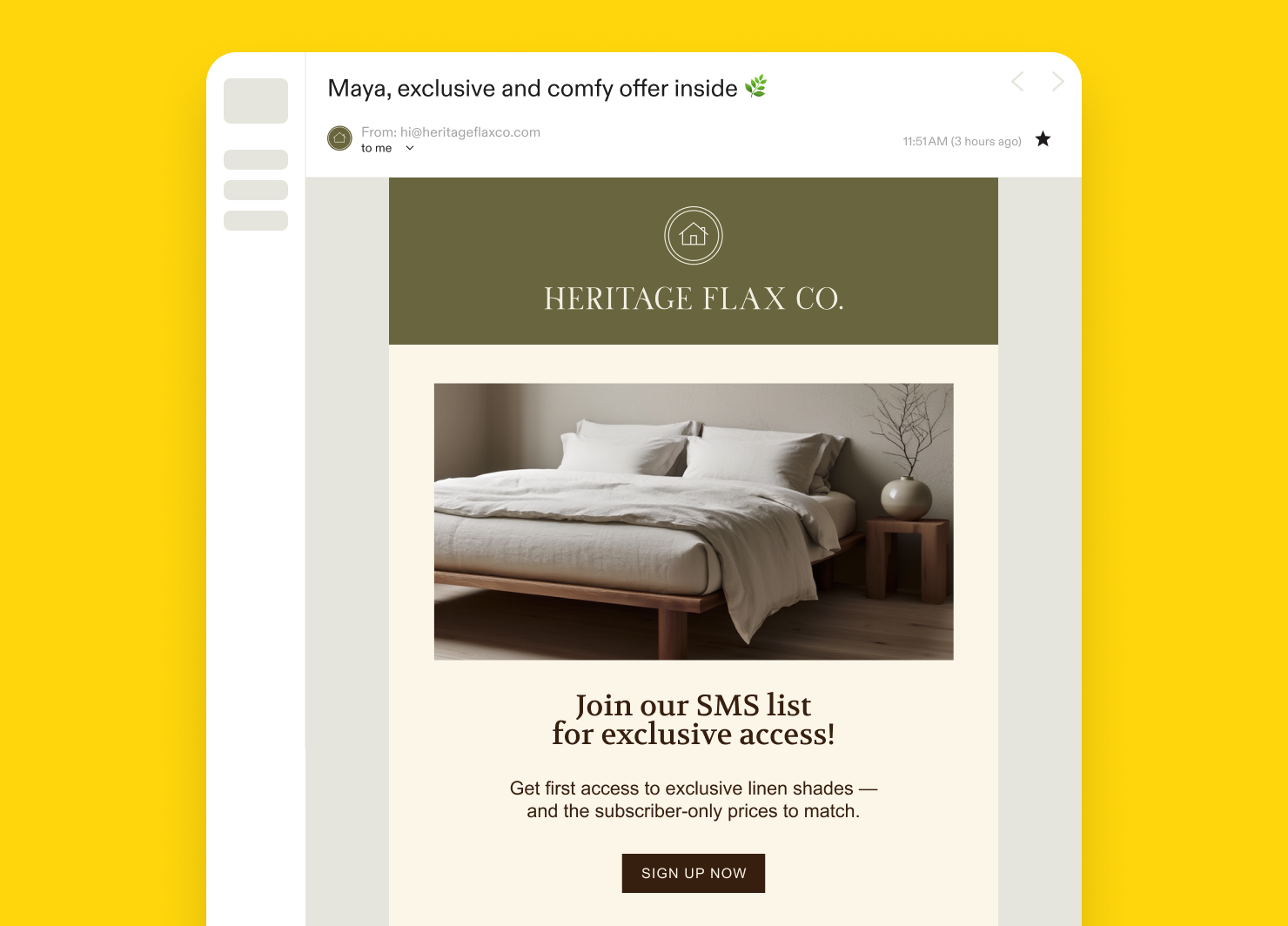
- Grow email and SMS in tandem. Promote both at the same time, and invite single-channel subscribers to the other.
- Collect zero-party data at sign-up. A question or two lets you personalize from the first message.
- Show sign-up units at the right moment. Time pop-ups to shopper readiness—and stop showing them to visitors who already subscribed.
- Optimize your design for every device. Test every element of your sign-up units to maximize sign-ups. Then, ensure they’re iOS 26 friendly, using two-tap™ sign-up on mobile and QR codes on desktop to keep sign-ups frictionless—and your texts in the primary inbox.
- Match your approach to the customer journey. Adapt units to their relationship with your brand and where they’re browsing.
- Make sign-up experiences compliant. Build clear, compliant opt-in into every unit.
- Measure what matters. Track the metrics that reveal what's working, and refresh your sign-up units when growth slows.
And to retain your subscribers, keep messages relevant and provide value early.
1. Check the health of your existing sign-up units
Before you add new ways to collect subscribers, audit the ones you have to make sure they’re working.
It's more common than you'd think for list growth to stall because something in the sign-up experience stopped working—rather than because shoppers are no longer interested in subscribing.
Maybe a pop-up gets disabled during a site update and never turned back on. A welcome offer code expires. A display rule set during a long-ago test keeps your unit hidden from most visitors.
These issues rarely announce themselves. Traffic looks normal, your messages keep sending, and the only signal is a slow bleed in new subscribers. So run a health check on every sign-up unit—and repeat it any time your site changes or sign-up unit impressions drop relative to traffic.
Confirm every unit is live and working
- Test each sign-up flow end to end. Subscribe through every unit—welcome pop-up, bubble, PDP embeds, exit-intent, landing pages—on a fresh browser. Confirm the unit appears, the form submits, and the welcome message arrives.
- Verify your offer codes. Make sure the discount code in your welcome flow is active and applies at checkout.
- Check desktop and mobile separately. It's easy for a unit to be suppressed on one device type without anyone noticing. Test both.
Review your display rules
Display rules and timing settings are the most common silent killers of sign-up unit performance:
- Long delays. A unit set to appear after 20–30 seconds may never be seen—many visitors have left by then. (More on timing in step 7.)
- "First page view only" rules. If your pop-up only shows on a visitor's first page view and never re-shows, you miss everyone who wasn't ready in that moment. Keep a persistent bubble on the site so shoppers can come back to your offer.
- Frequency caps and cookie windows. Check how long your unit stays hidden after a shopper closes it. A suppression window that's too long means returning visitors never get a second chance to subscribe.
Look for conflicts on the page
Your sign-up unit competes for attention—and sometimes screen space—with everything else on your site:
- Cookie consent banners can overlap or block your pop-up, especially on mobile. Make sure your unit displays cleanly after consent is handled.
- Multiple pop-ups can clash. If you run an exit-intent unit alongside your welcome pop-up, confirm they don't trigger over each other.
- Site redesigns and platform migrations are when units most often break. Add a sign-up flow test to your launch checklist any time the site changes.
Verify your third-party integrations
If you collect subscribers through tools outside your email and SMS platform—a separate pop-up vendor, a quiz tool, a loyalty platform—confirm those integrations are syncing on a regular basis. A broken connection can silently drop new sign-ups before they reach your list.
Third-party capture flows are also less likely to support two-tap™ sign-up—which matters for reaching subscribers in iOS 26 (more on that in step 8). Where you can, consolidate capture into flows you can monitor and test directly.
Make impressions your early-warning metric
The fastest way to catch a broken or misconfigured unit is to watch sign-up unit impressions—how many visitors actually see your units. If impressions drop while site traffic holds steady, a display rule or integration may have broken, and you can fix it before it costs you a quarter of your list growth.
We'll cover the full measurement framework in step 11.

2. Add new sign-up touchpoints across your customer experience
The more opt-in moments you create, the faster your list grows. So look for new opportunities to test.
Online
- Add a welcome pop-up to your homepage, collection pages, and product pages.
- Keep a persistent bubble on the site so shoppers can reopen your welcome pop-up if they close it.
- Use PDP embeds that show visitors exactly how much they'll save on a specific product by subscribing.
- Add waitlist sign-ups to out-of-stock product pages.
- Show an exit-intent pop-up with one last incentive to catch visitors who are about to leave.
- Use an add-to-cart trigger to catch shoppers when they’re in consideration mode.
- Add a form to your site footer.
- Consider adding a link in your website header to trigger a pop-up or lead to a landing page.
- If you’re on Shopify, turn on opt-in at checkout.
- Promote your email and SMS lists on social, through your link-in-bio page or a direct link in Instagram Stories.
Offline
Add QR codes or Text-to-Join keywords to offline touchpoints where shoppers interact with your brand, like:
- In your retail stores: Dressing rooms, at checkout, on receipts
- Direct mail campaigns
- Postcards in order packages (particularly valuable for marketplace orders where you can’t collect opt-ins)

3. Determine the best incentive to grow your email and SMS subscriber list
When a shopper hands over their email address or phone number, they expect something worth it in return. The incentive is what earns the sign-up in the moment—and our latest survey shows just how much weight that carries.
89% of email subscribers and 85% of text subscribers are influenced by a welcome incentive—and close to half won’t sign up without one.

Discounts are the most effective way to get shoppers to subscribe. According to our internal data, sign-up units with a discount convert at an average of around 43% and bring in roughly 55% more subscribers than a generic “stay in the know” prompt.
If you go this route, two factors determine how well it converts.
The amount
Offer enough to motivate without eroding your margin. A/B test in 5% increments to find the floor that still converts—and that brings in subscribers likely to come back and pay full price later.
We recommend going no lower than 10%, as that will likely not feel worth subscribing for.
Then, consider boosting your SMS incentive. Multichannel subscribers tend to be more loyal to brands, so it’s worth getting customers on both lists. Plus, 83% of shoppers say they’re more likely to sign up for both email and texts if they get better perks for joining both.
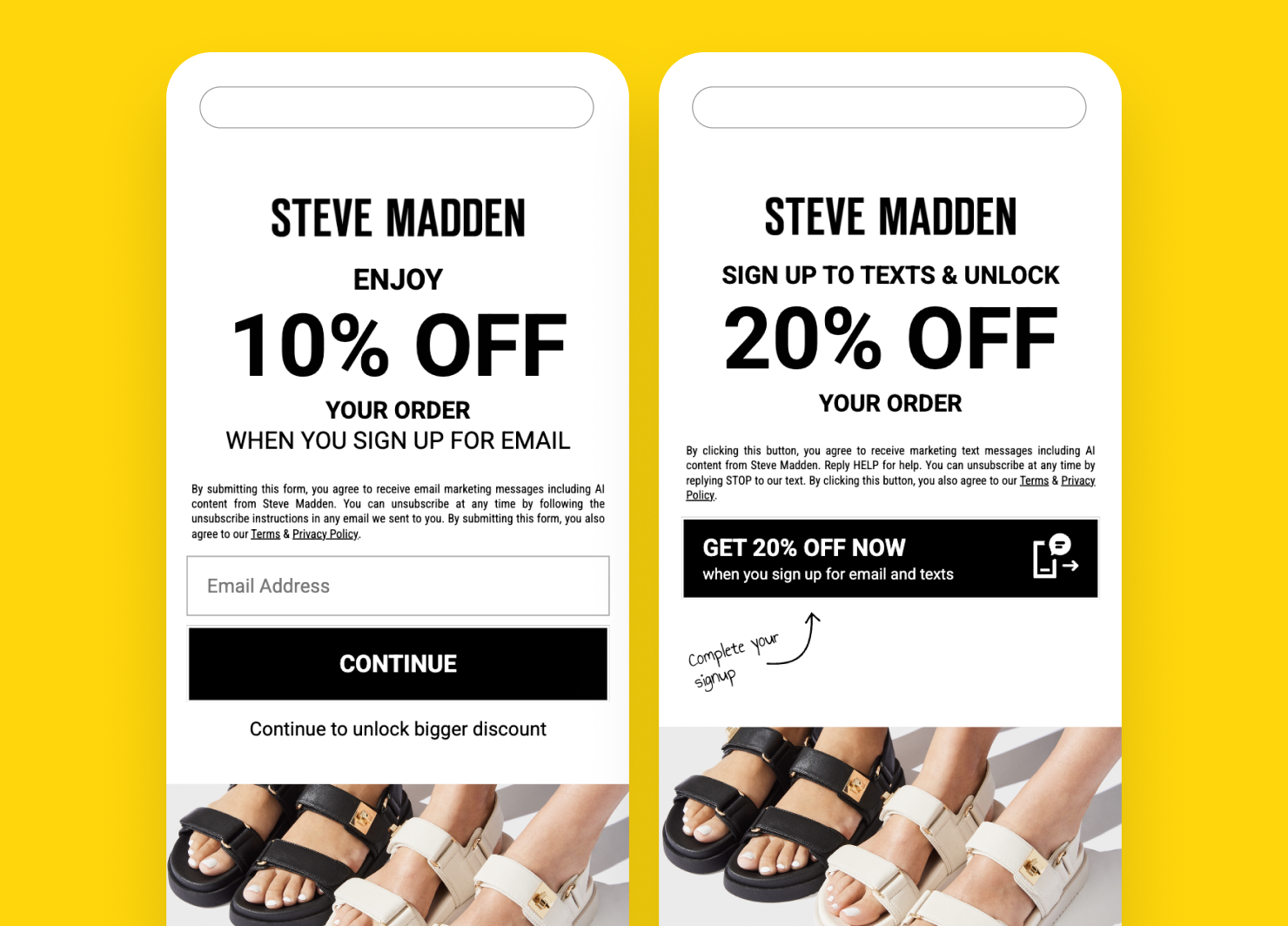
Consider increasing your SMS incentive by 5% more than your email offer. Steve Madden doubles the offer for SMS subscribers.
Word to the wise: Make sure your welcome discount is better than anything else they can get on site. If you’re advertising a 30% off sale, but your welcome discount is only 10%, there’s no reason to subscribe.
Many brands overcome this by simply temporarily replacing their typical sign-up unit with a unit promoting their sale offer—and an updated welcome flow to match.
Percentage vs. dollar format
We typically recommend brands use a percentage-based incentive as it encourages a higher cart value. The more items a shopper purchases in their first order, the more embedded they become in your brand.
However, it also depends on the amount you can give up.
For example, Eight Sleep offers a $100 incentive off its $3,000 Sleep Pod to new subscribers. This is only about 3%—which as a percentage wouldn’t seem as enticing.
If you go for a dollar-amount off, consider requiring a minimum purchase amount to protect your margins.
Consider non-discount incentives
If discounts don’t feel aligned with your brand, these sign-up incentives can be motivating too:
- Contests or giveaways (which convert at around 11%)
- Free gift with purchase
- Product recommendations from a quiz
- Loyalty or reward incentives
- Helpful content, like gift guides or how-to resources
If you go for a giveaway, keep an eye on your subscriber quality. Shoppers who sign up for a prize tend to have lower purchase intent than those who subscribe for a first-purchase discount. You don’t want a list full of low-engagement subscribers.
Use giveaways selectively instead—like to grow your list ahead of BFCM—and keep the prize modest enough to attract people who would buy your products.
4. Spell out the ongoing benefits of being a subscriber
An incentive alone won’t grow your list. 81% of shoppers are more likely to sign up for both email and SMS if it’s clear what they’ll get from each one—so spell out the benefits, not just the offer.
UNTUCKit describes compelling benefits for each channel:

These benefits also help you keep the subscribers you earn. Close to a quarter of shoppers on email and SMS unsubscribe early because they only signed up for a welcome offer. Make the ongoing value of subscribing clear from the start, and more of them stick around.
Highlight the perks shoppers care about
So what should you highlight? More than half of shoppers were drawn to every perk we asked about:
- Subscriber-only offers or discounts
- Loyalty rewards or points
- Free shipping
- Early access to sales or product launches
- Subscriber-only product drops
- More relevant product recommendations

Whatever you offer, highlight it in your sign-up units. And since they all resonate strongly, you can rotate which you feature to keep sign-up units fresh or speak to different visitor segments.
Differentiate channels by benefit
If shoppers expect the same experience on email and SMS, they may pick just one.
Because SMS is a channel of immediacy, use it as your “first-to-know” channel. Give text subscribers first access to launches and sales so there’s a clear reason to join both.
5. Grow your email and SMS lists in tandem
Tackling email list growth and SMS subscriber growth together compounds your results. Subscribers who get both are 2x more likely to buy than those who just get SMS, according to our internal data.
And 85% of email and SMS subscribers are open to signing up for both when a brand asks—only 15% typically pick just one.

So it pays to get shoppers on both channels.
Ask for email first, then the phone number
The best-practice flow: collect a shopper's email and phone number at the same time, in two separate steps—email first.
One ask at a time converts better than asking for everything at once—and it helps you align with phone carrier requirements.
Asking for email first is lower-commitment since shoppers tend to be more protective of their phone numbers.
If a shopper drops before sharing their phone number, you’ve still earned an email subscriber you can reach.
Encourage single-channel subscribers to join both
Some shoppers will only sign up for one channel at first, so make a habit of inviting them to the one they’re missing.
A couple places to do it:
- Add an SMS sign-up CTA to your emails—campaigns or welcome series.
- Point SMS-only subscribers to an email sign-up page—in your SMS welcome series or ahead of big events when you want to grow your multichannel list.
6. Collect useful zero-party data without adding friction
Personalization is the foundation of high-performing email and SMS programs—and you can start building it at sign-up.
Behavioral data—what shoppers click, browse, and buy—is your best read on shopper interest and intent. But zero-party data—the information shoppers tell you directly—fills in context that would be harder to infer, or that you might not gather until you have more browsing data.
Ask a few of the right questions and you’ll learn a shopper’s priorities, style, preferences, and values up front—so you can send more relevant messages from the beginning.
Add preference fields to your sign-up units
Shoppers want you to get to know them. And 75% are open to answering a few quick questions at sign-up if it makes the marketing they receive more relevant.
Gathering customer data in your email and SMS pop-up lets you personalize your welcome series, so you convert better from the first message.
Extra fields can add friction, so ask only for what you’ll use. Stick to 1–2 high-impact questions—ones that will meaningfully help you personalize a new subscriber’s experience and nudge them toward a first purchase.

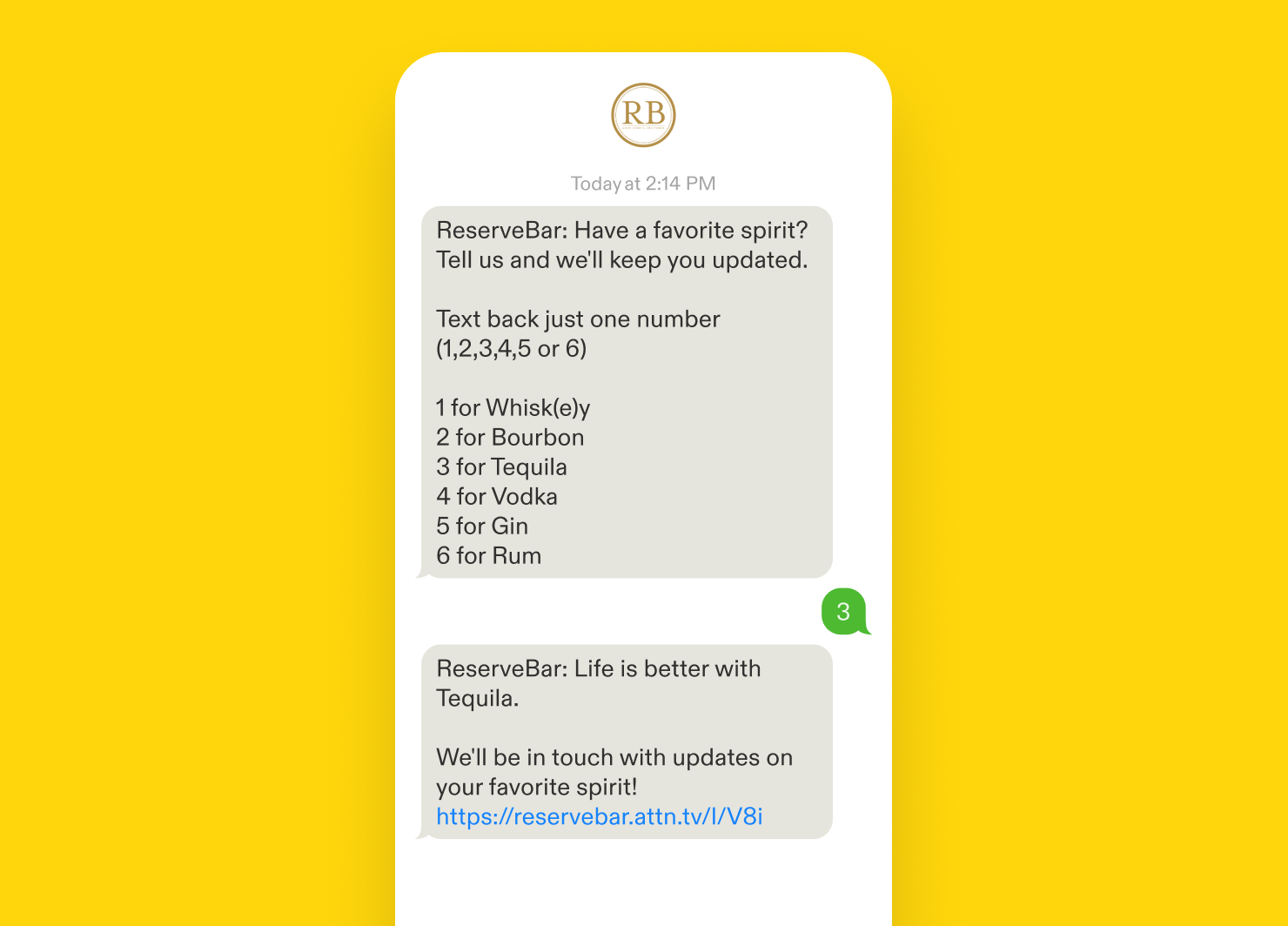
Use conversational SMS in your welcome flow
A conversational text can gather preferences while the relationship is fresh, without crowding the sign-up experience itself.
Add one to your welcome series to inform segmentation later or help shoppers discover their first purchase—like ReserveBar does here:
7. Show email and SMS sign-up units at the right moment
You can't always control site traffic—we've talked to several brands who are pulling back on paid media spend and seeing reduced traffic as a result—but you can control how much of it you capture.
And when shoppers see your sign-up unit can matter as much as what's in it.
Fine-tune your pop-up timing
As a baseline, you can test different pop-up timing triggers: time on-page, scroll depth, exit-intent, add-to-cart. A/B test to see what works for your brand.
While this can help you maximize list growth, the same trigger won’t work for every shopper. The latest data shows that when pop-up timing doesn’t align for a shopper, it can create a frustrating experience:
- 72% of shoppers say pop-ups usually appear before they’re ready to sign up for emails or texts
- 66% feel annoyed when a pop-up appears before they’ve had a chance to look around
To go beyond universal pop-up timing that applies one rule to every site visitor, use a tool like Attentive AI Grow, which personalizes timing based on each shopper’s behavior—surfacing your unit at the moment they’re most likely to sign up.
Brands using Attentive AI Grow see 25% more sign-ups from existing traffic and a 35% lift in welcome series revenue.
Build the foundation to recognize your existing subscribers
Showing welcome pop-ups to existing subscribers is an annoyance. Yet 70% of shoppers say they often see brands’ sign-up units when they’re already subscribed.
This points to a broader identity challenge: if you can’t recognize subscribers on your site, you can’t tie their behavior back to their customer profile for personalization.
Read more: Why Identity Resolution is Your Biggest Revenue-Opportunity in a Privacy-First World
8. Optimize your sign-up unit design for every device
What shoppers see—and how easily they can act on it—decides whether an impression becomes a subscriber. And in the era of iOS 26, it determines whether they’ll see your SMS campaigns moving forward.
Make signing up effortless on mobile
In our 2026 Personalization Trends report, we found that 73% of consumers had shopped on a phone web browser in the past three months, compared to 58% on desktop.
So build a mobile-friendly version of your sign-up unit: legible copy for small screens and tappable buttons within the thumb zone.
Also consider using Attentive’s patented two-tap™ sign-up technology. Two-tap™ sign-up reduces friction for SMS list growth and captures 2x more subscribers than other sign-up units.
Earn “Known Sender” status in iOS 26
Two-tap™ sign-up is also the best way to earn “Known Sender” status in iOS 26 and ensure your messages land in subscribers’ primary inbox.
New iOS 26 settings filter texts from unrecognized senders into a separate, silenced inbox. Subscribers who opt in through flows that don't establish that recognition—like desktop sign-ups or third-party pop-ups—may never see your messages, even though they asked for them.
Attentive two-tap™ sign-up solves this on mobile.
For desktop visitors, add a QR code to your SMS sign-up step that shoppers can scan to initiate the sign-up from their phone. They get a low-friction experience, and you get subscribers whose messages reach the primary inbox.
Test your sign-up unit design
A few pop-up optimization levers worth testing in your design:
- Format: For your new subscriber offer, we recommend using a full-screen pop-up. But there are a variety of formats you can try for different purposes. Bubbles for shoppers who closed out your welcome pop-up, PDP embeds to show savings on a specific item, or dedicated landing pages for off-site use cases.
- Interactive elements: Try gamified features like spin-to-win, tap-to-reveal, or other pre-engagement steps to capture interest. Add countdown timers for sale-specific sign-up units that add urgency to your limited-time event.
- Social proof: Try adding a trust signal—a star rating, a short customer quote, or your subscriber count. A line like "Join 500K+ subscribers" legitimizes your list before they hand over their contact info. Social proof makes the most sense for landing pages, where you have more room for copy.
- Aesthetic: Test different imagery, background colors, and button colors to see what converts best.
- CTA: Write copy that makes the next step clear.
Calla Shoes has seen strong performance by adding pre-engagement steps to their sign-up units.
While standard units without a pre-engagement step average around a 1.8% CTR, they’ve bumped that up to 2.4% with a question-based prompt and 2.9% with tap-to-reveal a mystery discount.

Test one element at a time so you know what's actually driving the change.
9. Match your approach to the customer journey
Our survey reveals that sign-ups happen at every stage of the customer journey.
While purchase consideration emerged as the single biggest moment for email and SMS subscribers to sign up for a brand’s marketing, their responses were widespread.

When we parse out the data further, a couple of patterns stand out:
- Shoppers are more likely to sign up for emails before a purchase than they are for SMS: 79% most often subscribe to emails pre-purchase, compared to 67% for SMS.
- A sizable share won’t sign up for either until after they’ve purchased: 21% subscribe to emails exclusively after a purchase, and 33% for SMS.
Since shoppers subscribe at different stages, a universal sign-up unit won’t always land. Tweak your approach to meet shoppers where they are.
Adapt your sign-up unit depending on where shoppers are browsing
Where someone is on your site can hint at where they are in their journey. A first-time visitor on your homepage is still learning about your brand, while someone on a PDP has higher purchase intent.
So adapt the unit to the page. For example, if a shopper’s on a PDP, tie your offer to what they’re viewing—swap the imagery, or highlight how much they’d save on that exact item.
Tailor sign-up units to the customer relationship
The same logic applies to who someone is.
A returning customer who isn’t a subscriber shouldn’t see a “first-purchase discount”. Instead, you could adapt your sign-up unit:
- Frame your offer as a “next order” discount.
- Highlight savings on something they buy regularly.
- Put a greater emphasis on the benefits of subscribing that they’ve been missing out on: loyalty points they can use toward their next purchase or first-to know about launches and sales.
- Or, simply keep a bubble on your site that’s less intrusive, but there if they want it.
Similarly, an existing email subscriber doesn’t need to see your full sign-up experience—just an ask to join your SMS list as well.
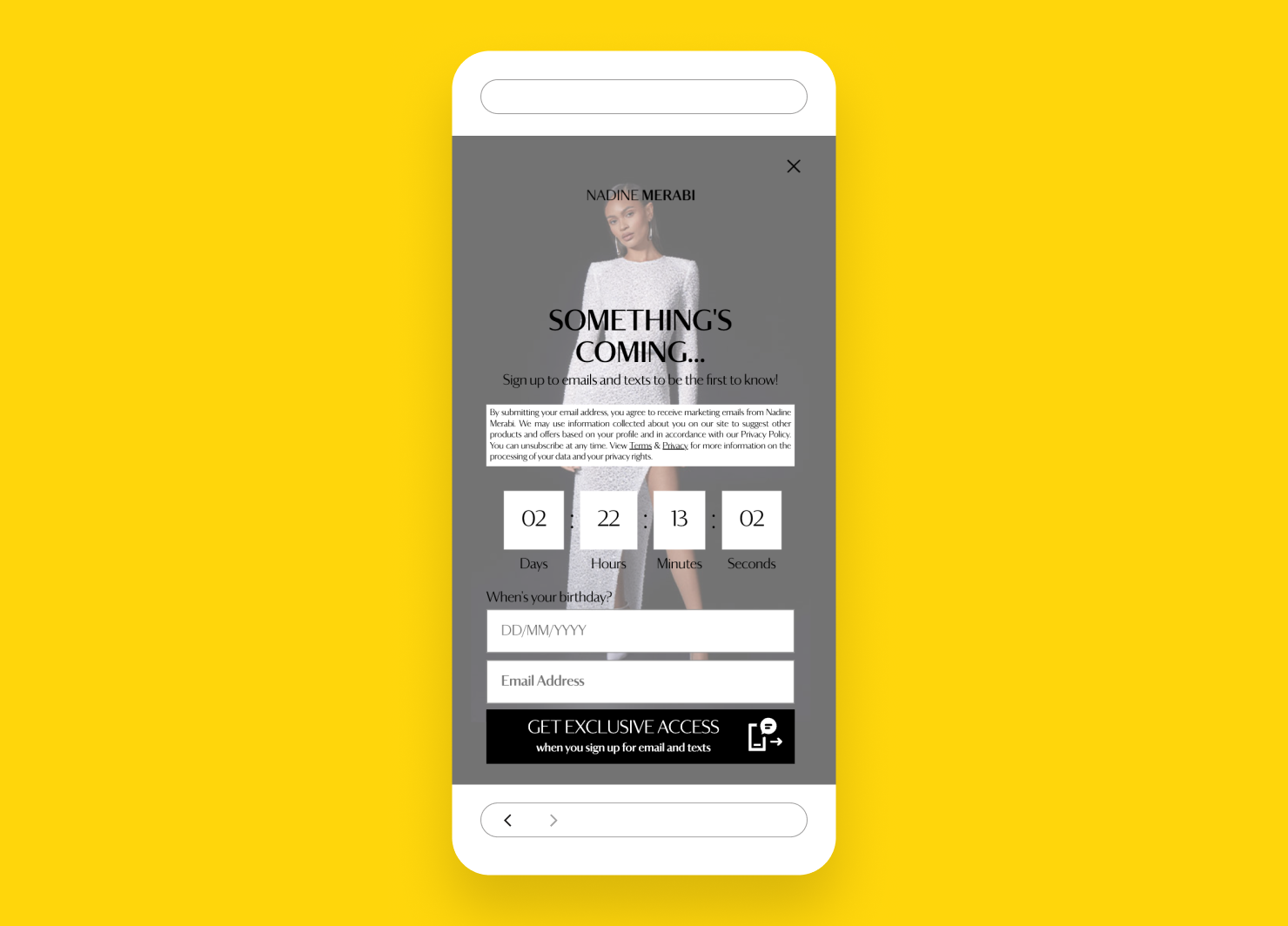
Use campaign-specific units for launches and sales
Teasing campaigns in your sign-up units can boost subscriber acquisition by giving shoppers a timely reason to join.
Think: seasonal sales, BFCM, or highly anticipated product launches.
10. Design your sign-up units with compliance in mind
Email and SMS are both regulated channels. Applicable rules vary by region and channel. Obtaining the necessary level of consent from your subscribers starts with your sign-up units.
Attentive sign-up units are designed with compliance in mind and the Attentive platform includes tools to help you comply with applicable industry regulations (e.g., the TCPA, ADA, and CTIA).
Read more about SMS compliance and email deliverability for the full scoop.
11. Measure for success: Determine the metrics that matter
By now, you probably have several ideas to test in your email and SMS marketing program. But what works for one brand might not work for another. So before trying anything, determine which metrics you’ll analyze to make sure you’re on track.
A few worth considering:
- Impressions: This is your early warning sign that a display rule or new integration may have interfered with your sign-up unit, rather than demand dropping.
- Sign-up unit conversion rate: Your most direct read on whether your offer, design, and timing are landing.
- Click-through rate at each step of your sign-up flow: Shows where shoppers drop off so you know which stage to tweak.
- Welcome flow conversion rate: High sign-ups but low welcome conversions can signal you’re attracting subscribers with low purchase intent.
- First order value: Another way to determine if you’re drawing in the right subscribers.
- Second purchase rate: A signal that you’ve earned a customer, not just a discount hunter.
- Opt-out rate: Early unsubscribes can mean you’re drawing in discount hunters, or that there’s a mismatch between your sign-up unit promises and what your messages deliver.
The same sign-up unit may not work forever. So when you’ve landed on a design that works for your brand, keep tracking these metrics over time. If subscriber acquisition declines, consider refreshing your sign-up experience.
Bonus: Keep the subscribers you earn
Subscriber acquisition is half the job. Subscriber retention—nurturing them into loyal customers—is the other half.
50% of email subscribers say they’ve recently unsubscribed soon after signing up—the same for SMS subscribers.
To keep them, you’ll want to use welcome and post-purchase flows at a baseline to ensure you provide early value and keep new subscribers engaged.
To dig deeper, we asked why early unsubscribers leave and what leads shoppers to stick around after a first purchase.
Why new subscribers leave
Knowing what leads to unsubscribes can help you reduce churn.
The top reason shoppers unsubscribe soon after signing up is message volume—but volume and relevance are tied together.
Our 2026 Personalization Trends Report found that 65% of shoppers are open to receiving messages more frequently if they’re relevant.
The reasons subscribers stay after the first purchase reveals how to keep shoppers who only signed up for the welcome offer.
What keeps subscribers after a first purchase
To keep subscribers who only signed up for the welcome offer, provide value early to outlast that first discount.
The survey shows that once shoppers make their first purchase, ongoing value keeps them subscribed:
So don’t go silent on subscribers after their first purchase. Continue promoting things they may be interested in and launch a post-purchase flow to keep them engaged.
Learn more: Boost revenue from email, SMS, RCS, and push
Keeping your hard-earned email and SMS subscribers comes down to nailing your cross-channel marketing strategy.
The Cross-Channel Marketing Playbook lays out six tactics for getting relevance, frequency, and message sequencing right across email, SMS, and push:
- Give each channel a role
- Give your messages room to land between sends
- Sequence messages like a conversation
- Segment for relevance
- Match frequency to engagement
- Build your identity foundation so behavior and suppression rules carry across channels, devices, and sessions
Read: The Cross-Channel Marketing Playbook: How to Boost Revenue from Email, SMS, RCS, and Push
Methodology
This survey was conducted online via Pollfish among 600 US adults from April 10–15, 2026. The study was designed to analyze results evenly across four generations: Baby Boomers, Gen X, Millennials, and Gen Z. Because younger respondents were harder to recruit in field, final results were weighted only by generation so that each one contributed equally to the overall analysis. No other post-stratification adjustments were applied.
FAQ: Email and SMS subscriber list growth
1. Why did my email and SMS list growth slow down?
Work through the funnel in order:
- Check sign-up unit impressions first. If impressions dropped while traffic held steady, a display rule, disabled unit, or broken integration is likely the culprit—not shopper demand.
- Then check conversion rate. If shoppers see your units but aren't subscribing, revisit your offer (is it still better than any site-wide discount?), your timing, and your design.
- Then look at traffic. If fewer people are reaching your site, focus on capturing more of the visitors you do get—and add offline and cross-channel touchpoints that don't depend on site traffic.
- Finally, check opt-outs. If unsubscribes are matching your sign-ups, the issue is retention: revisit your message frequency, relevance, and post-purchase value.
2. How does iOS 26 affect SMS list growth?
iOS 26 filters text messages from unrecognized senders into a separate, silenced inbox—so subscribers who opt in through flows that don't establish sender recognition (like desktop sign-ups or third-party pop-ups) may never see your messages, even though they asked for them.
There are two fixes:
- Have subscribers initiate the conversation. Attentive two-tap™ sign-up earns "Known Sender" status on mobile, ensuring your messages land in the primary inbox. For desktop visitors, add a QR code to your SMS sign-up step so shoppers can complete the opt-in from their phone. Text-to-Join keywords also work.
- Encourage 3 replies from existing SMS subscribers. For subscribers acquired through other methods, you can earn “Known Sender” status by getting three replies back from a subscriber. Conversational texts do double-duty by encouraging a reply and giving valuable zero-party data for personalization.
In short: iOS 26 doesn't just affect how many subscribers you acquire—it affects whether the subscribers you acquire can actually be reached. Prioritize sign-up flows that protect SMS deliverability.
3. How can brands optimize sign-up forms and pop-ups for higher conversion rates?
A few levers move conversion the most:
- Compelling incentive
- Clear subscriber benefits
- Mobile-friendly design
- Email and SMS as two steps, email first
- Minimal additional preference fields
- Clear CTA
- Imagery that resonates
- Social proof, like a star rating or customer quote on landing pages
- Pop-up timing, ideally personalized with AI
- Contextual adjustments (depending on who they are and where they are on your website)
Test one element at a time to see what works for your audience.
4. When is the best time to ask shoppers to subscribe?
There's no single best moment—shoppers subscribe at every stage of the journey, though during purchase consideration is the most common.
On your site, show sign-up units after a shopper has shown interest (a few seconds on the page, some scrolling, or exit intent) rather than the instant they land, since 72% say pop-ups usually appear before they're ready.
Better yet, a tool like Attentive AI Grow can personalize the timing for each shopper automatically—surfacing your pop-up when each visitor is most likely to convert.
5. Where should brands promote email and SMS sign-ups beyond website pop-ups?
Beyond on-site pop-ups, you can promote sign-ups across:
- On PDPs: Using embeds to show how much they’ll save
- On social: Your link-in-bio page or Instagram Stories
- Across channels: Invite email subscribers to join SMS, and vice versa
- Offline: Add QR codes or Text-to-Join keywords in stores, in order packages, and in direct mail