125
days
06
hours
20
min
05
sec
Till BFCM

Your Pre-BFCM Messaging Tune-Up

Test what your audience responds to now, so your biggest sends are sharper when it counts

Table of contents

Consumer Survey: Meet the 2026 BFCM Shopper

Read now

Here’s what to test now, so your messages are sharper, more relevant, and ready to perform when Q4 demand picks up.

The months before BFCM are your window to find out what moves your subscribers, while the stakes are low.

The marketers who tested early last year saw it pay off:

  • Brands that tested across several major shopping events—e.g., Prime Day, Labor Day, Veterans Day/Singles Day—were 29% more likely to see year-over-year improvements during BFCM.
  • "Start earlier" was one of the most common regrets in our survey of 200+ marketers—and often it meant the testing and prep.

You could test everything, down to the CTA button color on your sign-up unit. But we recommend focusing your tests on the six areas with the most leverage over your BFCM results.

1. Offer types

When we asked marketers what they'd do differently about BFCM 2025, complexity was a recurring theme. Rotating categories and stacked offers like “20% off + LTD extra 10%” weren’t as effective as a straightforward “30% off sitewide” sale.

The brands that improved year-over-year performance kept the core deal simple and differentiated with structure on top: those using tiered discounts (spend more, save more) were 29% more likely to report improved performance, and loyalty-led offers showed the same lift.

The sales already on your calendar are the place to find your version of that structure before Cyber Week. A few tests worth running:

  • Flat vs. tiered: Run a straightforward sitewide offer during one sale and a spend-more-save-more ladder at the next. Compare AOV, not just conversion.
  • Value adds vs. deeper discounts: Shoppers named free shipping their top non-discount motivator (68%). Test layering free shipping, a gift with purchase, or bonus loyalty points onto a moderate discount before you assume you need to cut deeper—4 in 5 shoppers say 40% off or less can motivate a purchase.
  • The one-line test: If your offer is cumbersome to explain, simplify it. Complex offers create friction.

Whatever you test doesn't need to be your Cyber Week discount depth—you're validating the structure.

"We're using every major promotional opportunity leading up to BFCM as a testing ground.

That includes evaluating discount thresholds, bundle offers, spend-based promotions (Spend X, Get Y Off), messaging frameworks, creative approaches, and audience segmentation strategies. These campaigns provide valuable data on what motivates customers to convert and what offers drive the highest revenue and profitability.

By the time Black Friday arrives, we'll have months of performance data that allows us to confidently deploy the highest-performing offers, messaging, and audience strategies."

– Ian Archbold, Director of Retention and Lifecycle Marketing at Flight Performance

2. Behavioral flows

Since these messages engage your customers based on their actions, small improvements here compound into significant revenue gains. And testing flows is a move that separates the pack: 23% of marketers who improved their BFCM performance last year are testing flow timing or content ahead of BFCM 2026, versus 14% of everyone else.

  • Test your copy, trigger timing, and flow order.
  • Add conversational elements like surveys or quizzes to boost engagement.
  • Use AI Journeys to optimize triggered messages and tailor them to each subscriber—brands see 200% more revenue on and 5x+ incremental ROI.

Go deeper: 9 Behavioral Flows to Turn On Before BFCM

3. Sign-up units

Your sign-up units are working around the clock to grow your audience, so optimizing them supports list growth.

  • Ensure sign-up units are legible and adapt to all screen sizes as a baseline.
  • Test your incentive in 5% increments to find the lowest effective incentive.
  • Experiment with trigger timing to find a sweet spot where shoppers have had a chance to browse your site, but haven’t left yet.
  • Track how much new subscribers spend and how long they stay subscribed, not just subscriber count.
  • Use AI Grow personalize sign-up unit timing and increase sign-ups by 25%.

Go deeper: 7 Ways to Grow a Higher-Value List Before BFCM

4. Campaigns

Every email, text, and push notification you send teaches you what resonates with your subscribers so you can iterate with every campaign. Copy is the second-most common thing improved brands are testing ahead of BFCM 2026—53% are testing subject lines, message body, or CTAs.

  • Test message format (plain text vs. stylized for email; MMS vs. SMS for text messages; image vs. no image for push).
  • Test sense of urgency, tone of voice, and CTAs.
  • Test a cross-channel follow-up: when a subscriber doesn't engage on one channel, follow up on another. Marketers who did this were 38% more likely to report improved BFCM performance—the strongest coordination lift we measured.
  • Test send times, or use Send Time AI to adapt to when each subscriber is most likely to take action—this improves CVR and CTR for 75%+ of eligible SMS campaigns and gives email an average CVR boost of 15%.

5. Segmentation

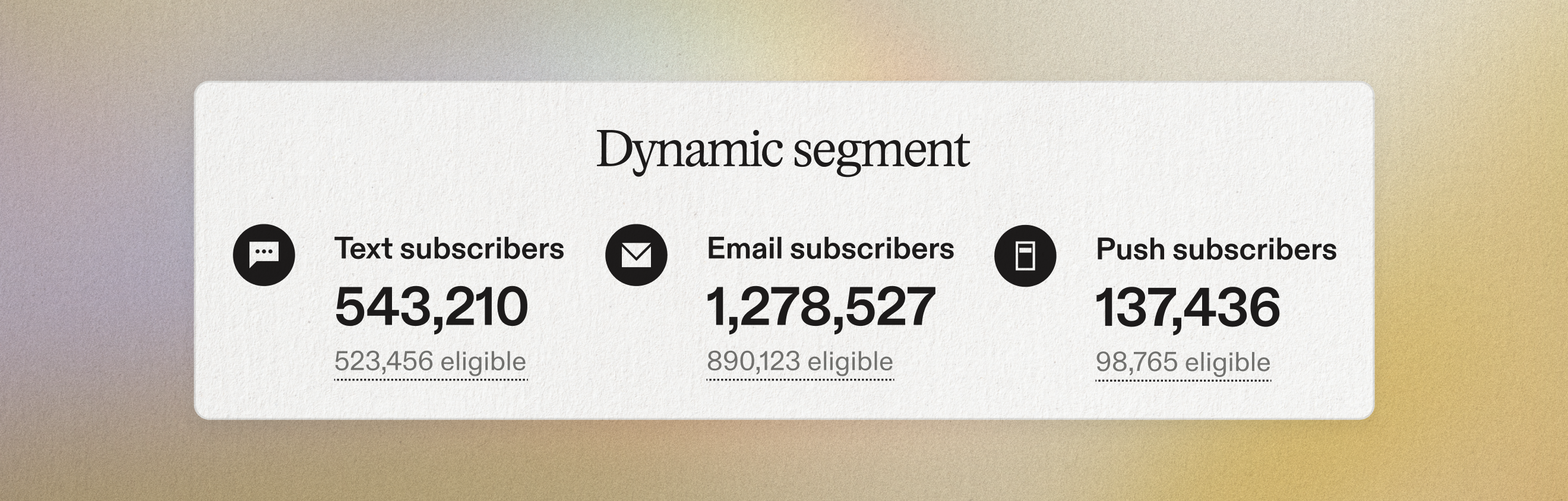
Use this time to test your segmentation thresholds and refine your targeting. Audience segments are the #1 thing improved brands are testing ahead of BFCM 2026—59% have them on the docket.

  • Test how different portions of your engaged segment react to campaigns—if you lose subscribers at the 120–150 day mark, scale back.
  • If you've extended your "engaged" segment to 150 days with no negative impact, test including customers who've purchased or clicked in the 150–180 day window.
  • Use Audiences AI to target likely buyers and exclude those unlikely to buy—Estella Bartlett saw 32% revenue uplift on optimized campaigns

Go deeper: Segmentation: The Audiences to Define Before BFCM

6. Creative

Your visual assets are an important factor in campaign performance—and improved brands know it: 41% are testing creative (imagery, GIFs, video) ahead of BFCM 2026.

Your pre-BFCM sends are where you learn what converts before higher-stakes campaigns go live.

  • Brief with your data: What works for one brand can fall flat for another. Use everything you've learned from A/B testing throughout the year to point your creative team in the right direction.
  • Request iterations for testing: Copy variations on the images, text-heavy vs. simple, product image styles, tones and moods, GIF vs. static.
  • Test MMS: MMS sees a 2.8x higher average conversion rate than SMS.
  • Give richer formats a trial run: If you've adopted RCS for Business, test its media-rich formats—image carousels, suggested replies—on a pre-BFCM send before relying on them for your biggest campaigns.

Next read

Your test calendar is built into the season: Labor Day, Prime Big Deal Days, Veterans Day, Singles' Day. Each one is a chance to pressure-test one piece of your BFCM plan.

And those test sends serve another purpose. Brands that launched deals before November last year were 25% more likely to report improved BFCM performance. The demand is there, too: 46% of shoppers will start their holiday shopping before November this year.

So put your tests on the calendar—then plan the campaigns to run in those windows:

{{next-article}}

More from The Edit

Extra! Extra! Read all about it in The Edit

BFCM insights, trends, and
strategies—fresh off the press

Read now