We asked 200+ marketers what they’d change for 2026. Their answers match what the brands that improved already did—turning hindsight into a validated playbook.
We asked marketers: If you could redo one thing about your BFCM 2025 strategy, what would it be?
The answers clustered into seven themes. The striking part: the 60% of brands that improved their messaging performance year over year had already acted on nearly every one.
Use last year’s lessons to sharpen your 2026 BFCM plan. Each section pairs one—in marketers' own words—with the proof from the improvers' results and what move to make now.
{{callout-1}}
1. Grow the list sooner
The hindsight: A bigger list, built earlier
A common regret: Marketers wished they'd had a larger, fresher audience ready before Cyber Week:
- "Start earlier with building the list with an exciting incentive."
- "Use our sign-up units during sale."
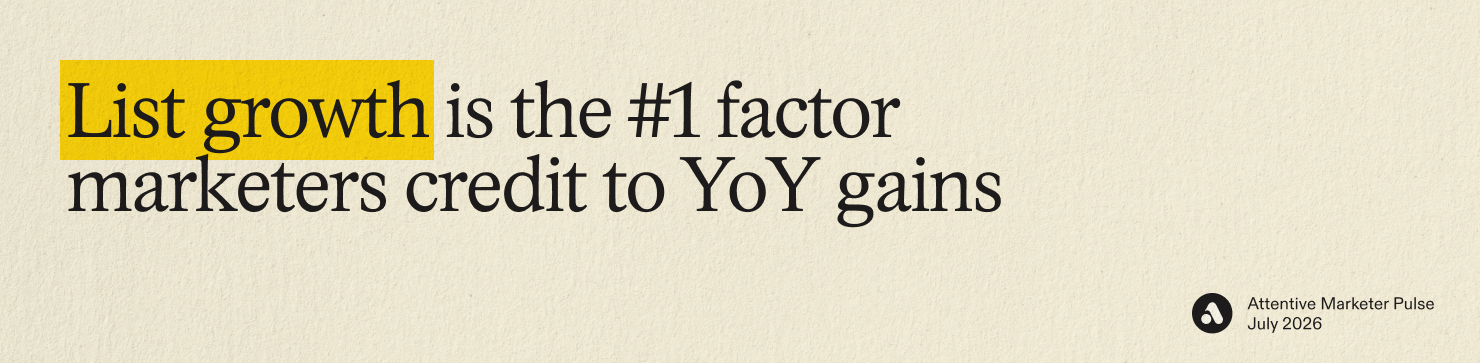
The proof: List growth is the #1 tactic improvers credit for their success
We asked brands whose BFCM messaging performance improved year over year what they most credit for the improvement. The answer?
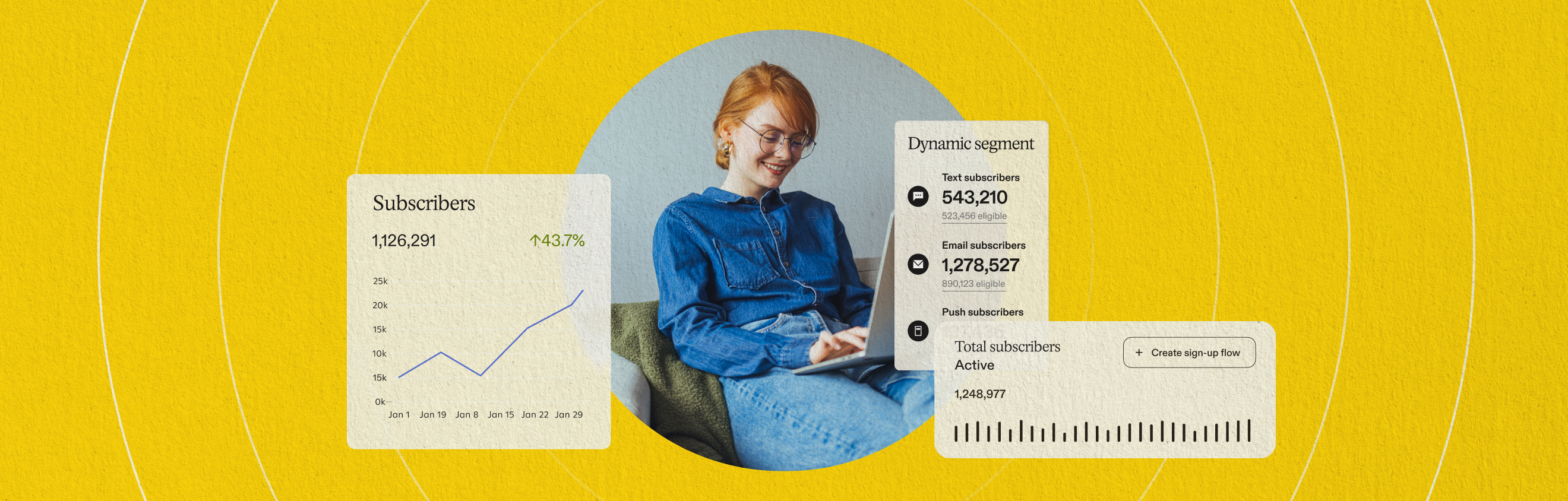
Growing their list ahead of BFCM—55% name it a top-three factor.
And shoppers are ready to join: 93% say the right incentive would get them to sign up for a new brand's emails or texts before BFCM.
{{callout-2}}
“For organic, we're helping brands leverage their existing social audiences by promoting email and SMS signup experiences through Linktree, social bios, posts, Stories, and creator content. For brands with strong influencer and ambassador programs, we’re building dedicated influencer landing pages and personalized welcome experiences that reflect the creator’s voice and audience, helping improve conversion rates and subscriber engagement.
For paid, we're encouraging brands to increase investment in customer acquisition now rather than waiting until Q4—growing both the customer file and subscriber base before acquisition costs spike during BFCM allows brands to enter the holiday season with a larger audience they can market to through email and SMS.”
– Ian Archbold, Director of Retention and Lifecycle Marketing at Flight Performance
2. Plan and pressure-test before BFCM
The hindsight: Start earlier
One of the most repeated phrases: “start earlier.” Sometimes that meant the deals themselves—often it meant the planning, testing, and prep behind them.
- "Start testing messaging 3 months prior"
- "Move up the discounting on certain products earlier. It cost us significant revenue."
The proof: Improvers have a plan—and they test it
Across questions, one pattern kept surfacing: improvers have already made their decisions for BFCM 2026. They’re more likely to know when their deals will launch, what their offer structure will be, and what investments they’re making in their messaging program on the way in.
And they test those decisions in advance.
Marketers who tested across several major shopping events—Prime Day, Labor Day, and the like—were 29% more likely to report year-over-year improvements.
What improvers will be testing this year:
Brands that didn't improve share most of these priorities, with one difference: more of them are testing offer types. That's a good instinct—complex offer structures were one of last year's most cited regrets (more on that in section 4), and the sales leading up to BFCM are exactly where to test a different approach.
“We use every major sale leading up to BFCM as a live testing ground, and one of our biggest wins has been validating VIP early access. Our VIP list gets a full day of exclusive access before any sale goes public — we send a text at 8pm the night before letting them know the sale drops at midnight, so they can start building their carts before items sell out.
By the time BFCM arrives, we're not guessing — we already know the timing, cadence, and messaging that moves our list to act.”
– Clarissa Wright, Founder at CNW Digital Inc
Early deals: a minority move that pays off
Deal launch timing tells a more modest story. Most marketers—improvers included—start their deals in November.
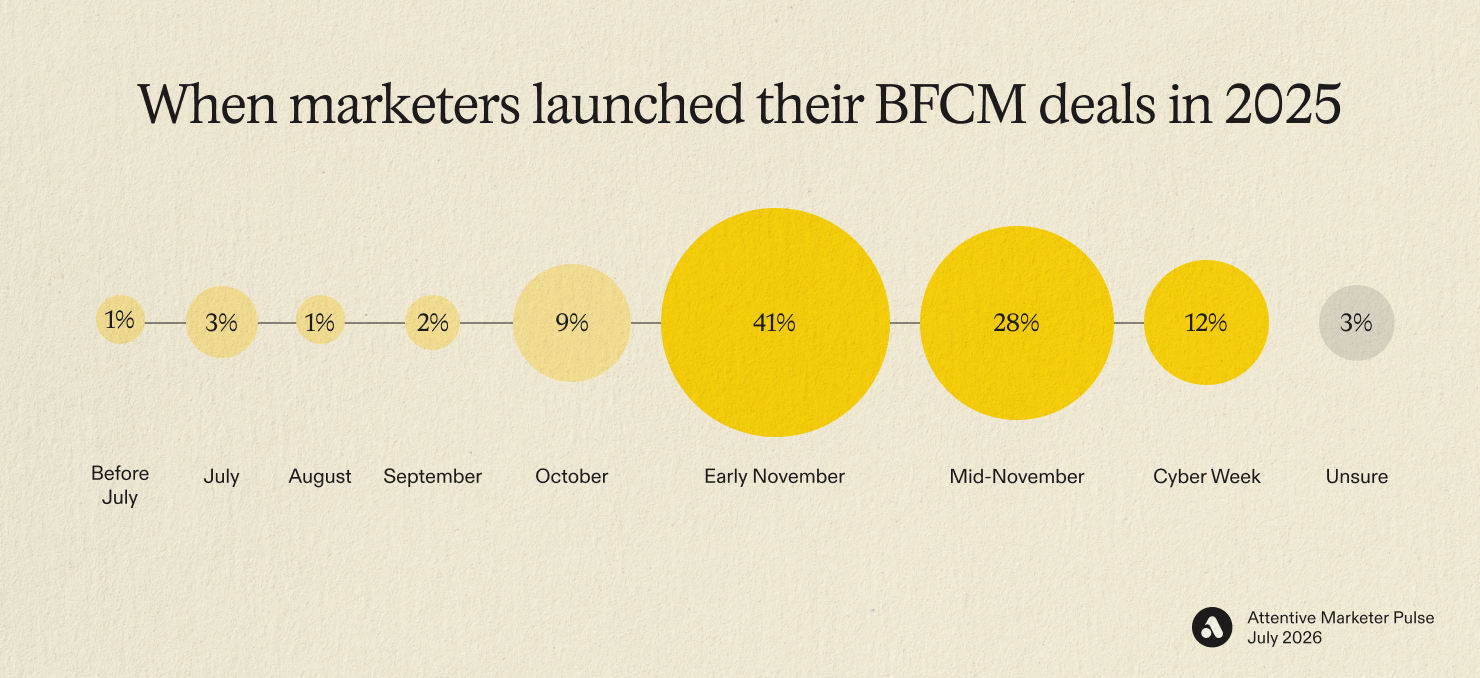
But the minority who moved sooner saw it pay off: Brands that started BFCM deals before November 2025 were 25% more likely to report improved performance.
The audience for an early offer is already there: 46% of shoppers will start holiday shopping before November this year.
And an early deal can outrun expectations: most shoppers don't expect BFCM deals until November. So your earliest deals don't need to be your deepest. Early shoppers just need to feel like they're getting a good deal when they find one.
{{callout-3}}
3. Segment and personalize deeper
The hindsight: Campaigns "felt too broad"
The most common sentiment of all: personalization deserved more attention.
"I would have started segmenting audiences earlier and tailored messaging more specifically to customer behavior. Some campaigns felt too broad…"
The proof: Precision is where improvers separate from the pack
Better targeting and segmentation is the #2 factor improvers credit for their gains—52% name it, just behind list growth.
And 71% of all marketers predict that brands that personalize BFCM campaigns this year will earn more revenue.
Shoppers confirm that bet. 73% say relevant product recommendations make them more likely to buy during BFCM.
“A smaller, highly engaged segment will almost always outperform a large, cold one, and deliverability is a big part of why."
– Courtney Syrop, CRM Director at Lunar Solar Group
{{callout-4}}
4. Simplify and differentiate the offer
The hindsight: Make promos easier to understand
The offer regrets weren't about depth, but complexity:
- "We did % off specific categories, a different category would be hit every other day—that doesn't work."
- "20% off + LTD extra 10% was not as strong as 30% off sitewide."
The proof: Improvers differentiate with structure, not depth
A large majority of brands run a flat sitewide deal—76% did in 2025.
The separation happens in what sits on top of it:
- Improvers used tiered discounts (spend more, save more) at nearly twice the rate of everyone else—and the brands that used them were 29% more likely to report improved performance.
- Loyalty-led offers (member pricing, extra rewards) show the same lift: brands that used these were 29% more likely to report improved performance.
Selective discounting—specific items or collections—was more common among marketers whose performance did not improve. It can work, but it requires finesse: rotating categories and stacked conditions ask shoppers to do math, and confused shoppers may bounce.
Here’s the full distribution of what types of deals improvers used during BFCM last year compared to what they’ll do this year:
Compare the columns and the direction is consistent: Improvers are adding structure—tiered discounts, loyalty pricing, gifts with purchase, and product bundling all tick up. They're building offers designed to grow cart value, not just cut price.
{{callout-5}}
5. Update behavioral flows for BFCM
The hindsight: Flows were running, but not ready
Many marketers thought they could have done more with their behavioral flows, whether having more of them active or reworking them for Cyber Week:
- "Make sure every single flow was updated as some didn't speak to the offer."
- "Spend more time analyzing our journeys as they saw the biggest lift."
The proof: Improvers plan to adjust their flows for BFCM
Many brands already keep their flows live during BFCM, but what sets improvers apart? They adjust their approach for Cyber Week.
41% of improvers are adjusting flow timing or content specifically for BFCM 2026, versus 31% of everyone else. They're also more likely to test their way there—23% are testing flow timing or content before BFCM, versus 14%.
{{callout-6}}
“By swapping in seasonal messaging across all your high-intent flows, like browse and checkout abandonments, you create a seamless, high-urgency experience. It gives your hero offer the spotlight it deserves and injects a healthy dose of FOMO that drives shoppers to act before it's too late.”
– Emily Roberts, VP of Growth Marketing at Roswell NYC
6. Plan your retention strategy
The hindsight: The retention plan came after the customers did
Many marketers felt unprepared to nurture the new customers they acquired during BFCM last year:
- "Get ahead of re-engagement of new customers—we were too late to the game and didn't have a solid plan."
- "Have a strong post-purchase flow already built out and ready for capturing new customers and driving them to second purchase."
The proof: Improvers were more successful at retaining new customers
This is the widest gap in the survey: 79% of improvers reported successfully retaining their BFCM-acquired customers, versus 48% of everyone else.
The most common tactics among brands that retained successfully: re-engagement campaigns and BFCM-tailored flows.
But the flows are what differentiate—marketers who ran a welcome or post-purchase flow tailored to BFCM subscribers were 29% more likely to report successful retention.
{{callout-7}}
7. Treat your channels as one system
The hindsight: Channels ran "in silos"
The channel regrets were about running them separately:
- "Be more consistent across all 3 channels and not work in silos"
- "Better integration between email and SMS campaign sends."
The proof: Improvers coordinate at the subscriber level
Most marketers already believe that email and SMS compound: 66% say email and SMS are incremental—subscribers who receive both spend more overall. Just 12% see them as competing for the same revenue.
The improvers act on that belief with thoughtful cross-channel coordination:
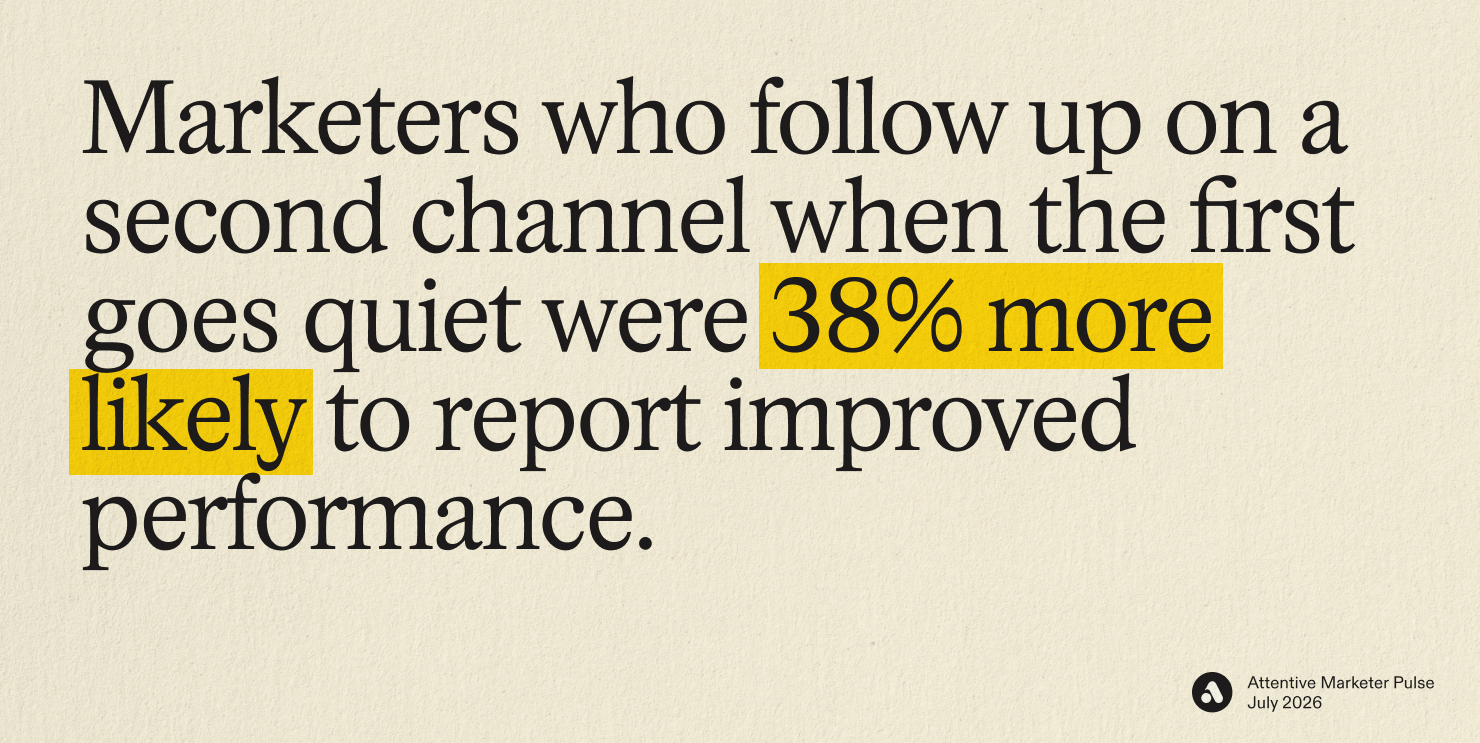
- Marketers who follow up on a different channel when a subscriber doesn't engage on the first were 38% more likely to report improved performance—the strongest lift of any coordination tactic we measured.
- Those who use suppression rules to keep competing messages from stacking up were 23% more likely to report improved performance.
- Those who set frequency caps to prevent over-messaging were 21% more likely.
Meanwhile, nearly a quarter of marketers run their channels with no active coordination at all.
{{callout-8}}
The last word: Run BFCM 2026 with the benefit of hindsight
This is the playbook your peers' do-over list points to—and what the improvers already proved works. This year, you get it in advance.
Every guide in The Edit picks up these strategies—tested, data-backed plays for each move above, from list growth to post-Cyber Week retention.
Explore The Edit: Attentive's definitive guide to BFCM.
Methodology
The Attentive Marketer Pulse: In June 2–18, 2026, Attentive surveyed 240 users of the Attentive platform to find out how their messaging programs performed during BFCM 2025, what they'd do differently, and how they're preparing for BFCM 2026.
Respondents covered companies from less than $1M to more than $100M in revenue and across 12+ verticals.
Disclosure: Where this material includes Attentive proprietary internal product, platform, or performance data, certain benchmarks, summaries, statistics, or insights may have been compiled or analyzed with AI-assisted tools using Attentive proprietary internal data believed to be reliable. AI-assisted analysis was subject to internal review, but may contain errors, omissions, or limitations, and the data reflects the applicable dataset, methodology, assumptions, and time period used for the analysis. Unless otherwise stated, the data has not been independently audited or verified by a third party and may not be representative of all customers, industries, campaigns, use cases, or time periods. This material is provided for general marketing and informational purposes only and does not constitute a guarantee, warranty, or prediction of future performance, savings, revenue, conversion rates, deliverability, engagement, or other business outcomes. Individual results may vary.