Most triggered email programs don’t fail.
They plateau.
A welcome series that performs well. A cart abandonment flow that reliably converts. Maybe a few post-purchase messages layered in over time.
On paper, it looks like a complete strategy. But if you zoom out, a different pattern shows up.
Most of the revenue is coming from a small set of obvious moments—while a much larger set of customer signals goes untouched.
Not because those moments aren’t valuable. But because they’re harder to see—and even harder to act on.
That’s the gap.
The shift most teams haven’t made yet
Triggered email is often treated like a checklist:
- Welcome flow: live
- Cart abandonment: live
- Post-purchase: live
Done.
But the brands pulling ahead aren’t thinking in flows. They’re thinking in signals.
Every visit. Every browse. Every pause in the journey. Each one says something about what a customer is considering—even if they don’t convert.
The difference is simple:
Some teams wait for clear intent. Others learn how to recognize it earlier.
That’s where triggered email starts to behave less like automation—and more like an always-on system for capturing demand.
5 underleveraged triggered flows to unlock always-on revenue
If your program is built around welcome and cart abandonment, you’re not behind—you’re at the starting line.
The next layer of growth comes from expanding beyond the obvious.
1. Session abandonment
The signal most teams never capture
A customer visits your site. Looks around. Leaves.
No product view. No cart. No trigger.
In most programs, that session disappears.
But it’s still intent—just earlier, and less explicit.
When you can recognize who that visitor is in real time, you can follow up while the visit is still fresh. Not with a hard sell, but with something that helps them pick up where they left off.
What changes when you capture it:
- You engage customers before consideration narrows
- You expand triggered reach beyond known click traffic
- You turn “invisible” sessions into measurable revenue
2. Browse abandonment
Interest without commitment—and a chance to meet it
A product view is a clearer signal, but still easy to underplay.
Many teams either skip browse entirely or treat it like a softer version of cart abandonment. It’s neither.
Browse works because it meets the customer at a different moment—when they’re exploring, not deciding.
That changes how the message should feel: less urgency, more relevance.
What strong programs get right:
- The email reflects exactly what the customer viewed
- Timing is tight, while context still holds
- The message helps, instead of pushing
3. Post-purchase sequences
Where long-term value is actually built
A purchase answers one question: “Will they buy?”
It doesn’t answer the more important one: “Will they come back?”
That’s what post-purchase is for.
Not a confirmation email, but a sequence that continues the conversation—helping the customer get more value from what they bought, and naturally guiding them toward what’s next.
Why it matters:
- Repeat behavior is easier to build than to recover
- Relevance increases after a purchase, not before
- Small improvements here compound over time
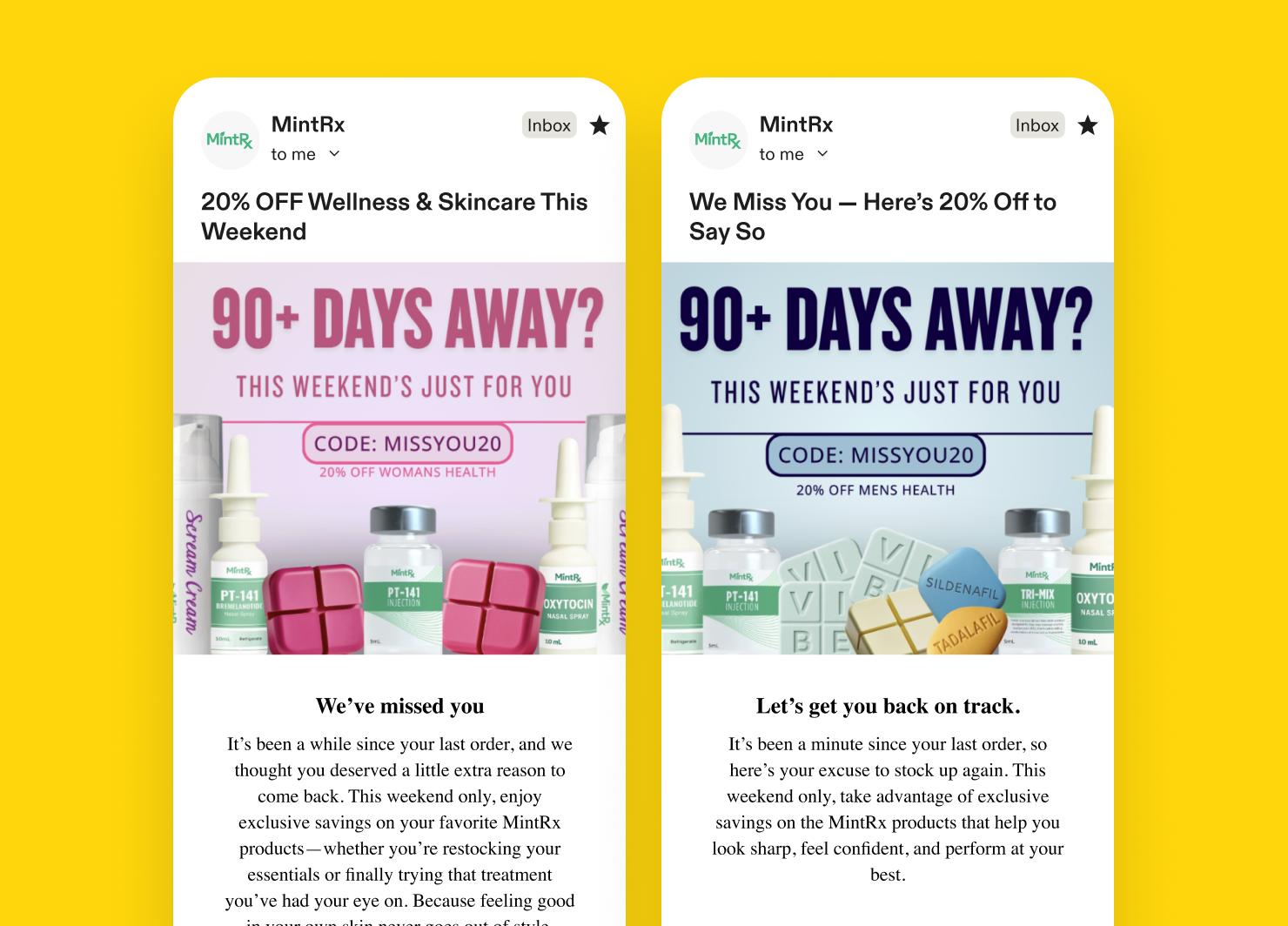
4. Winback flows
Intervening before disengagement becomes churn
Most winback efforts start too late.
By the time a customer is clearly inactive, familiarity has already faded. The message has to work harder to rebuild something that’s already gone.
A better approach is to define the moment before that—when engagement is slowing, but not lost—and step in there.
What this unlocks:
- More efficient recovery of at-risk revenue
- A structured way to manage lifecycle drop-off
- Less reliance on constant new acquisition
5. Lifecycle and custom event triggers
The moments that make messaging feel personal
Not every high-impact moment looks like a funnel step.
Anniversaries. Loyalty milestones. Subscription cycles. Service updates.
Individually, they seem small. Together, they shape how a customer experiences your brand over time.
They work because they’re grounded in something real about the customer—not just what you want them to do next.
Why they consistently outperform:
- The message has built-in context
- The timing feels natural, not scheduled
- The experience reflects the relationship, not just the transaction
What these flows reveal
None of these flows are new.
What’s new is how clearly they expose a limitation most teams are running into:
You can only act on the signals you can see.
And for many programs, that visibility starts late—after a click, after a product view, after intent is already fully formed.
What most triggered programs can’t see
The common thread across these flows isn’t complexity. It’s visibility.
Most triggered programs are built on the signals that are easiest to capture: clicks, carts, known users. That’s where intent is clearest, but also where it’s already narrowed.
The earlier signals—like sessions and browsing behavior—are harder to connect to a person in real time. So they often go unused.
That’s where identity becomes the unlock. The more consistently you can recognize your customers across sessions and devices, the more of those early signals become actionable.
That’s why so many programs plateau. Not because the strategy is wrong, but because the picture is incomplete.
When you can see more of the journey, you don’t just add new flows—you start responding to intent while it’s still forming.
Where this is going next
As teams expand what they can see, they’re also rethinking how triggered flows adapt.
Instead of fixed timing and static logic, we’re starting to see:
- Send times adjust based on when each customer is most responsive
- Content shift based on real-time behavior, not predefined segments
- Triggers evolve from reactive to predictive
The goal isn’t more automation.
It’s better alignment with how customers actually move.
The takeaway
Most triggered programs are built around a handful of clear moments.
The opportunity is everything around them.
When you start capturing earlier signals, responding with more context, and building flows that reflect the full customer journey, triggered email stops being a set of automations.
It becomes a system that’s always working—quietly, consistently, and in the moments that matter most.
Up next: How to Audit and Optimize Your Triggered Email Program.