
Introducing: Emails We Love. Curated email marketing examples to drive revenue and engagement.
You know what you want to accomplish—drive more sales, re-engage customers, build loyalty—but translating those goals into compelling email content that stands out in crowded inboxes can feel intimidating.
Maybe your open rates have plateaued or your campaigns aren’t converting like they used to. Or perhaps you’re launching a new product and need fresh inspiration for announcement emails that convert shoppers.
The good news? You don’t have to reinvent the wheel.
Emails We Love, a new series from Attentive, curates great emails from brands that get it right. Draw on inspiration from their proven strategies, then add your brand’s own unique voice and perspective to send emails that get subscribers to take action.
Explore these 25 email marketing examples to spark your creativity and help you create messages that resonate with your audience at every stage of the customer lifecycle.
What makes a good email marketing campaign?
Creating an email that drives results often comes down to a few elements working together.
Subject lines that encourage opens
Subscribers decide whether to engage in an instant based on your email subject line, so this is the first element to get right. We analyzed 91B+ billion email subject lines to find out what works.
For triggered emails (like your welcome series or cart abandonment flow):
- Personalized subject lines outperform generic ones. Product names are the most effective, followed by the shopper’s first name.
- Medium-length subject lines (25–35 characters) perform best for triggered emails, followed by short ones (fewer than 25 characters). This is likely because a slightly longer character count allows you to provide the behavioral context for your message.
- Triggered email subject lines including “you” or “your” outperform those that don’t.
- Subject lines without emojis perform better than those with emojis.
For campaigns:
- Personalization often feels out of place in campaign emails, so subject lines without personalization perform best (though recommendations in the body of your email work to ensure relevance).
- Campaign subject lines shorter than 25 characters drive the most opens, followed by medium-length ones (25–35 characters). Campaign emails should be straight to the point, so jump right into highlighting the value of the message.
- Campaign email subject lines that don’t include “you” or “your” perform better than those that do.
- Subject lines without emojis outperform those with them.
Content that drives action
Once subscribers open your email, attention is limited and they decide whether to take action within seconds. So it’s important to communicate value immediately and design for scannability:
- Lead with your most important message or strongest offer, and make sure it shows above the fold.
- Use clear visual hierarchy with text sizes to highlight what’s most important.
- Keep your email focused with one primary message and call-to-action (CTA). Giving subscribers too many choices can lead them to taking no action at all.
- Design a clear CTA with contrasting colors and plenty of space around it so it stands out.
- Include high-quality product images that showcase what you’re promoting.
- Design a mobile-friendly version with a single-column layout, easy-to-read text size, and large buttons.
Relevance through personalization
The 2026 Attentive Marketer Pulse reveals the importance of personalization: 69% of brands that personalize in their messaging programs saw improved performance year-over-year—compared to just 20% of those that don’t personalize.
Emails that resonate use subscriber data to send the right message to each subscriber. The most effective ways to personalize your emails are:
- Segmentation: Group your subscribers based on engagement, behavior, preferences, interests, or demographics. Then you can send relevant emails featuring language, products, or pain points that speak to them.
- Triggered messages: Behavioral emails (or journeys) consistently outperform one-time campaigns because they respond to how a subscriber is interacting with your brand. Set up automated flows for key moments like welcome sequences for new subscribers, abandonment flows for shoppers who didn’t complete a purchase, and post-purchase emails to grow customer relationships.
- Personalization macros: You can enrich your campaigns and journey messages with dynamic variables based on customer information. For example, you can add a product name and link to remind shoppers about the exact product they browsed.
Testing and optimization to send better email campaigns over time
What works for one brand might not work for yours, so treat every email send as a learning opportunity to find what works for your audience.
To A/B test effectively:
- Test one element at a time (e.g., subject line, CTA copy) to isolate what drives impact.
- Test with statistically significant sample sizes (we recommend a segment of at least 3,000 subscribers) for clear results.
- Run multiple tests to account for differences in email design, offer, seasonality, or what’s happening in the macro-environment.
- Focus on metrics that matter to your business—opens are great, but not if they don’t lead to clicks and conversions.
AI to amplify performance
Email marketers have spent years developing sophisticated strategies for segmenting audiences, timing campaigns, and crafting subject lines that engage subscribers. But even with years of experience and data-driven insights, there are limits to manual optimization.
AI scales your efforts by spotting complex behavioral patterns that are impossible to identify by humans alone.
With tools like Attentive AI™, you can:
- Automatically optimize campaign audiences by identifying high-intent subscribers and suppressing those unlikely to engage, achieving 40% higher multi-channel campaign revenue.
- Personalize send times by delivering emails when each individual subscriber is most likely to engage, boosting email conversions by 17%.
- Generate high-performing subject lines while maintaining your brand voice, saving time on copywriting tasks.
- Identify more subscribers across devices by overcoming signal loss to recognize 15%+ more site visitors for better targeting and personalization, resulting in 20% journey revenue lift.
Learn more about Attentive AI™ and request a demo to see how you can amplify your email marketing results.
25 best email marketing examples in 2026
Each example breaks down a different type of email you can use across the customer lifecycle.
For every one, you'll find the goal it's working toward, a few best practices to guide your own version, and a real example from a brand that gets it right.
Treat them as a foundation to build on, adapting each idea to fit your brand and your audience.
1. Welcome emails
Goal: Earn new subscribers’ first purchase.
Welcome emails have some of the highest open rates of any email type, so they’re a prime opportunity to make a strong first impression.
A welcome series, rather than a single email, gives you more room to convert by introducing them to your brand over time.
Emails worth considering in your welcome series:
- Start with your welcome offer and brand story
- Highlight what makes your products special—materials, craftsmanship, sustainability, etc.
- Recommend products to help shoppers navigate your catalog
- Share social proof, like reviews from customers or press
- Remind subscribers about their welcome offer
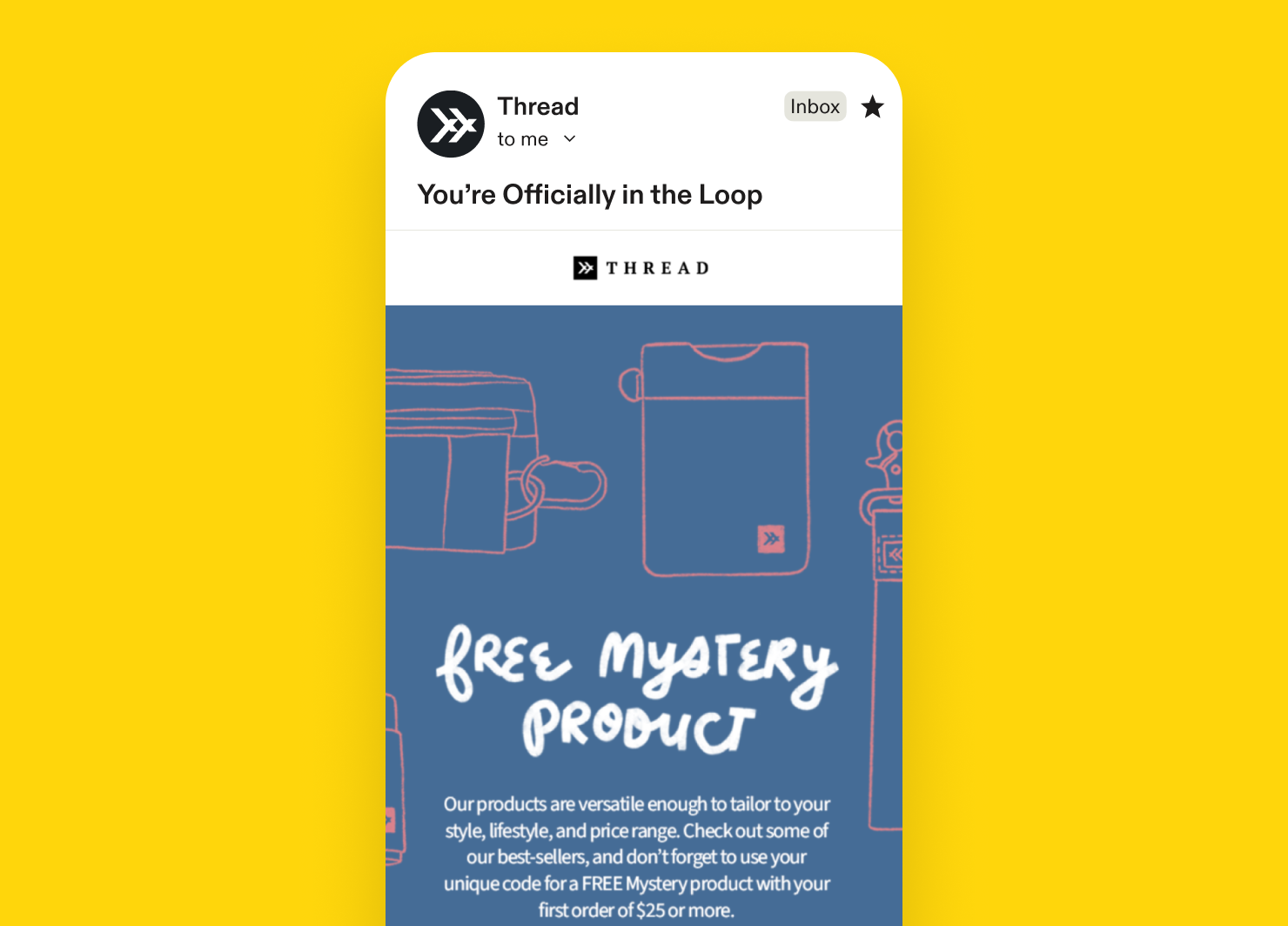
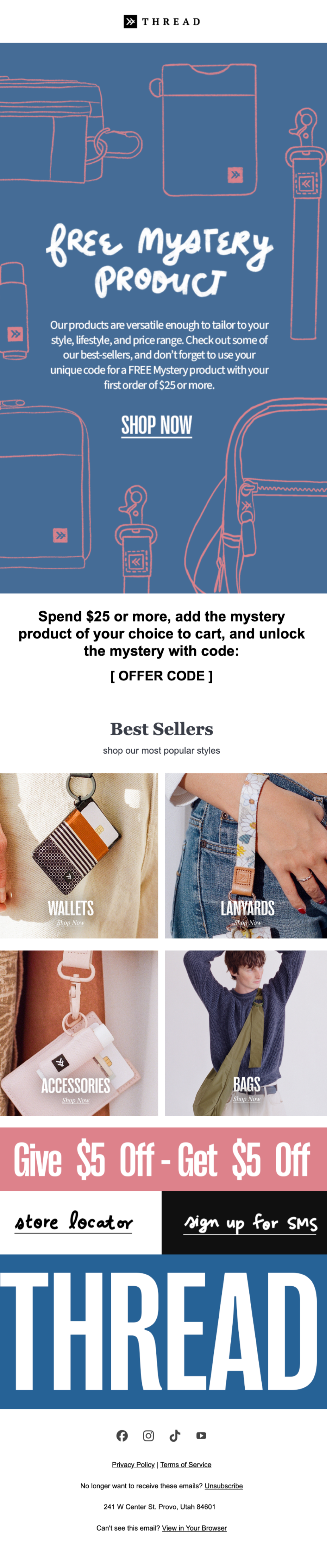
Thread opens its welcome series with a fun mystery-gift offer:
[image-modal-trigger-1] [data-bg="#FFD60B"]
[image-modal-trigger-1]
[image-modal-source-1]
[image-modal-source-1]
Why it works:
- Leads with the offer—this is a big reason shoppers signed up, so you don’t want to bury this.
- Features a few best sellers to get subscribers shopping.
2. Product education emails
Goal: Build buyer confidence by showing what sets your products apart.
Product education emails explain how your products work, what they're made of, or how to choose between options. They're especially valuable in helping shoppers pick you over competitors or educating shoppers on unique features they may be unfamiliar with.
They make a first purchase easier by helping people find the right fit before they buy.
UNTUCKit introduces new subscribers to the fabrics behind its shirts:
[image-modal-trigger-2] [data-bg="#FFD60B"]

[image-modal-trigger-2]
[image-modal-source-2]

[image-modal-source-2]
Why it works:
- Unpacks differentiators in a competitive product category
- Introduces core fabric options, so shoppers can then choose styles and colors—a simpler decision process than facing the full range at once.
3. Session abandonment emails
Goal: Re-engage shoppers who visited your site but didn't view a product.
Session abandonment emails reach people who landed on your site but left without viewing a specific product or adding anything to their cart.
Because you have little signal about what they were after, a broad approach works best—reintroduce your range or point to best sellers, and make it easy to pick up where they left off.
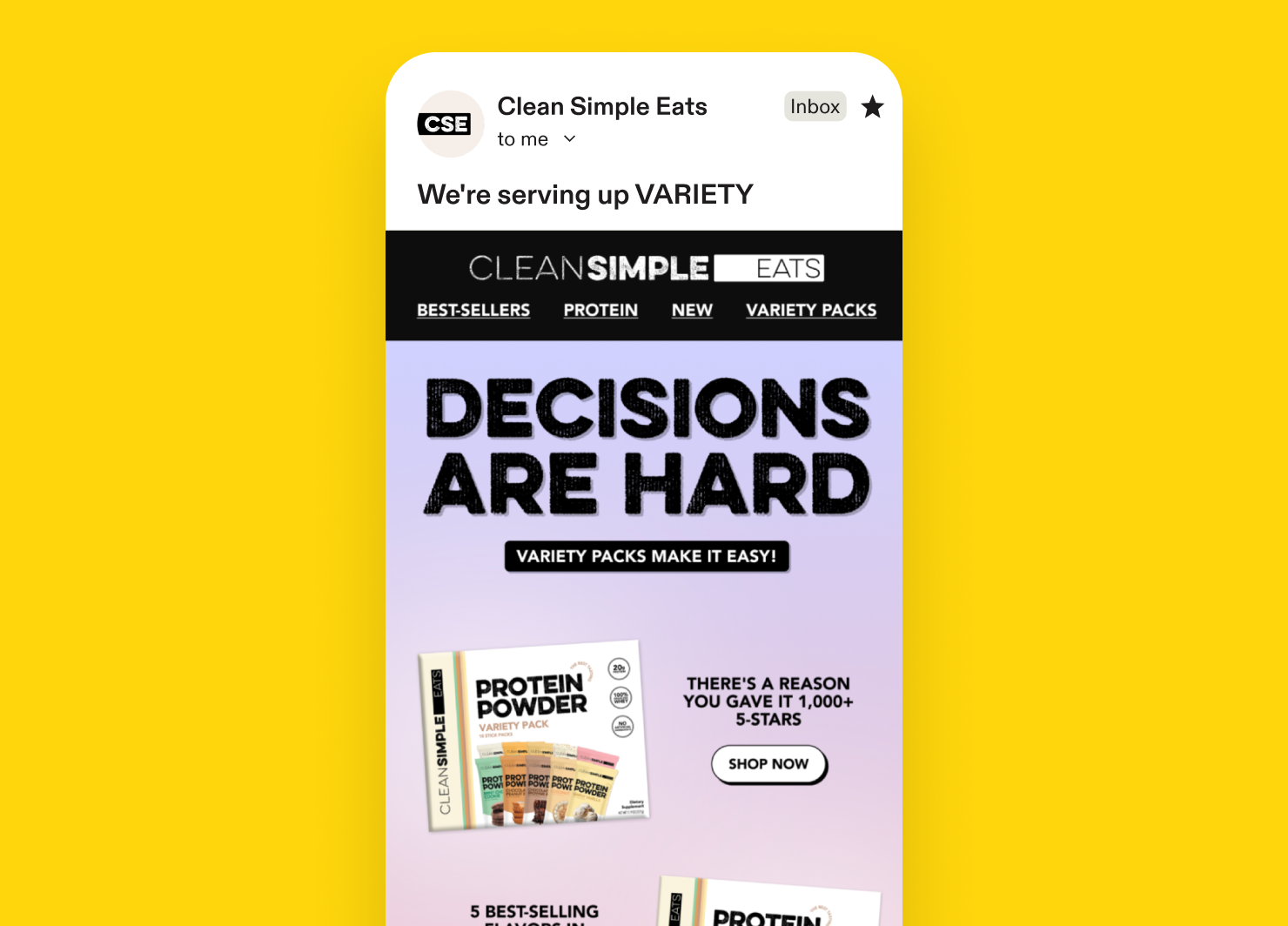
Clean Simple Eats meets these visitors with an open invitation to explore:
[image-modal-trigger-3] [data-bg="#FFD60B"]
[image-modal-trigger-3]
[image-modal-source-3]

[image-modal-source-3]
Why it works:
- Casting a wide net for shoppers that haven’t signaled interest in anything specific with variety packs lets shoppers explore what the brand has to offer.
- Highlighting added perks like free shipping and subscribe & save at the end gives shoppers an extra nudge.
4. Browse abandonment emails
Goal: Bring back shoppers who viewed a product but didn't add it to cart.
Browse abandonment emails follow up with shoppers who looked at specific products but left without adding anything to their cart. You know what caught their eye, so lead with those products.
Consider adding social proof or product education to help shoppers envision themselves with the product.
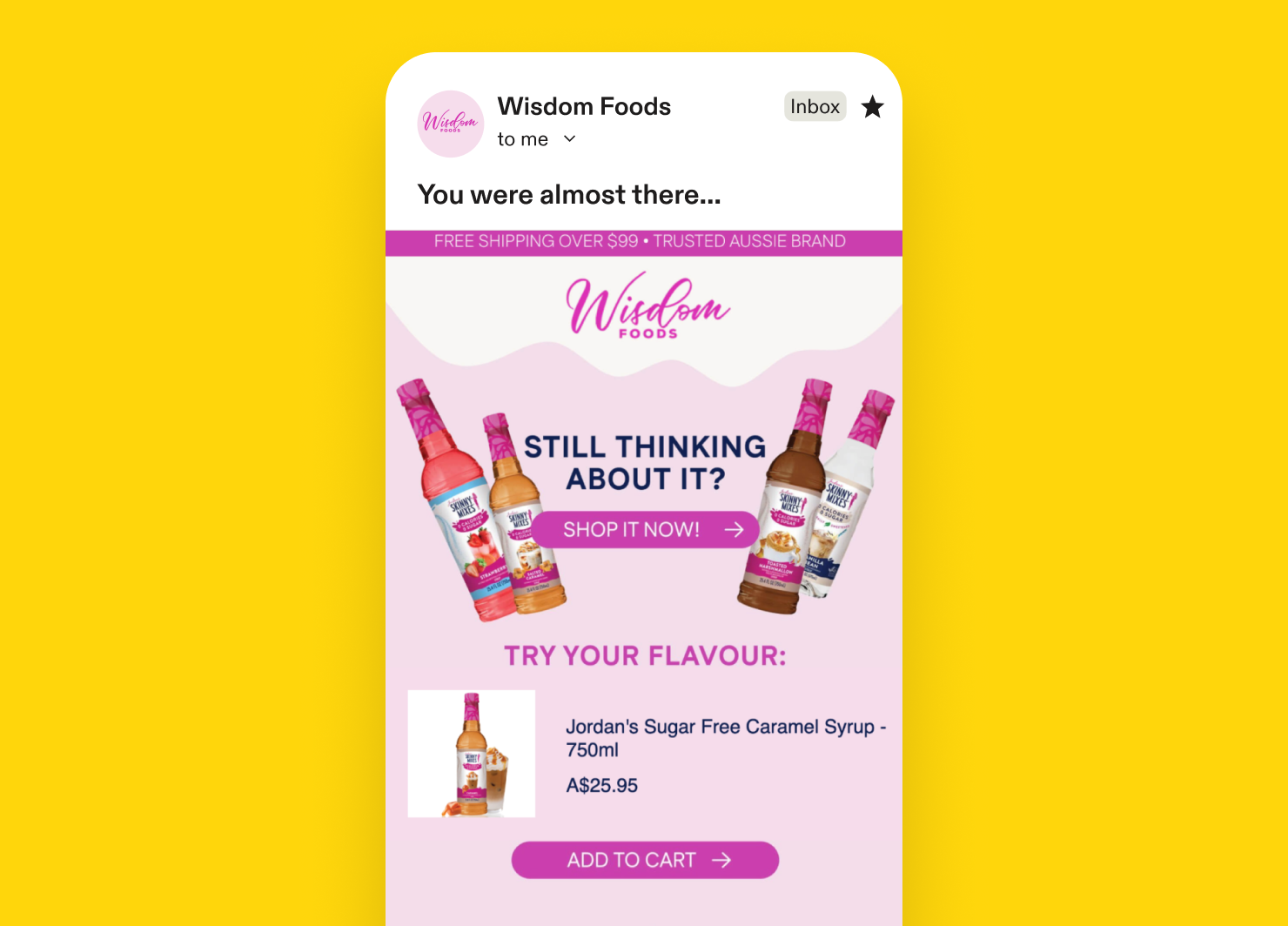
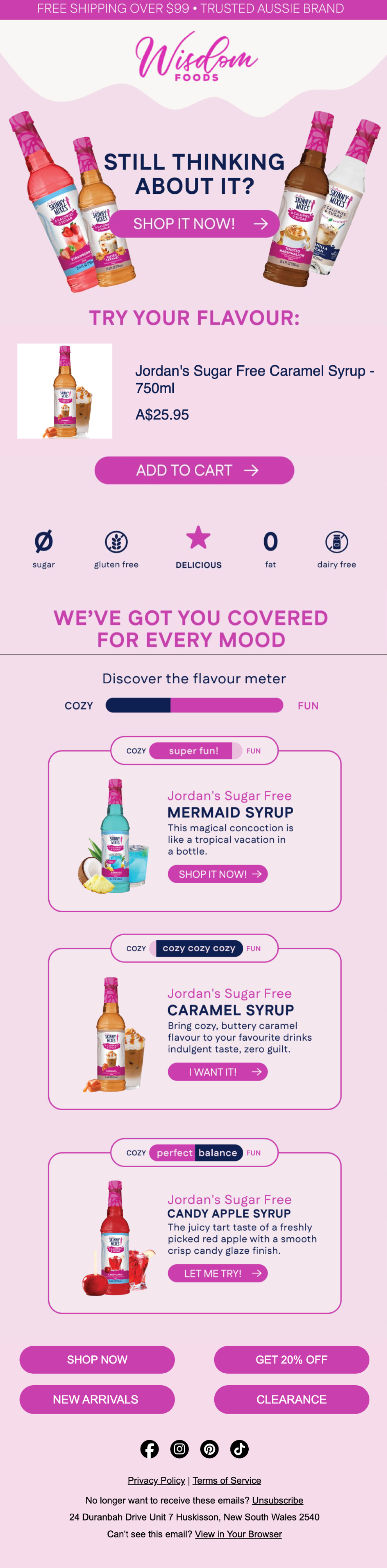
Wisdom Foods reminds shoppers what they browsed, then helps them find a better match:
[image-modal-trigger-4] [data-bg="#FFD60B"]
[image-modal-trigger-4]
[image-modal-source-4]
[image-modal-source-4]
Why it works:
- Features the product the shopper browsed front and center.
- Offers a playful “flavour meter” from “cozy” to “fun” to help shoppers discover an alternative if the first pick wasn’t their vibe.
5. Cart abandonment emails
Goal: Recover sales from shoppers who added to cart but didn’t check out.
Cart abandonment emails reach some of your highest-intent shoppers—people who added items but didn't complete the purchase.
In your cart abandonment email, show what they left in their cart to make getting back to checkout effortless.
Then consider layering in additional elements to your abandonment flows to help shoppers on their journey. In the April 2026 Attentive Consumer Pulse, hesitant shoppers said they could be moved forward by:
- Free shipping
- Confidence the product fits their needs
- Confidence in product quality
- Flexible payment options
- Easier returns
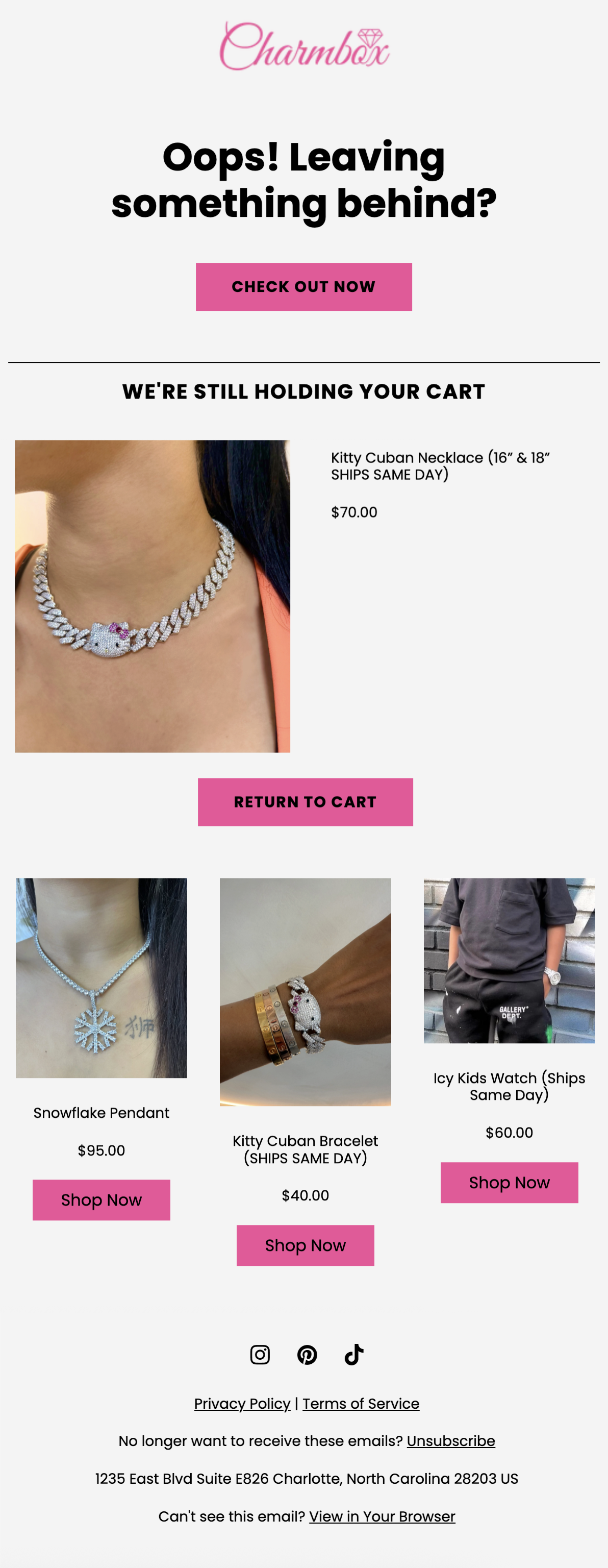
CharmBox helps shoppers pick up right where they left off:
[image-modal-trigger-5] [data-bg="#FFD60B"]

[image-modal-trigger-5]
[image-modal-source-5]
[image-modal-source-5]
Why it works:
- Includes cart contents in the email, so shoppers see exactly what’s waiting for them.
- Cross-sells other products the shopper might enjoy, like a matching bracelet.
6. Checkout abandonment emails
Goal: Recover sales from shoppers who started checkout but didn't finish.
Checkout abandonment emails reach shoppers who began checking out but didn't complete the purchase—they're even closer to buying than cart abandoners.
At this stage, hesitation usually comes down to last-minute objections, so the best emails highlight free shipping, easy returns, price guarantees, or payment plan options.
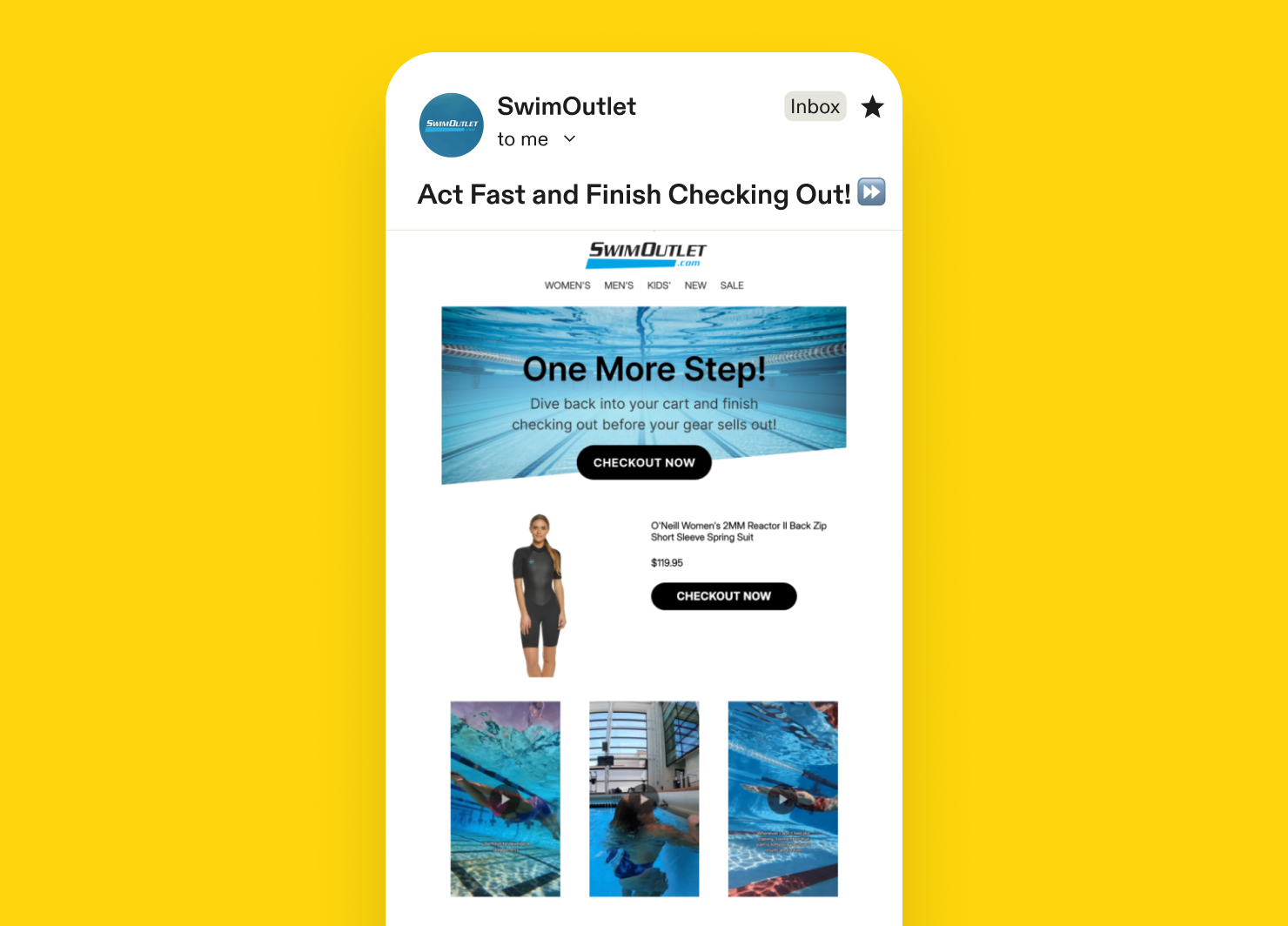
SwimOutlet reassures shoppers at the finish line:
[image-modal-trigger-6] [data-bg="#FFD60B"]
[image-modal-trigger-6]
[image-modal-source-6]

[image-modal-source-6]
Why it works:
- Features the product in the cart to remind shoppers what's waiting for them.
- Tackles common objections head-on—free shipping, a price match guarantee, easy returns, and high customer satisfaction.
7. Product recommendation emails
Goal: Drive purchases by suggesting products tailored to each shopper.
Product recommendation emails use what you know about a shopper—their purchases, browsing, or preferences—to suggest what they're likely to want next.
They're a natural way to cross-sell or introduce customers to more of your catalog.
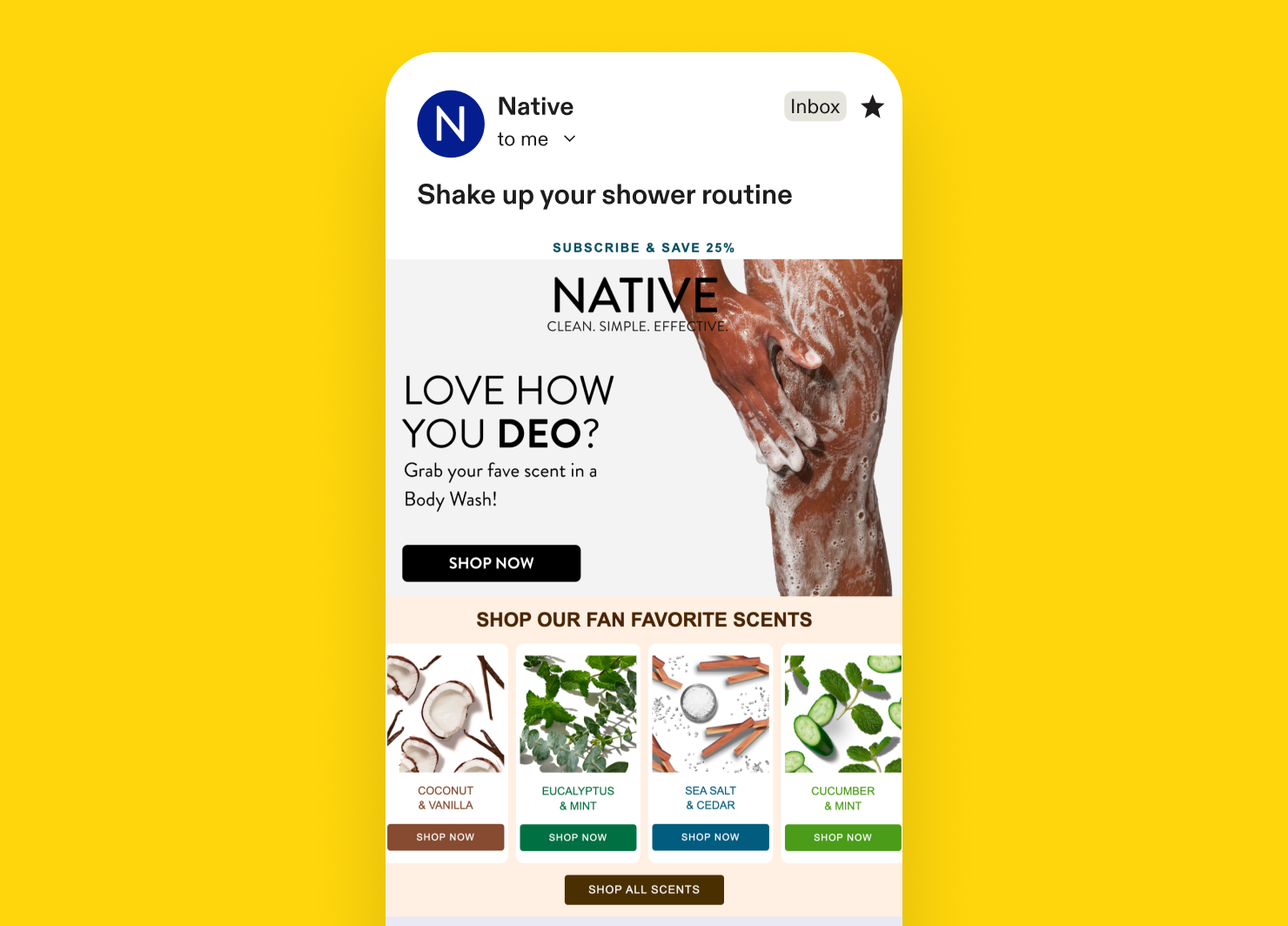
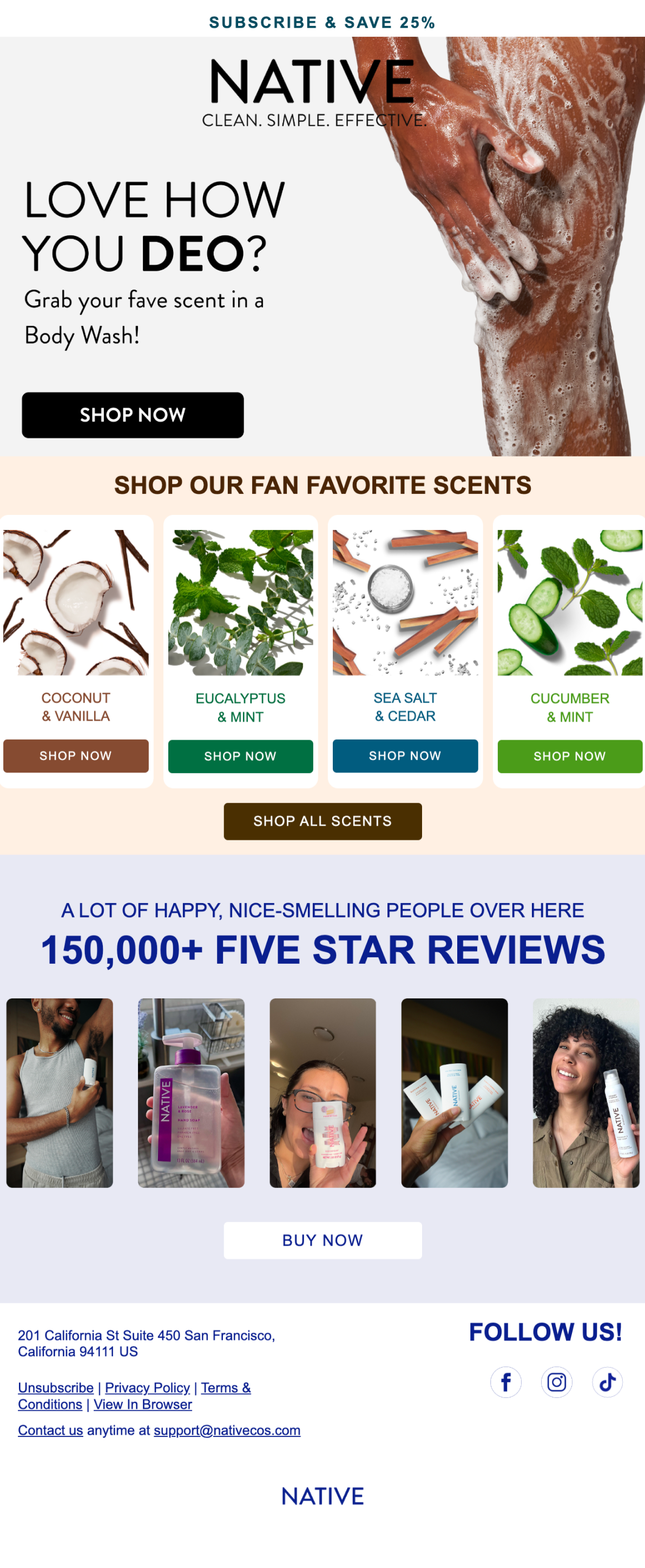
Native nudges customers who've only bought deodorant to try its body wash:
[image-modal-trigger-7] [data-bg="#FFD60B"]
[image-modal-trigger-7]
[image-modal-source-7]
[image-modal-source-7]
Why it works:
- Segments by purchase history (shoppers who have only purchased deodorant) so the recommendation is genuinely relevant.
- Offers a natural next step to deodorant (body wash) as opposed to an entirely new category (like toothpaste).
8. Transactional emails
Goal: Keep customers informed.
Transactional emails confirm something about a customer’s order or account—order confirmation, shipment, delivery, or account change. They help shoppers feel secure that things are running smoothly.
While they may not be conversion powerhouses, they’re an essential email for building trust.
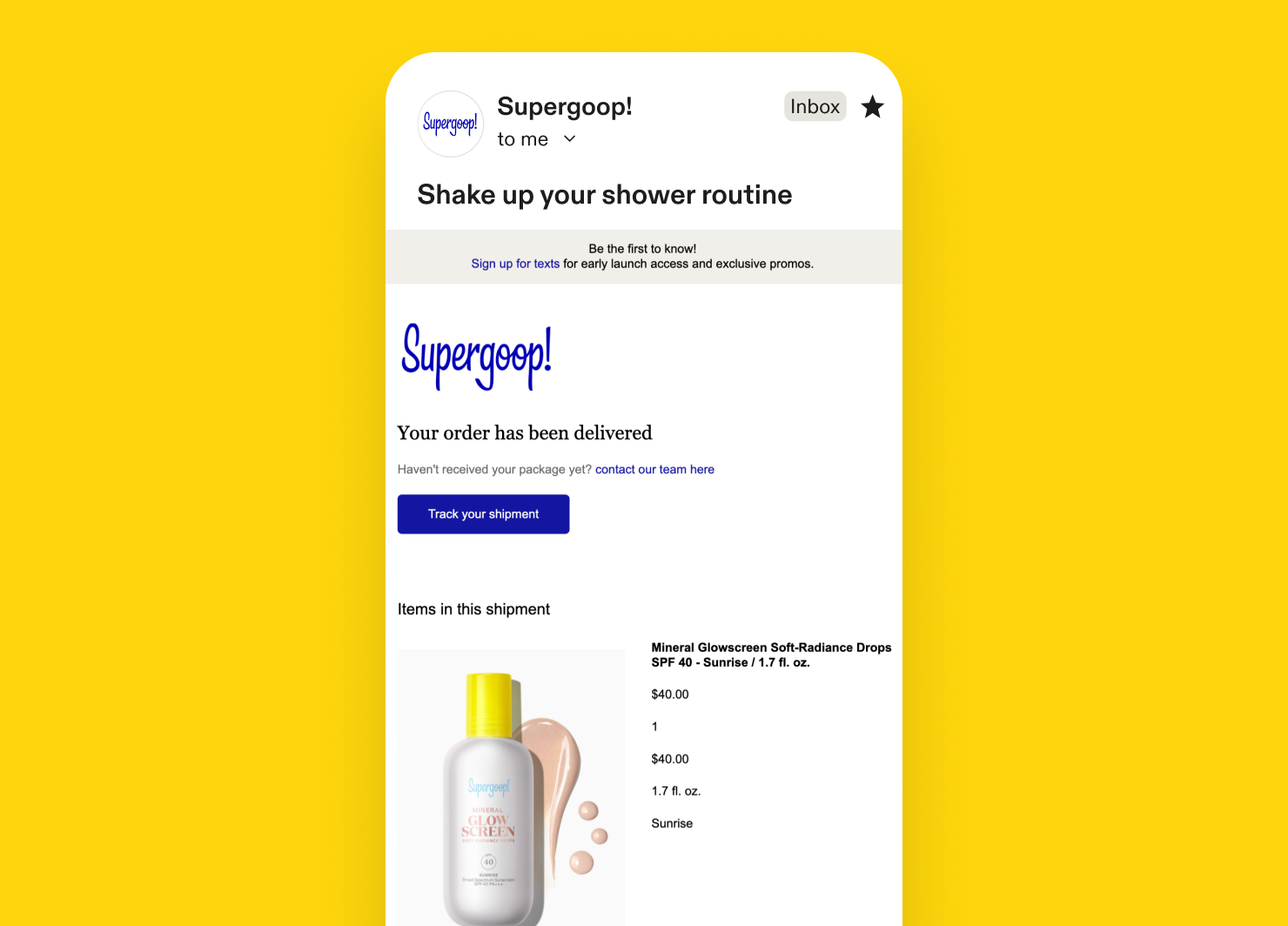
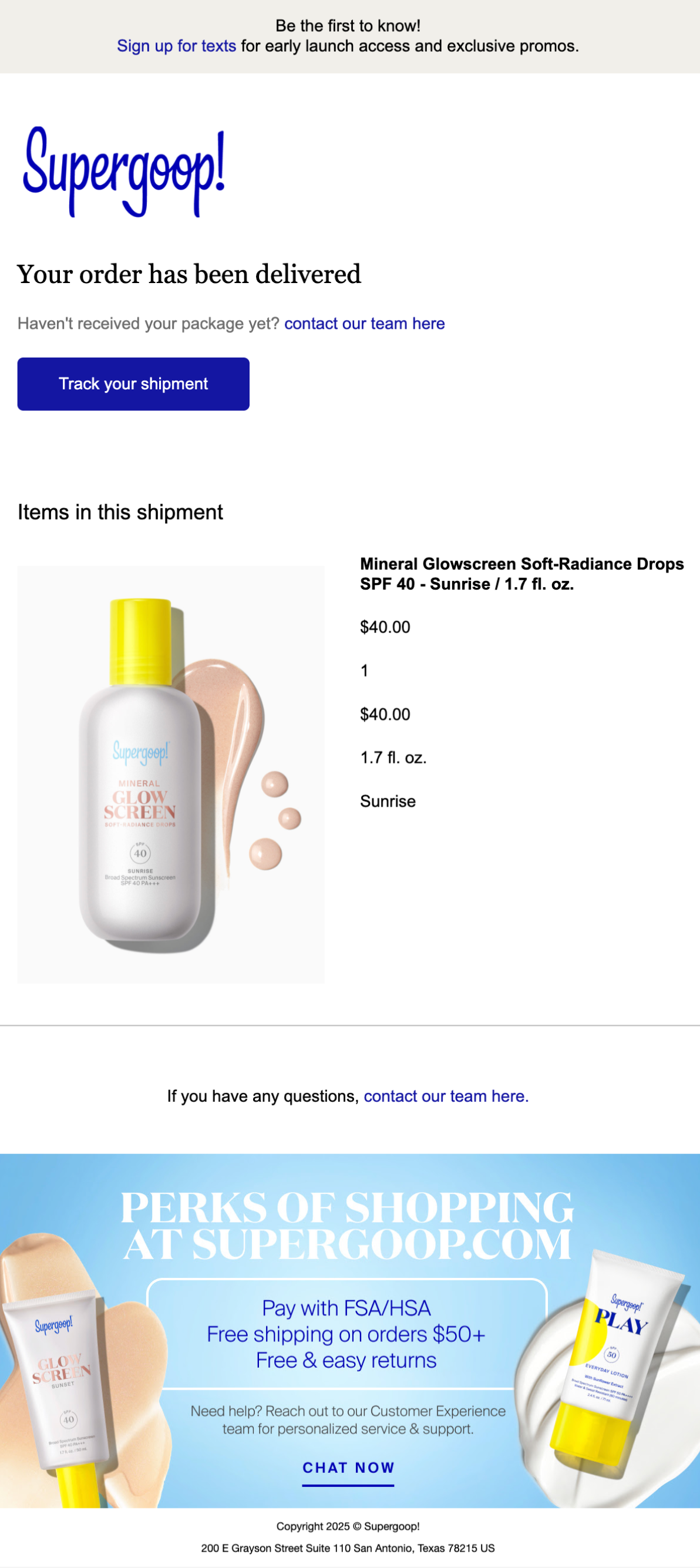
Supergoop! confirms a delivery and makes it easy to get help if anything’s off:
[image-modal-trigger-8] [data-bg="#FFD60B"]
[image-modal-trigger-8]
[image-modal-source-8]
[image-modal-source-8]
Why it works:
- Leads with core information—the order has arrived.
- Offers customer support, allowing shoppers to easily contact the brand if needed.
9. Thank you emails
Goal: Make customers feel valued after a purchase
Thank you emails go out right after a purchase to show appreciation and strengthen the relationship.
Their main purpose is to make customers feel good about their decision—the kind of goodwill that reduces returns and brings them back in the future.
The Frye Company thanks customers by name and reinforces pride in their purchase:
[image-modal-trigger-9] [data-bg="#FFD60B"]

[image-modal-trigger-9]
[image-modal-source-9]

[image-modal-source-9]
Why it works:
- Reinforces the value of the purchase.
- Highlights new styles and leather care products.
10. Post-purchase follow-up emails
Goal: Help customers get the most out of their purchase.
Post-purchase follow-up emails help customers succeed with what they bought—how to use it, care for it, or get better results.
They build satisfaction, reduce returns, and turn first-time buyers into fans who come back. Plus, according to the Attentive 2026 State of Loyalty & Retention Report, 69% of shoppers say post-purchase content helps them feel more confident after purchase.
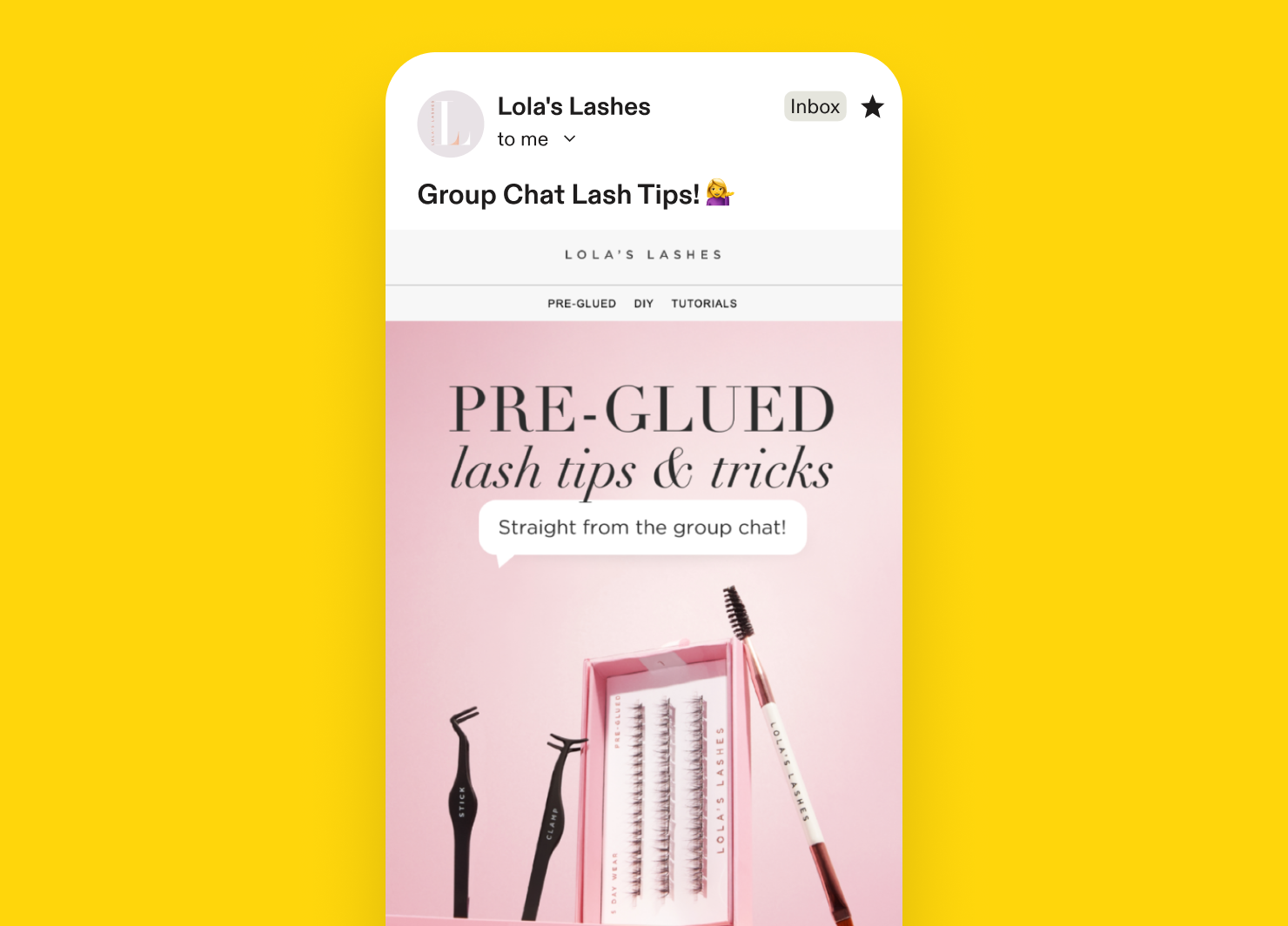
Lola's Lashes shares step-by-step tips for getting the best results from a new set of lashes:
[image-modal-trigger-10] [data-bg="#FFD60B"]
[image-modal-trigger-10]
[image-modal-source-10]

[image-modal-source-10]
Why it works:
- Step by step tips for the product the customer just purchased.
- Formatted in a “group chat” format, then includes a CTA to join a Facebook group for fans of the brand.
11. Review request emails
Goal: Turn happy customers into social proof.
Review request emails ask customers to share feedback after their order arrives. Time them to send once an order is delivered and the customer has had a chance to use the product.
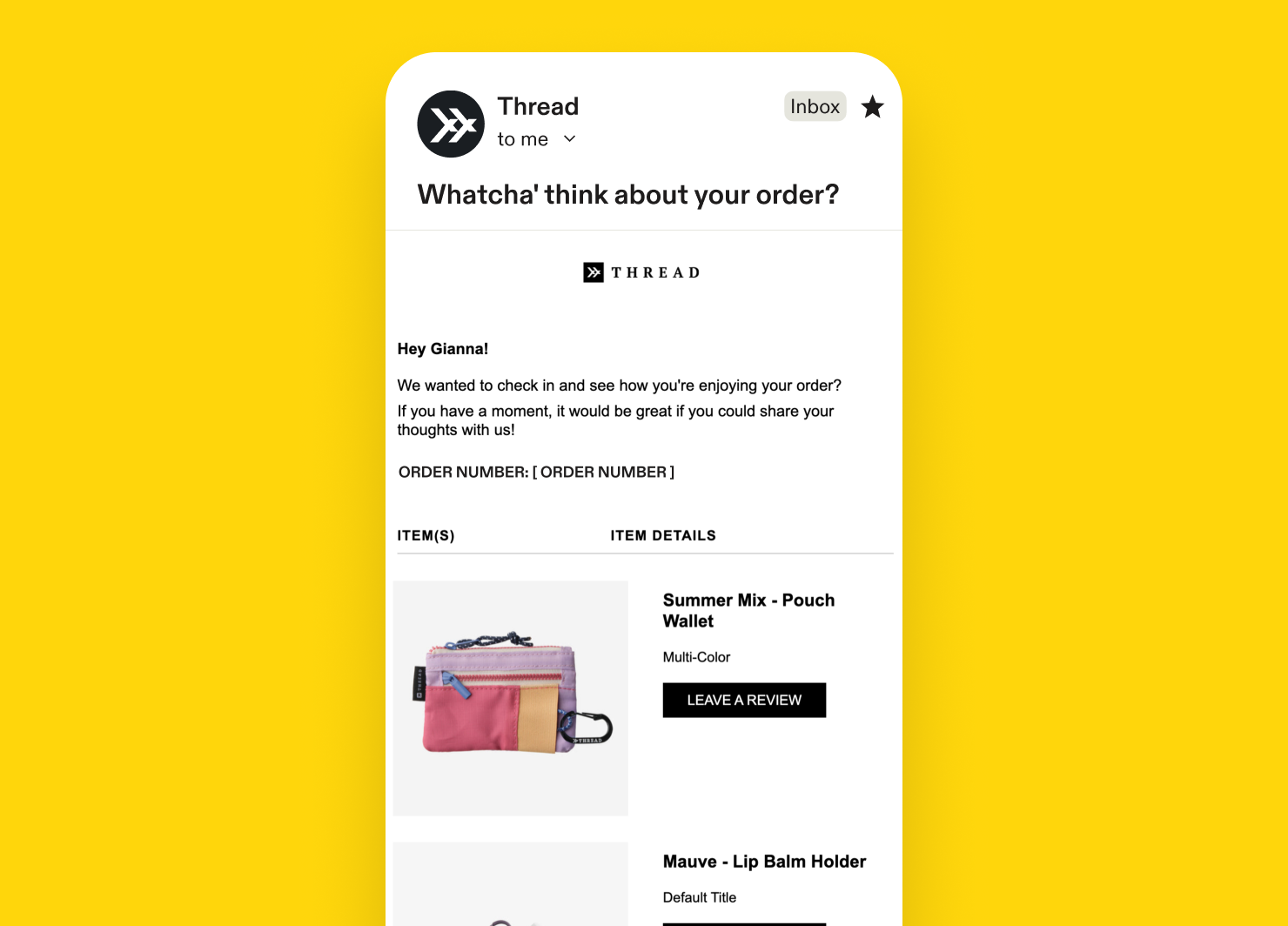
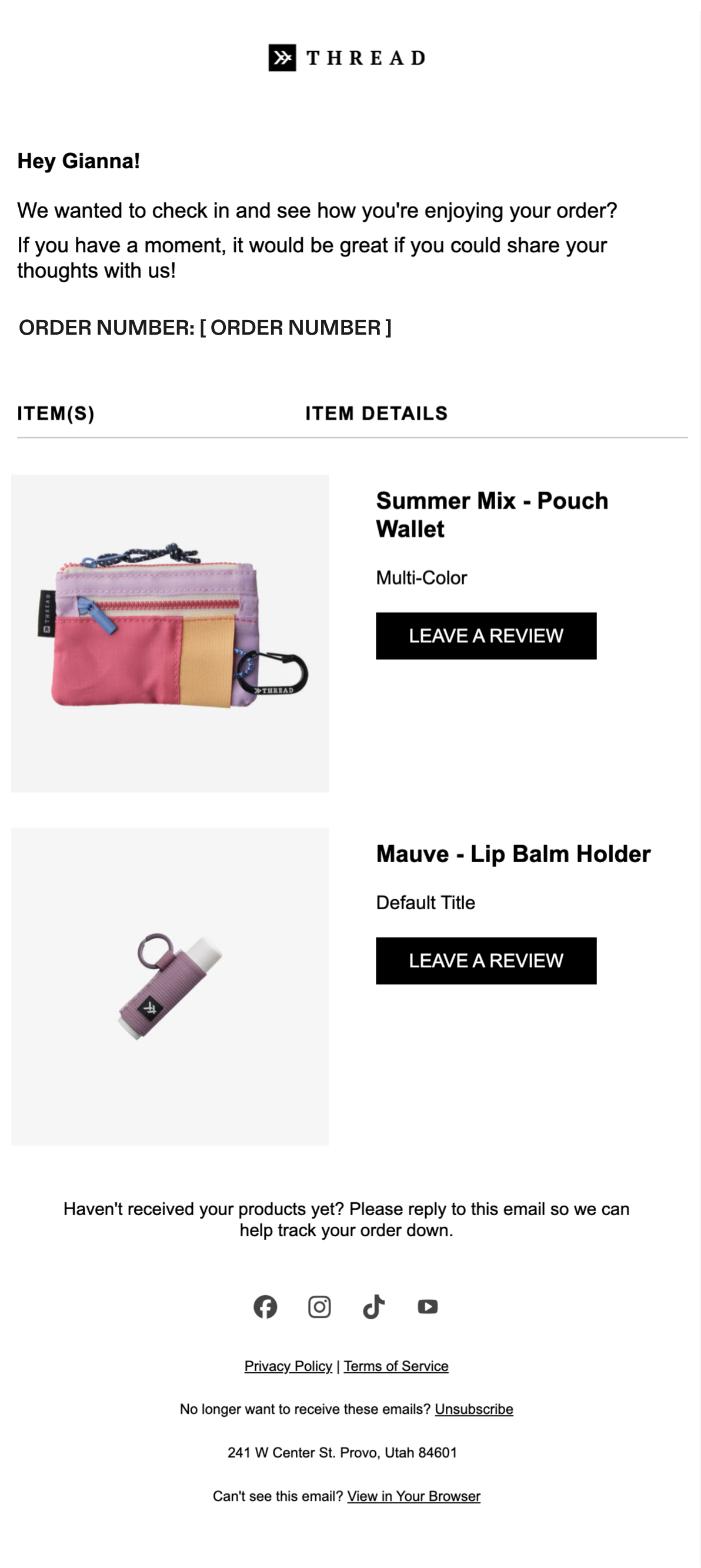
Thread runs a friendly, three-touch review journey through the Okendo integration:
[image-modal-trigger-11] [data-bg="#FFD60B"]
[image-modal-trigger-11]
[image-modal-source-11]
[image-modal-source-11]
Why it works:
- Triggers once an order is marked delivered and keeps the copy on-brand and low-pressure, so the ask feels helpful instead of pushy
- Follows up with non-responders up to twice, spaced out and capped to avoid over-sending
- Pays off: their top-performing review journey drives a 14% CTR and 29% CVR, while unlocking valuable UGC
12. Referral program emails
Goal: Turn loyal customers into new-customer referrals.
Referral program emails ask existing customers to spread the word, usually in exchange for a reward. They work because people trust recommendations from friends—and a clear, often two-sided incentive (where both the referrer and their friend benefit) gives customers a reason to share.
You can include these as part of post-purchase flows or in dedicated campaigns to give your program a boost.
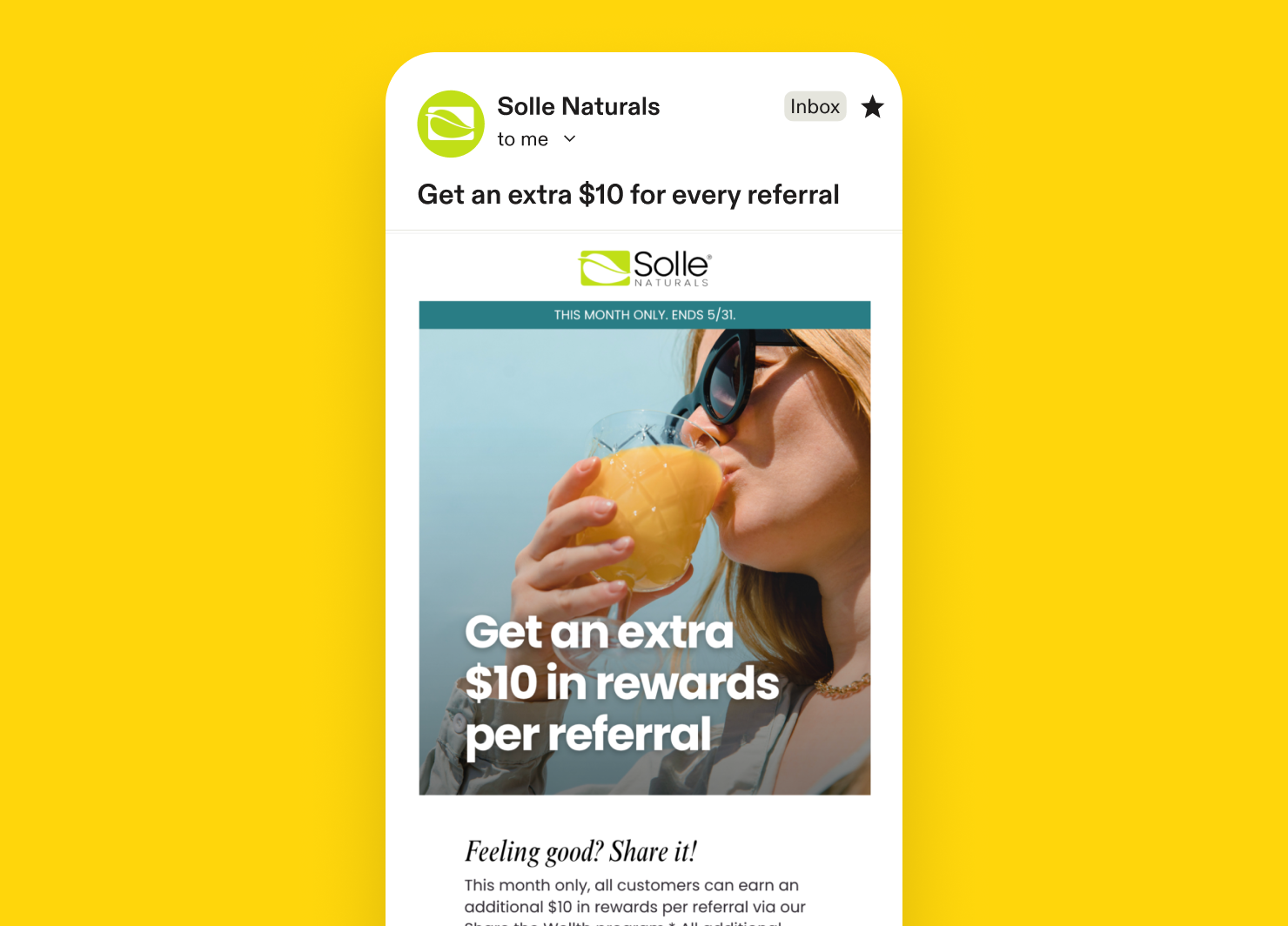
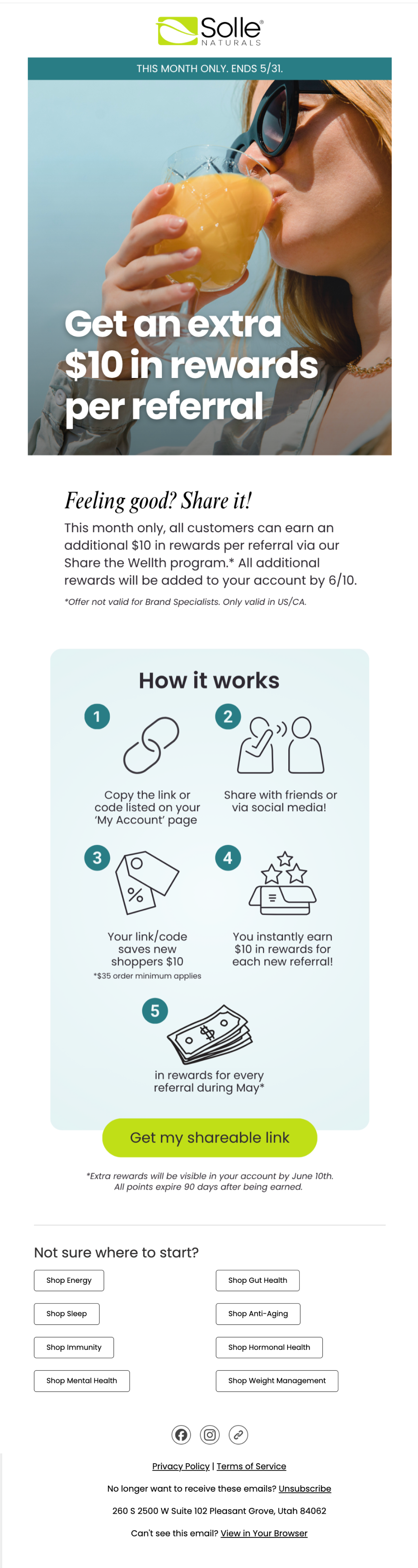
Solle Naturals recently ran a boosted referral offer:
[image-modal-trigger-12] [data-bg="#FFD60B"]
[image-modal-trigger-12]
[image-modal-source-12]
[image-modal-source-12]
Why it works:
- Highlights limited-time nature of the double rewards offer.
- Gives clear instructions on how to refer friends.
13. Replenishment emails
Goal: Prompt repeat purchases on consumable items.
Replenishment emails remind customers to reorder a consumable product around the time they're likely running out. The key is timing—base the send on the product's typical usage cycle—and making the reorder effortless with a quick path back to checkout.
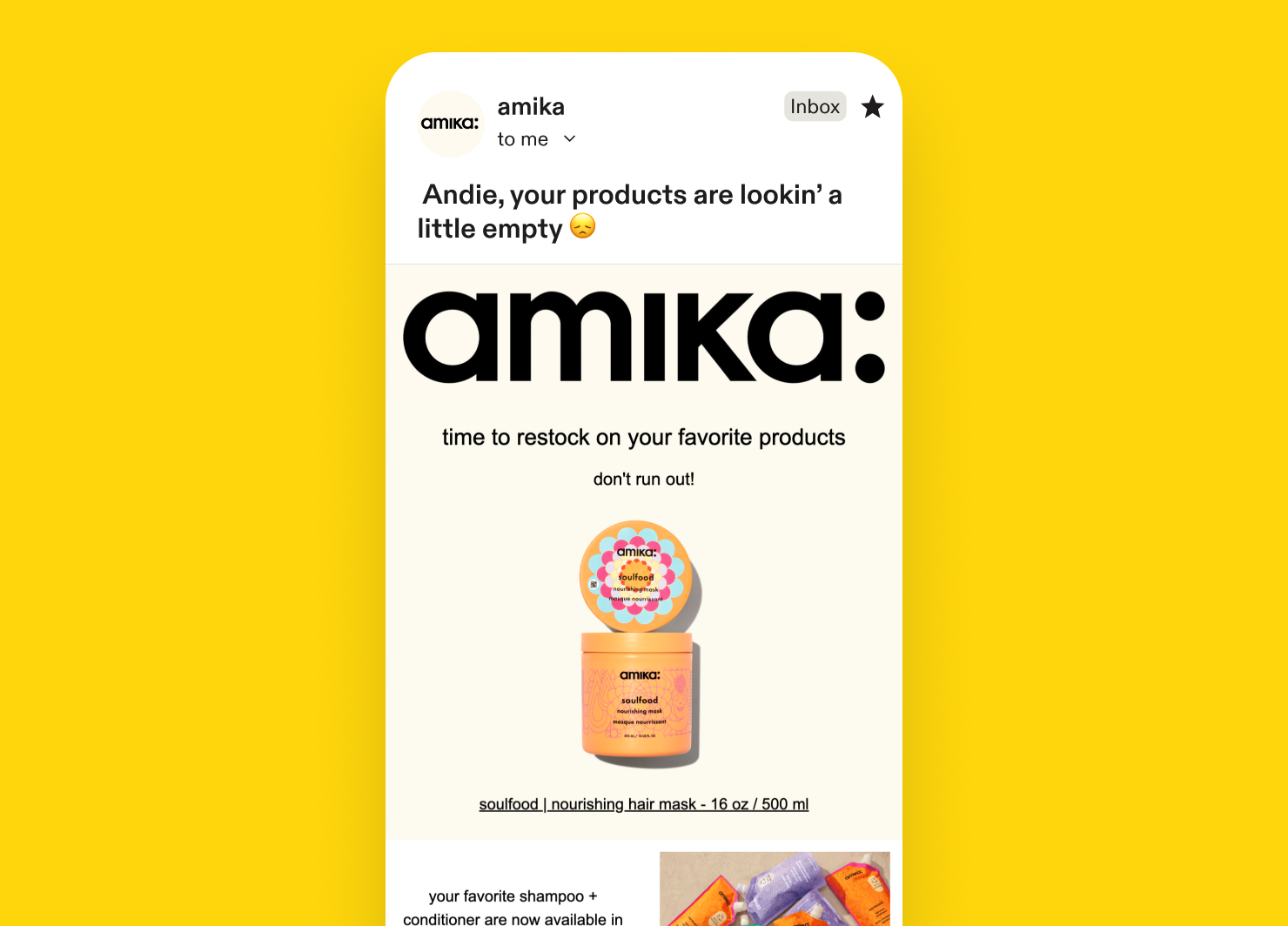
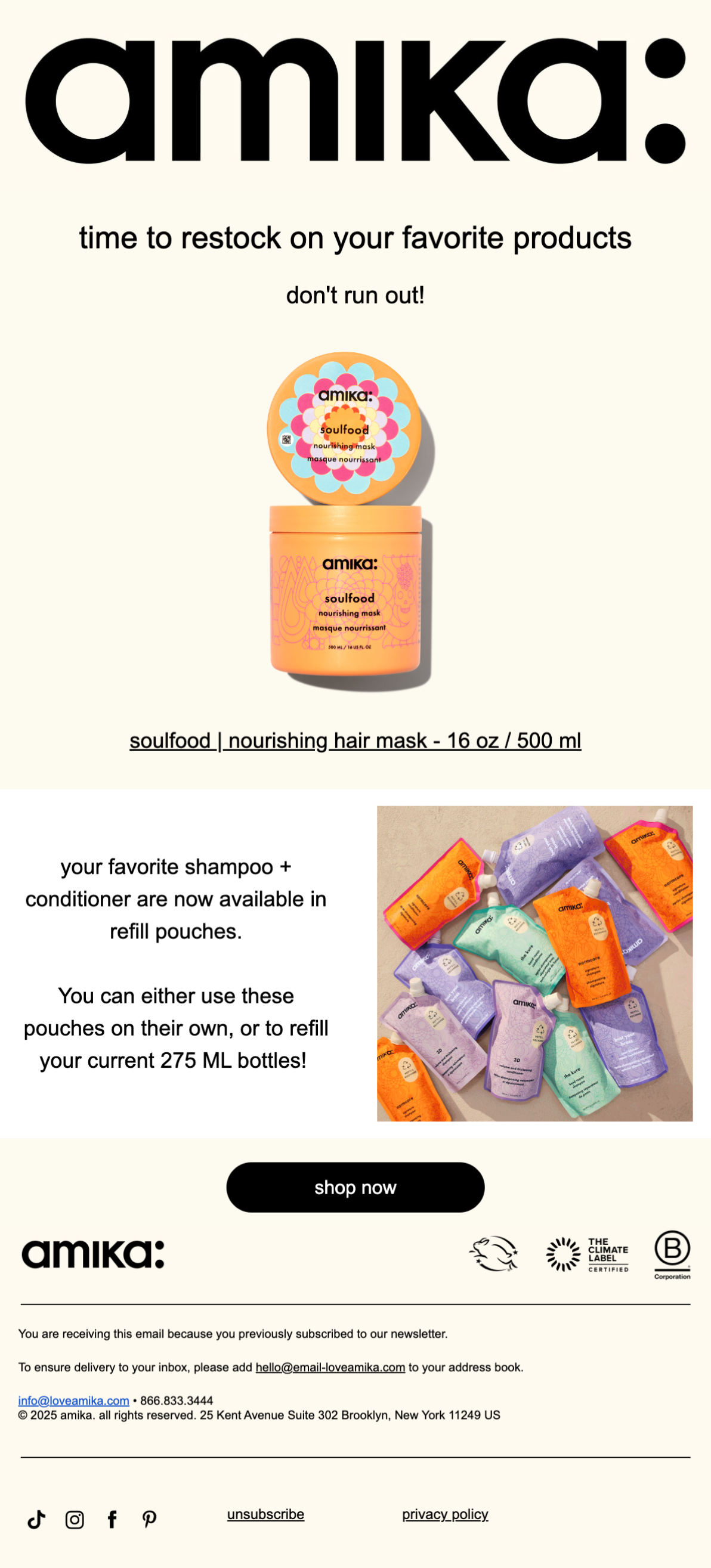
Haircare brand amika nudges customers to refill a couple months after purchase, right as they're likely running low:
[image-modal-trigger-13] [data-bg="#FFD60B"]
[image-modal-trigger-13]
[image-modal-source-13]
[image-modal-source-13]
Why it works:
- Times the send to the product's usage cycle, so the reminder lands exactly when customers need it.
- Adds a cross-sell to additional products the customer is likely to want.
14. Product launch emails
Goal: Build excitement and early sales for something new.
Product launch emails announce a new product, collection, or collaboration.
Build anticipation with a strong hero image that sets the mood, make the launch feel like an event, then guide subscribers to the individual products they can shop.
Teasers before and reminders after launch can extend the momentum.
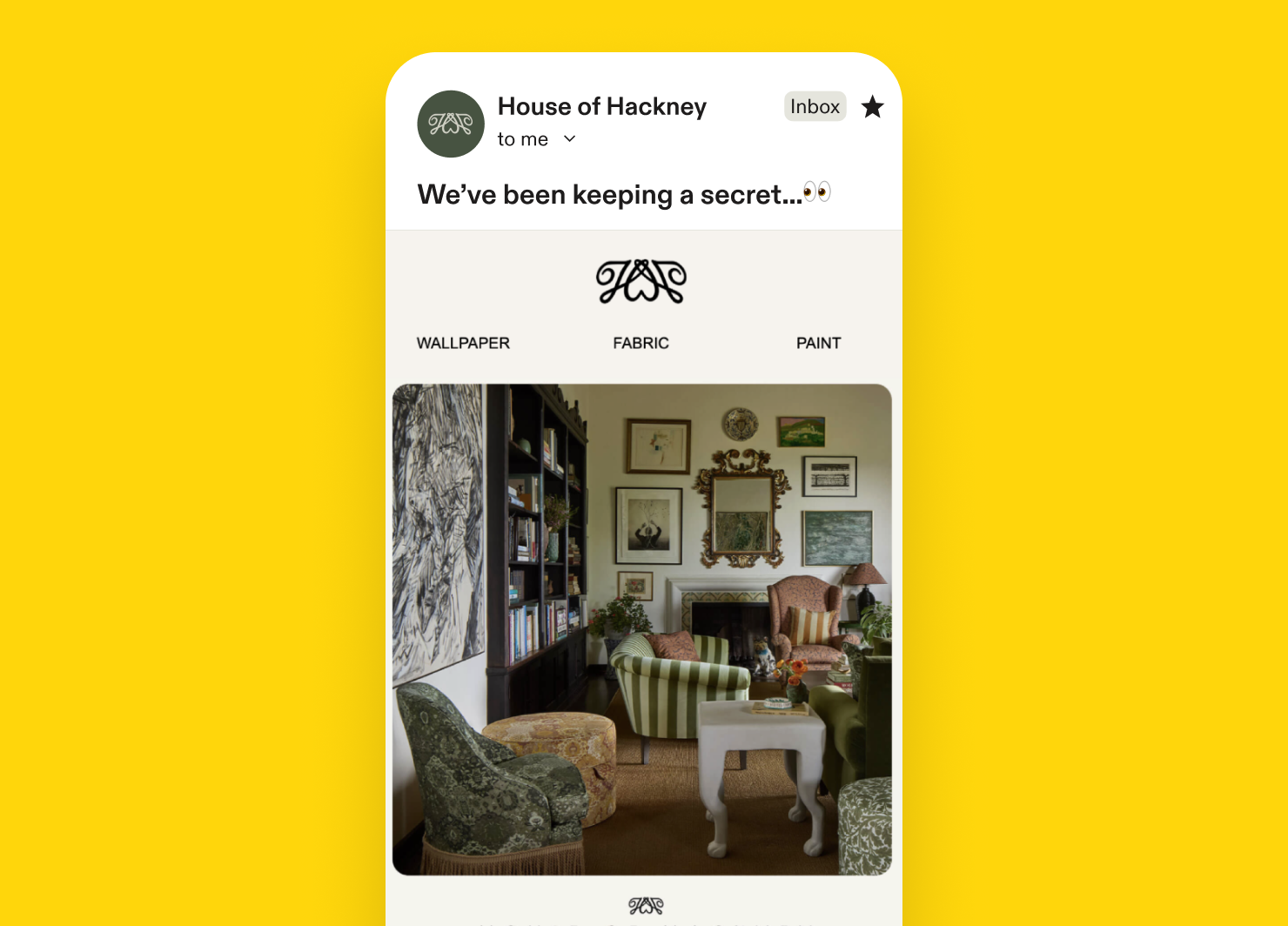
House of Hackney unveils a new collaboration with Nickey Kehoe:
[image-modal-trigger-14] [data-bg="#FFD60B"]
[image-modal-trigger-14]
[image-modal-source-14]

[image-modal-source-14]
Why it works:
- The email leads with a lifestyle photoshoot first—highlighting products in the context of a living space.
- Individual products are then highlighted to give subscribers a path from loving the look to shopping it.
15. Sale announcement emails
Goal: Drive sales with a compelling offer.
Sale announcement emails put a promotion front and center. Make the offer impossible to miss above the fold, communicate the value clearly, and give one obvious CTA to shop.
If there's a deadline, say so—and plan follow-up reminders as it approaches.
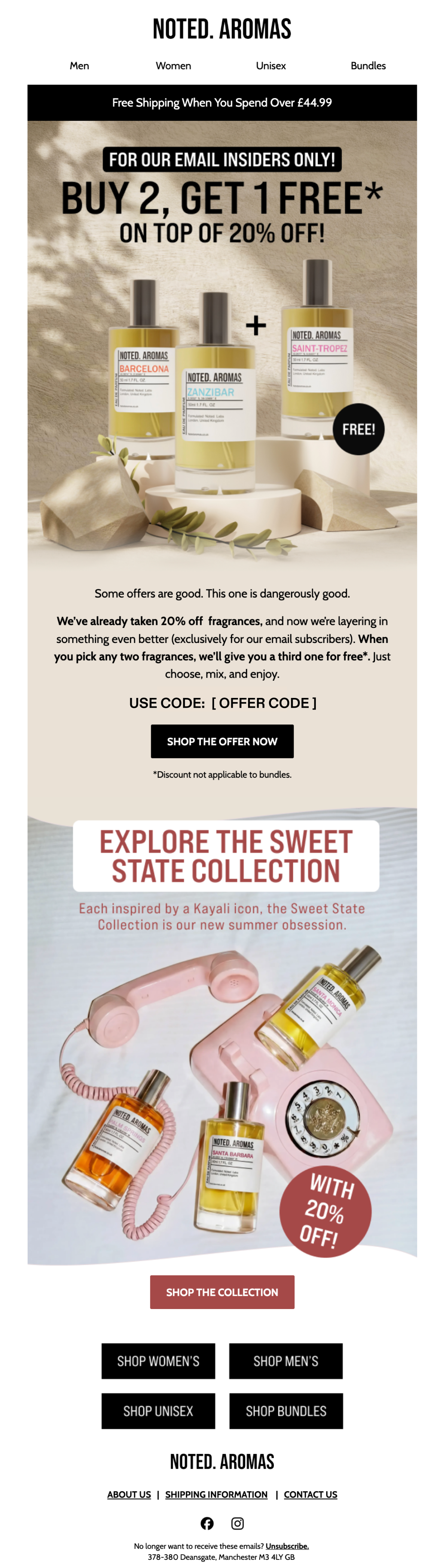
Noted. Aromas sweetens an existing sale with an email-exclusive offer:
[image-modal-trigger-15] [data-bg="#FFD60B"]

[image-modal-trigger-15]
[image-modal-source-15]
[image-modal-source-15]
Why it works:
- Leads with a big bold announcement above the fold.
- Frames it as an email exclusive layered on top of an existing sale, so subscribers feel rewarded.
16. Low inventory emails
Goal: Drive purchases before an in-demand product sells out.
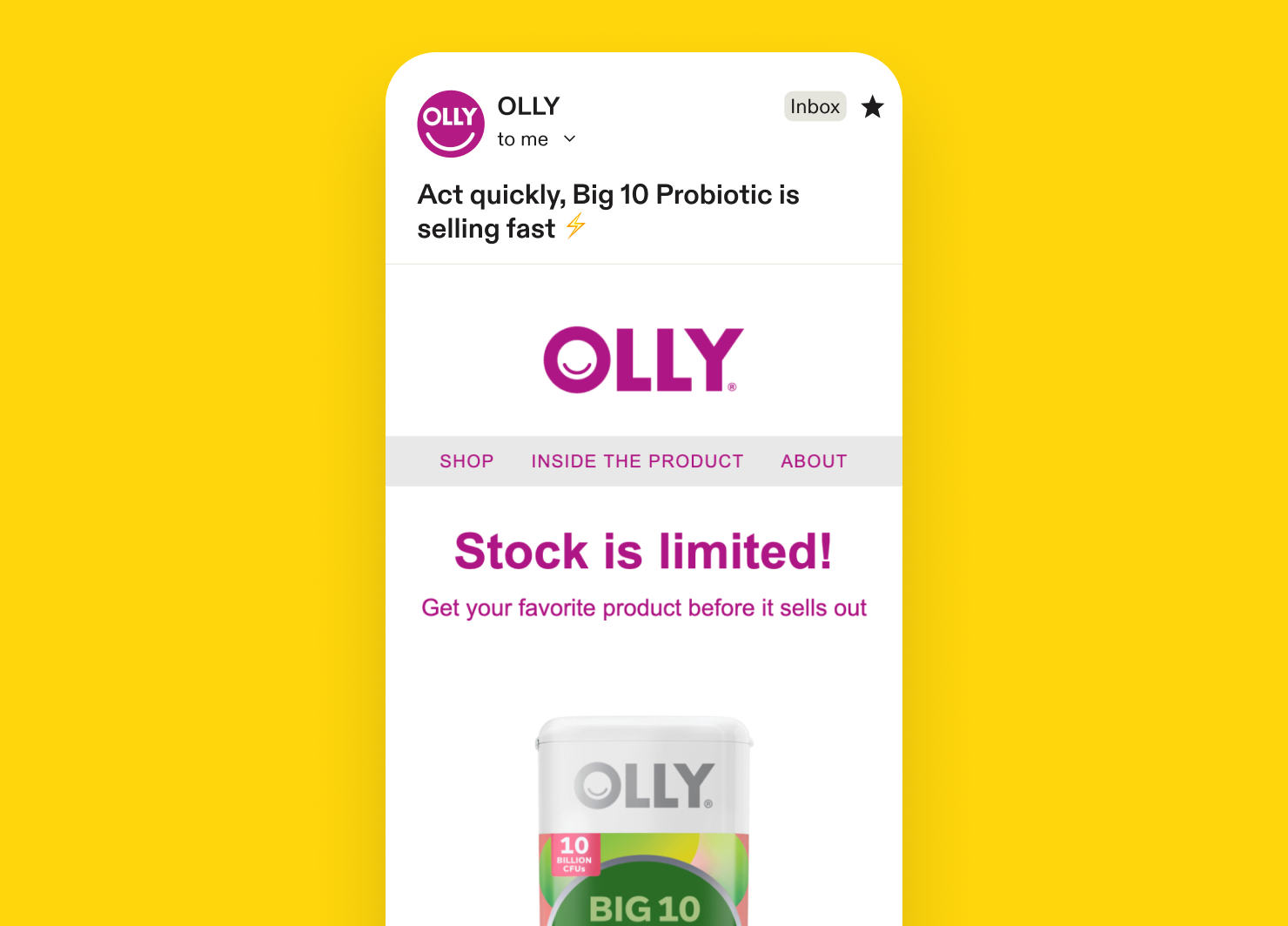
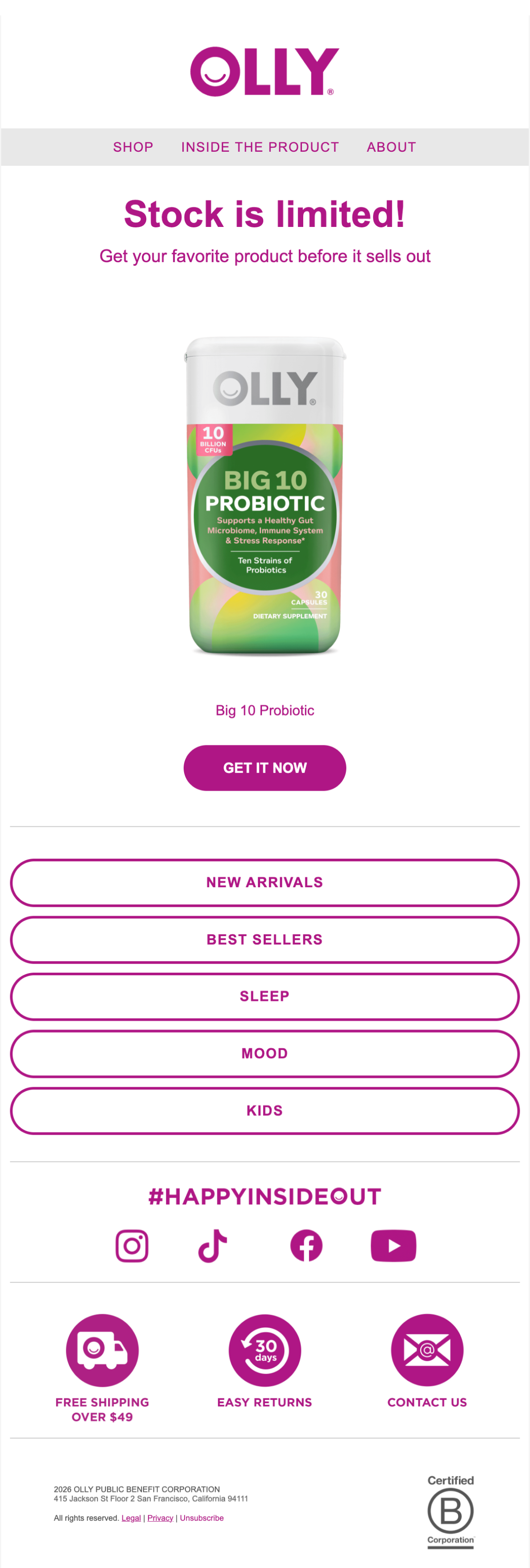
Low inventory emails let shoppers know a product is running low. They're most useful for items someone has already shown interest in, so keep them clean and simple: name the product, signal that stock is limited, and make it easy to buy.
OLLY lets fans know a favorite is selling fast:
[image-modal-trigger-16] [data-bg="#FFD60B"]
[image-modal-trigger-16]
[image-modal-source-16]
[image-modal-source-16]
Why it works:
- Subject line is straight to the point with the product name included.
- Keeps it clean—there's no need to re-sell a product customers already use and love, so it leads with the low-stock heads up.
17. Back-in-stock emails
Goal: Convert shoppers who waited for a sold-out product.
Back-in-stock emails tell shoppers that a product they wanted is available again.
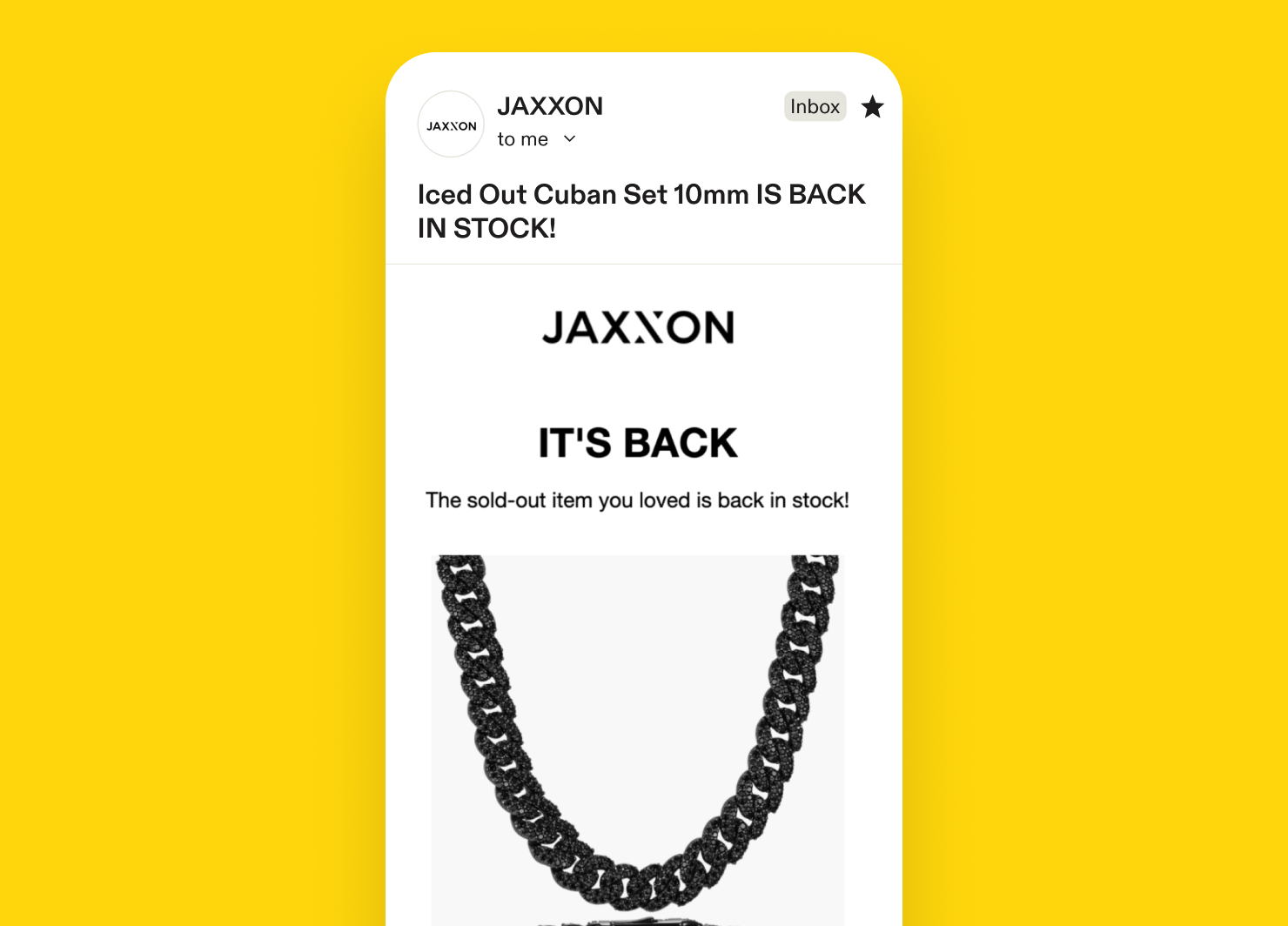
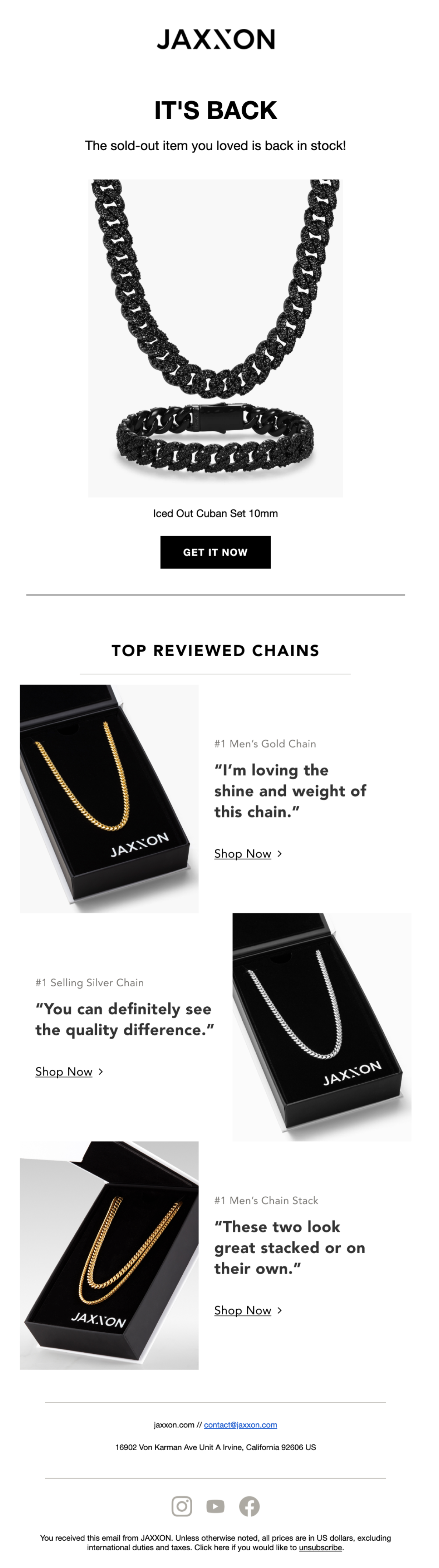
They reach high-intent people—often those who joined a waitlist—so lead with the good news and a fast path to buy before it sells out again.
JAXXON delivers the good news that a sold-out chain is back:
[image-modal-trigger-17] [data-bg="#FFD60B"]
[image-modal-trigger-17]
[image-modal-source-17]
[image-modal-source-17]
Why it works:
- Leads with a big back-in-stock announcement, exactly what waitlisted shoppers are waiting to hear.
- Features other chain styles at the bottom, giving shoppers alternatives if the original isn't quite what they want now.
18. Price drop emails
Goal: Convert interested shoppers with a lower price.
Price drop emails tell shoppers that a product has gotten cheaper—a strong nudge for anyone who was interested but hadn't bought yet.
They work best sent to shoppers who already viewed the item.
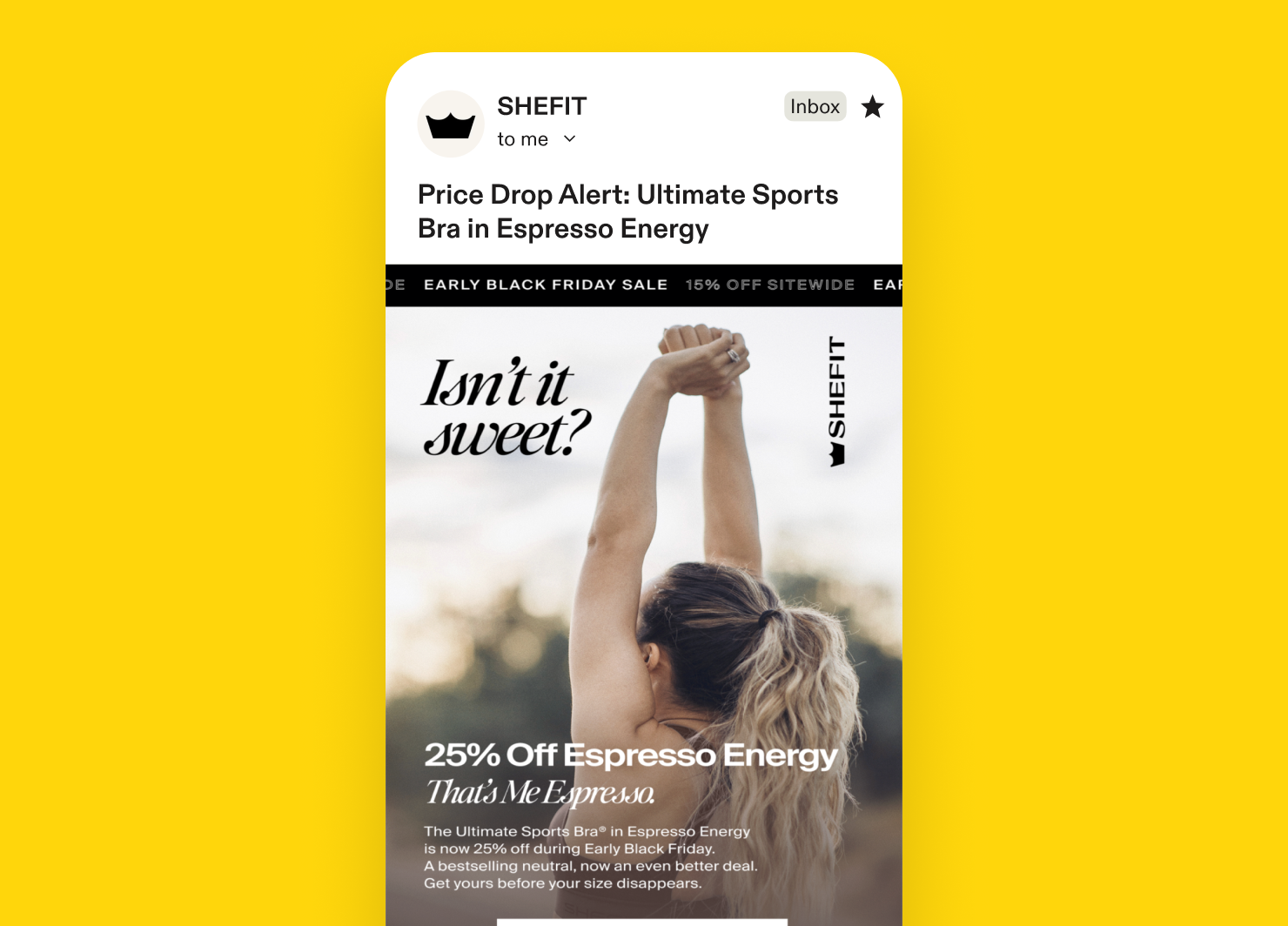
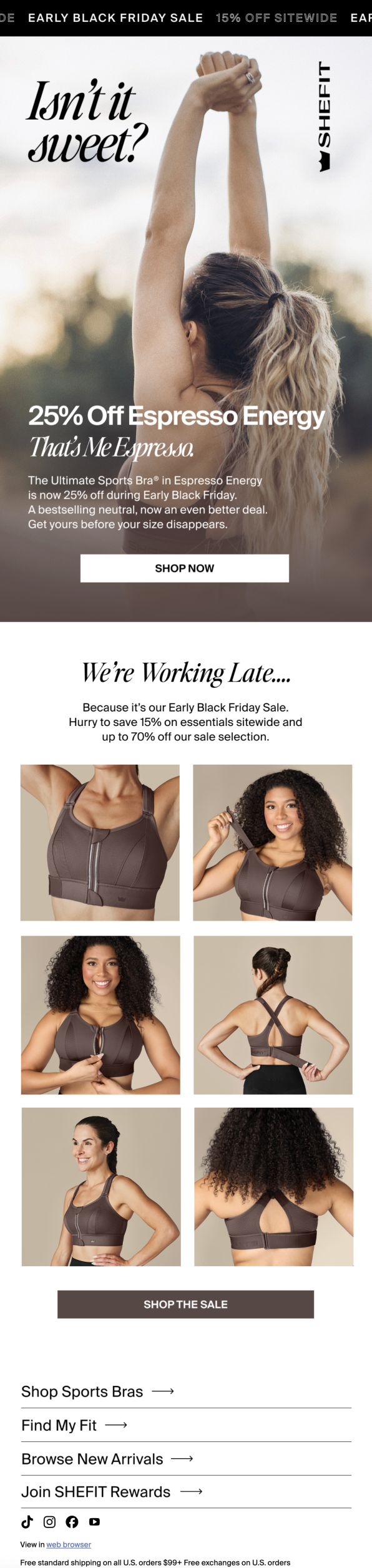
SHEFIT spotlights a single sports bra at its new lower price during its Black Friday sale:
[image-modal-trigger-18] [data-bg="#FFD60B"]
[image-modal-trigger-18]
[image-modal-source-18]
[image-modal-source-18]
Why it works:
- Focuses on one product that shoppers have shown interest in.
- Adds urgency to get the item before it goes out of stock—common for Black Friday sales.
19. Social proof emails
Goal: Convert hesitant shoppers by showing that others love your brand.
Social proof emails use reviews, ratings, testimonials, or user-generated content to show shoppers that real people love your products.
They're especially effective for shoppers on the fence—seeing positive experiences from others can be the reassurance that tips them toward a purchase. Include these in your welcome flows, abandonment messages, or sale campaigns that subscribers haven’t acted on yet.
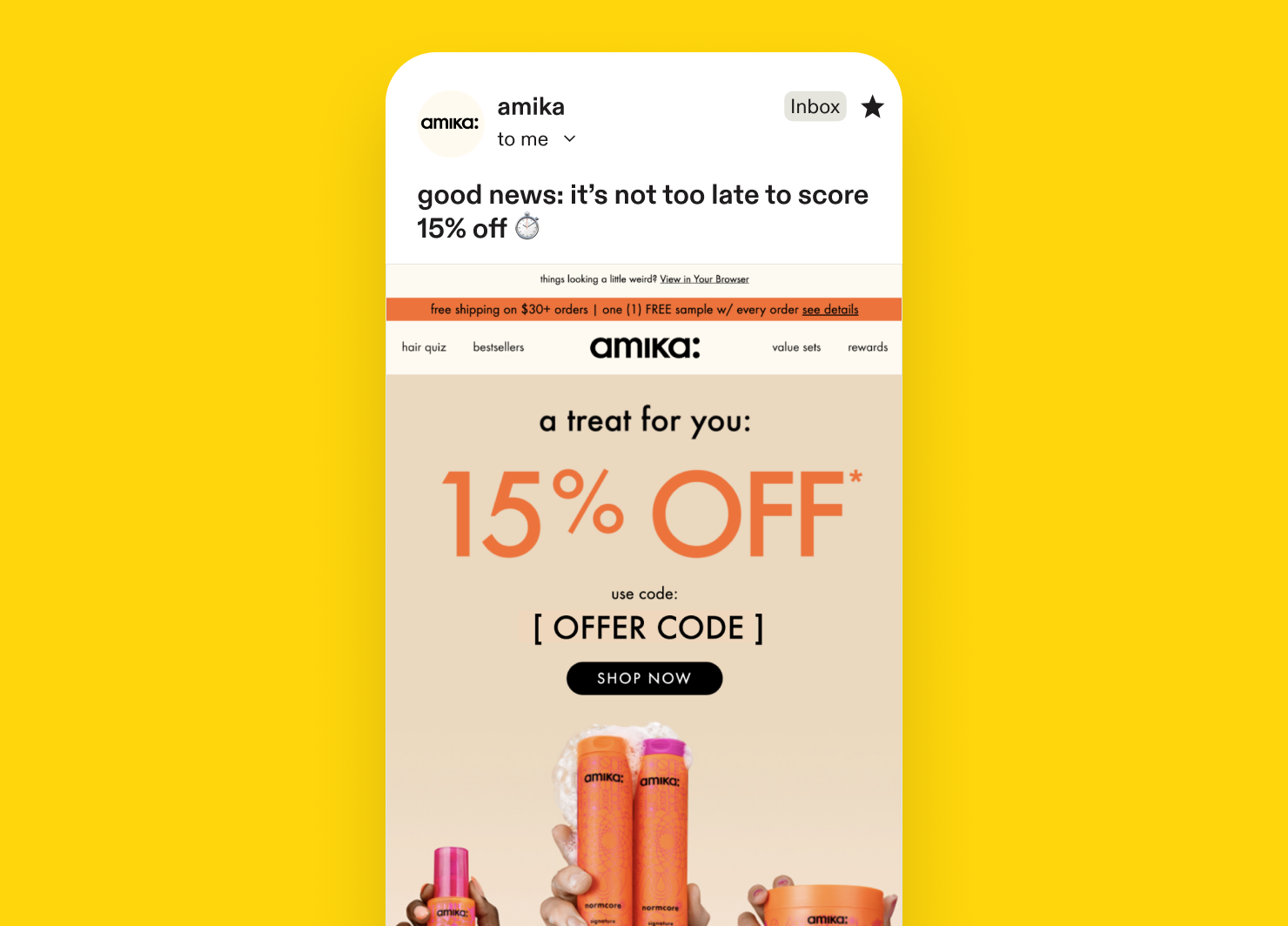
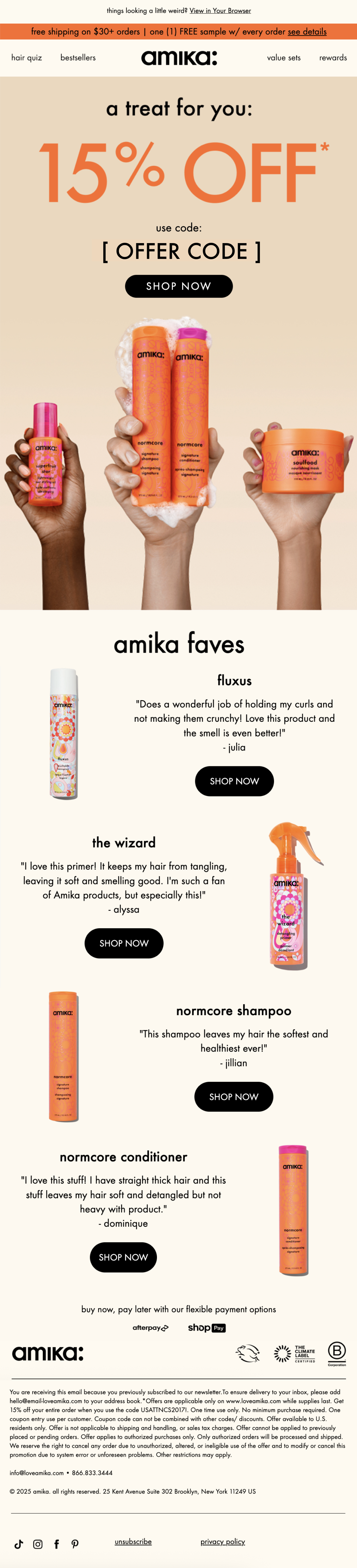
In its welcome journey, amika makes one more case with reviews from happy customers:
[image-modal-trigger-19] [data-bg="#FFD60B"]
[image-modal-trigger-19]
[image-modal-source-19]
[image-modal-source-19]
Why it works:
- Closes the welcome journey with customer reviews, giving non-buyers reassurance from real people.
- Keeps the welcome offer prominent, pairing the social proof with an incentive to buy.
20. VIP emails
Goal: Reward your best customers and keep them coming back.
VIP emails reward your most valuable customers with exclusive perks—early access, special discounts, or members-only offers.
They make top customers feel recognized, which deepens loyalty and drives repeat purchases. Personalize the experience to reinforce that the perk is reserved for them.
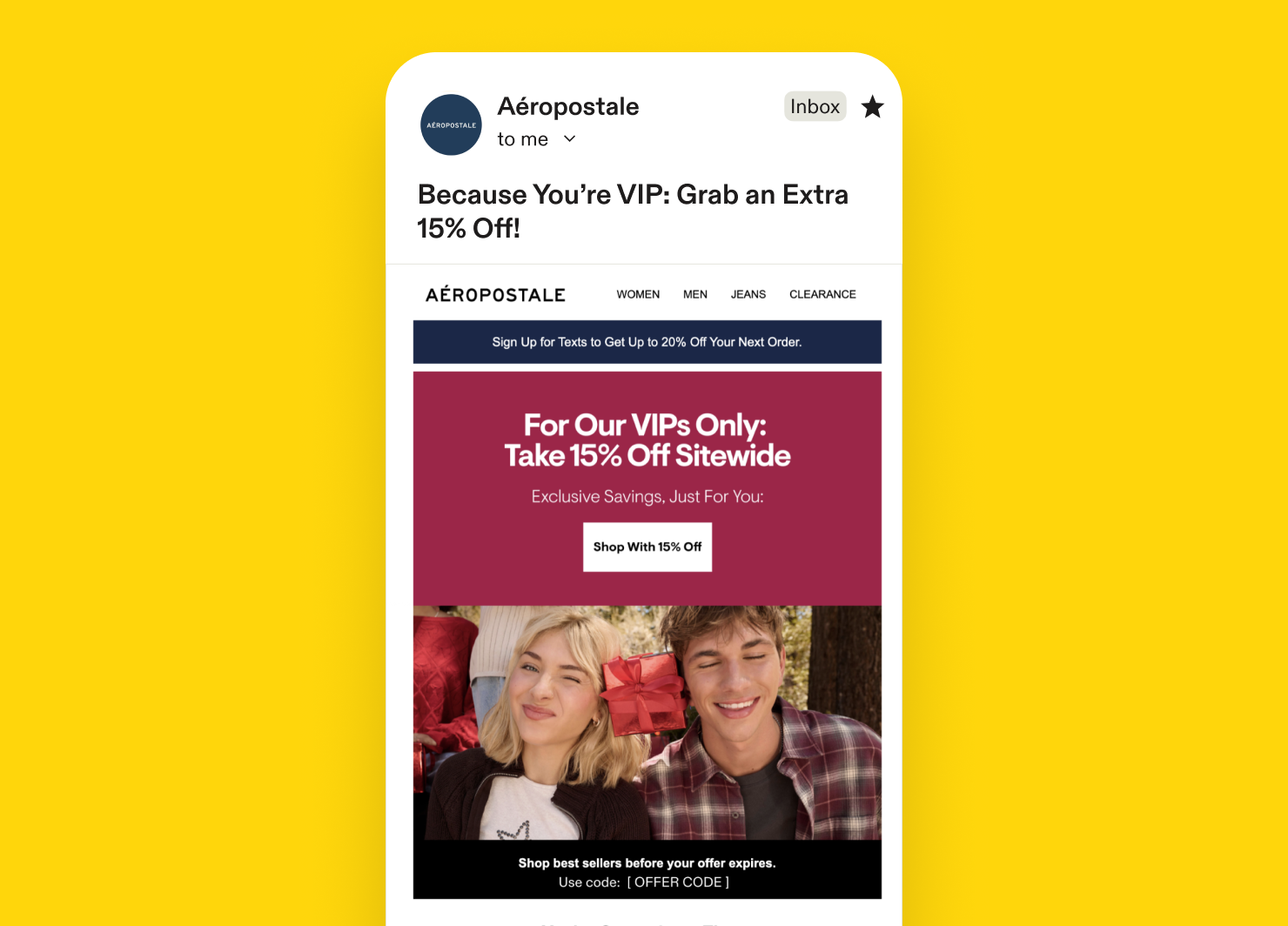
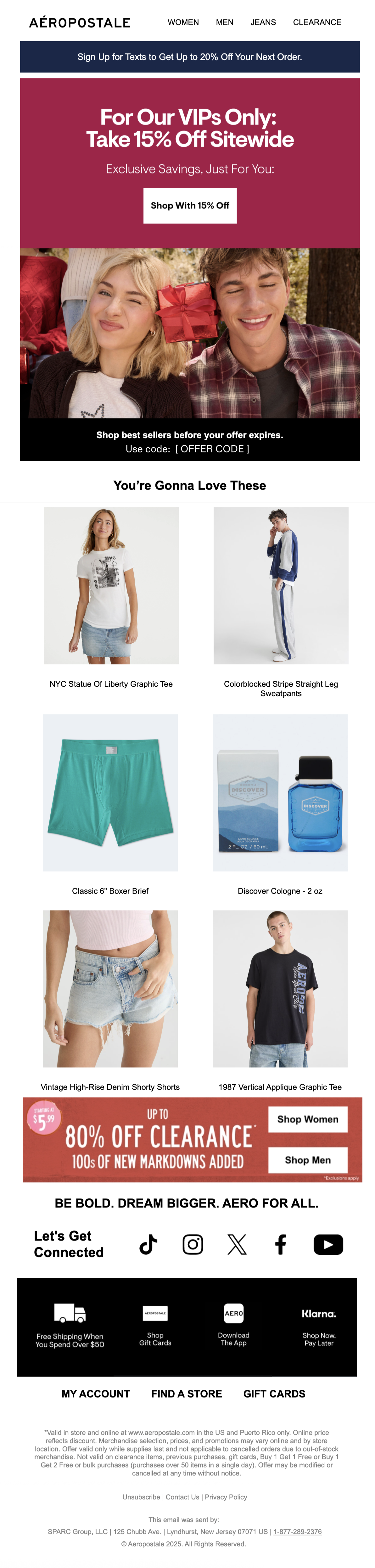
Aéropostale rewards its Platinum and Gold members with an exclusive extra discount:
[image-modal-trigger-20] [data-bg="#FFD60B"]
[image-modal-trigger-20]
[image-modal-source-20]
[image-modal-source-20]
Why it works:
- Frames the offer as a perk reserved for VIPs, so top customers feel recognized and valued.
- Personalizes the featured products to each subscriber, making conversions more likely.
21. Loyalty program emails
Goal: Welcome and engage loyalty members.
Loyalty program emails keep members active in your rewards program—welcoming new sign-ups, updating point balances, or highlighting what they can redeem.
A strong first loyalty email sets the tone by explaining how the program works and what members can earn, so they start participating right away.
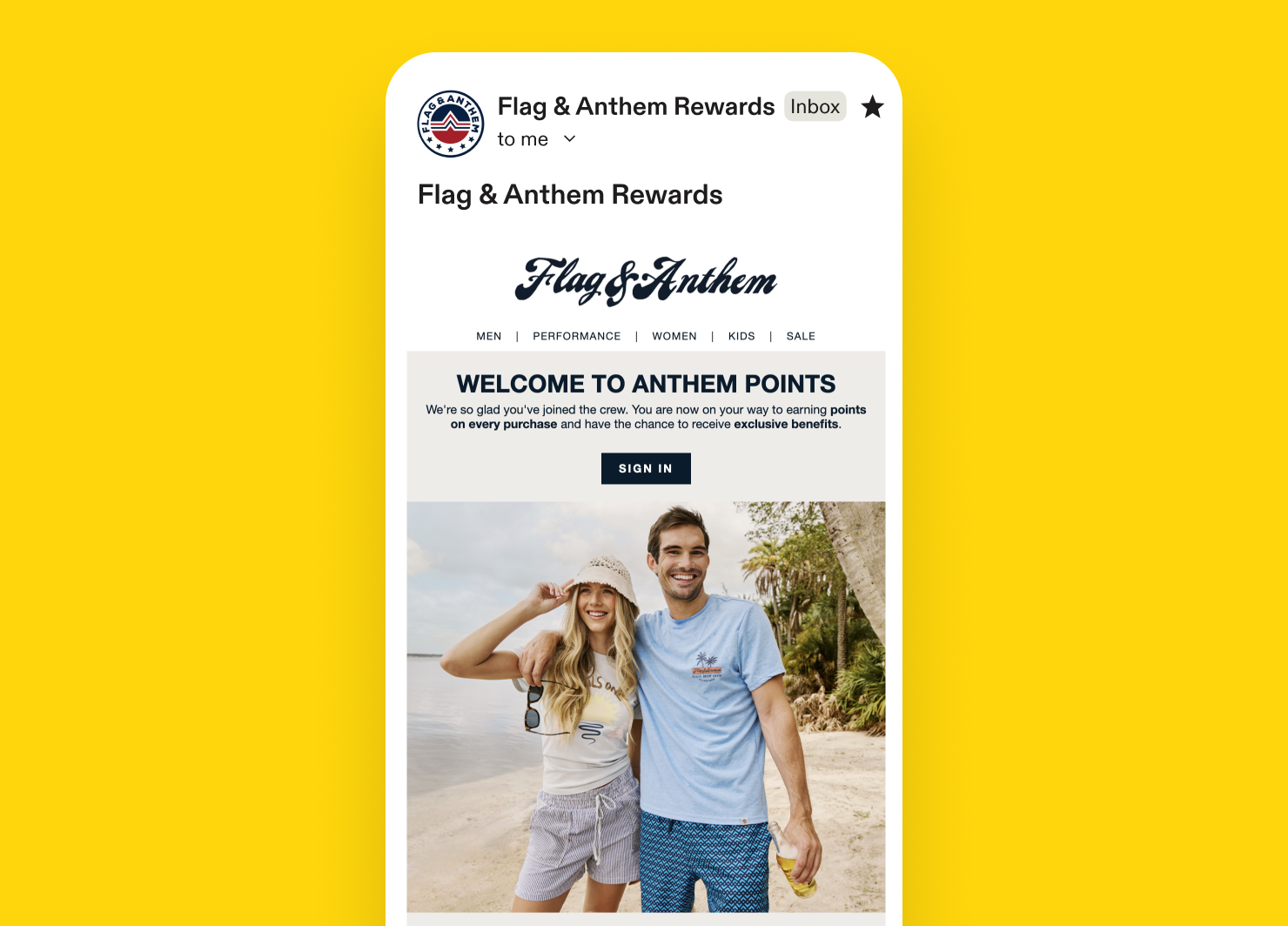
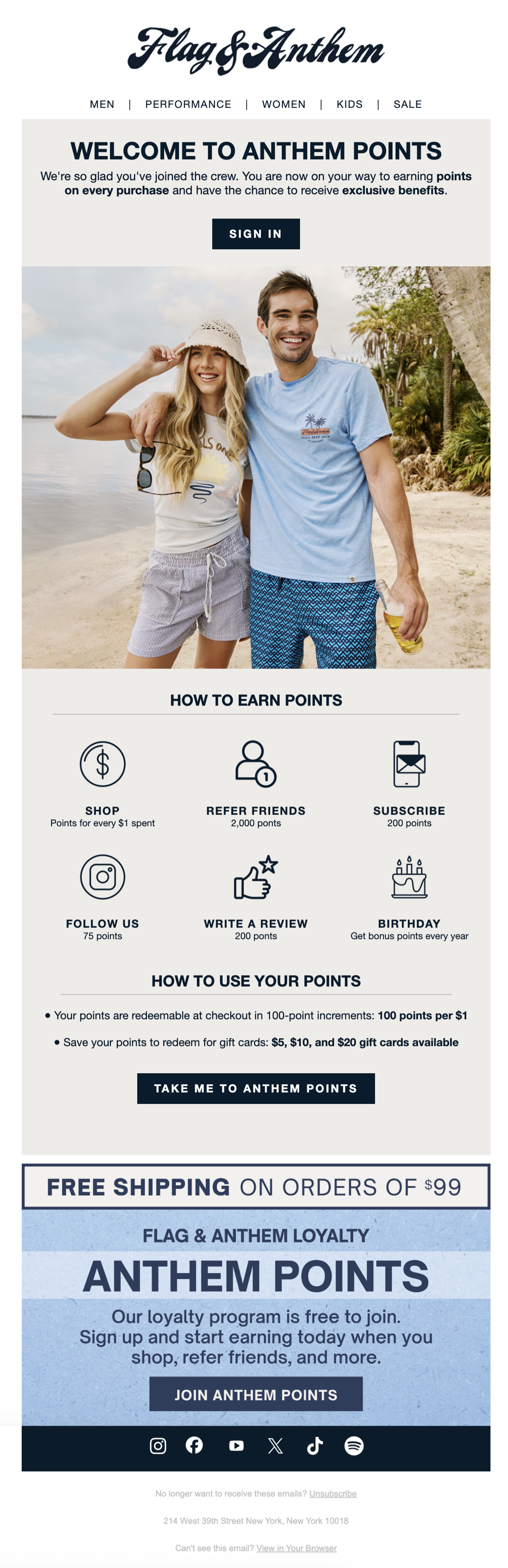
Flag & Anthem welcomes new members to its points program and lays out what to expect:
[image-modal-trigger-21] [data-bg="#FFD60B"]
[image-modal-trigger-21]
[image-modal-source-21]
[image-modal-source-21]
Why it works:
- Sets clear expectations—how the program works and what members can do to earn points—so they know how to start benefiting.
22. Seasonal emails
Goal: Drive sales by connecting products to the season.
Seasonal emails tie your products to the time of year—a holiday, a change of season, or a cultural moment.
They feel timely and relevant, giving subscribers a fresh reason to shop. The best ones go beyond seasonal products to sell a mood or occasion, helping shoppers picture themselves in the season.
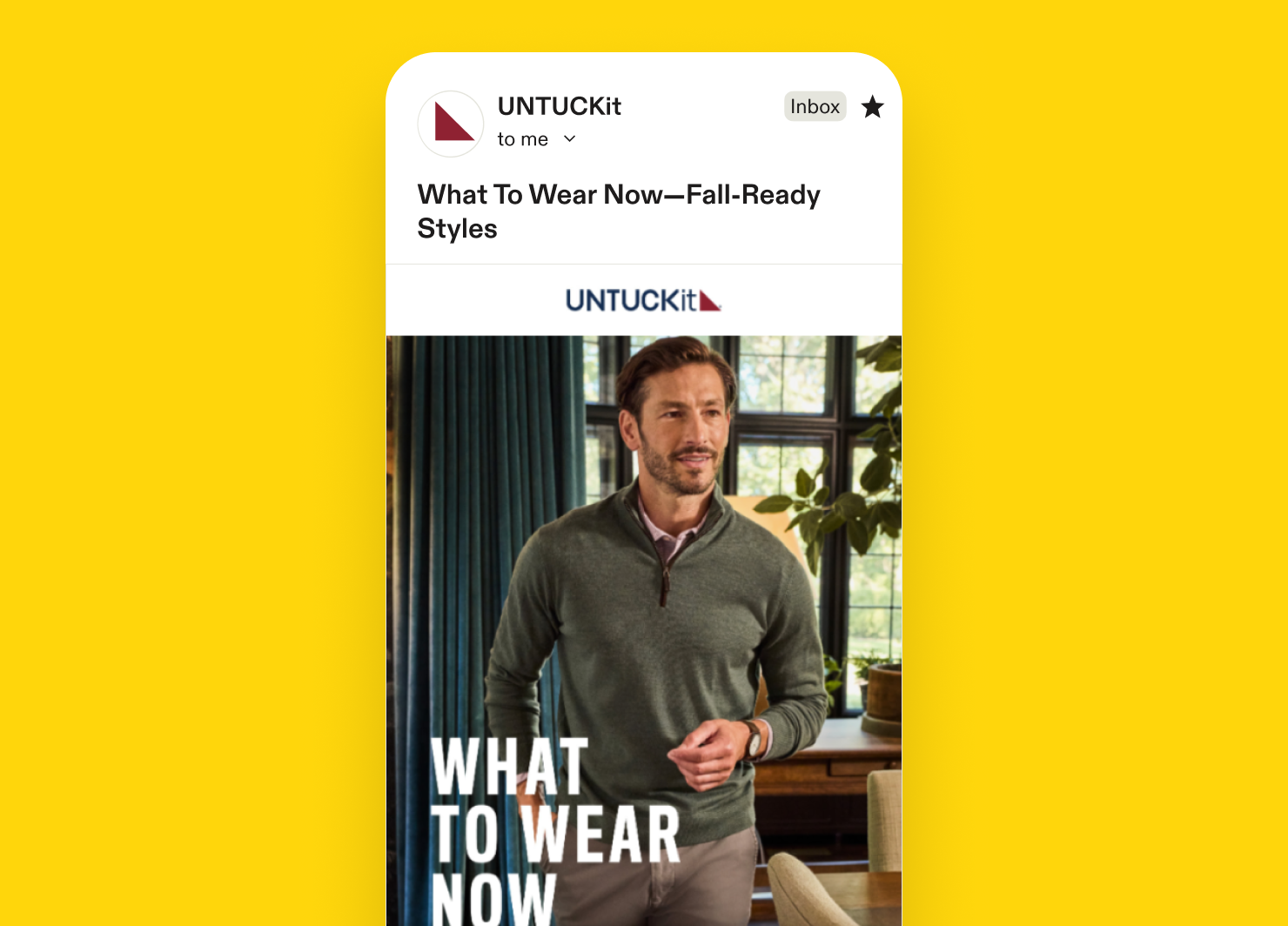
UNTUCKit curates fall-ready looks for the season ahead:
[image-modal-trigger-22] [data-bg="#FFD60B"]
[image-modal-trigger-22]
[image-modal-source-22]

[image-modal-source-22]
Why it works:
- Sells a seasonal mood by framing styles around fall occasions, so shoppers can picture themselves wearing them.
- Adds the same CTA after each featured look so subscribers can go shop when they feel inspired.
23. Birthday and milestone emails
Goal: Celebrate customers and give them a reason to shop.
Birthday and milestone emails mark a personal moment—a birthday, a sign-up anniversary, or a first-purchase milestone.
A small gift or exclusive discount makes the moment feel special and gives customers a timely reason to shop.
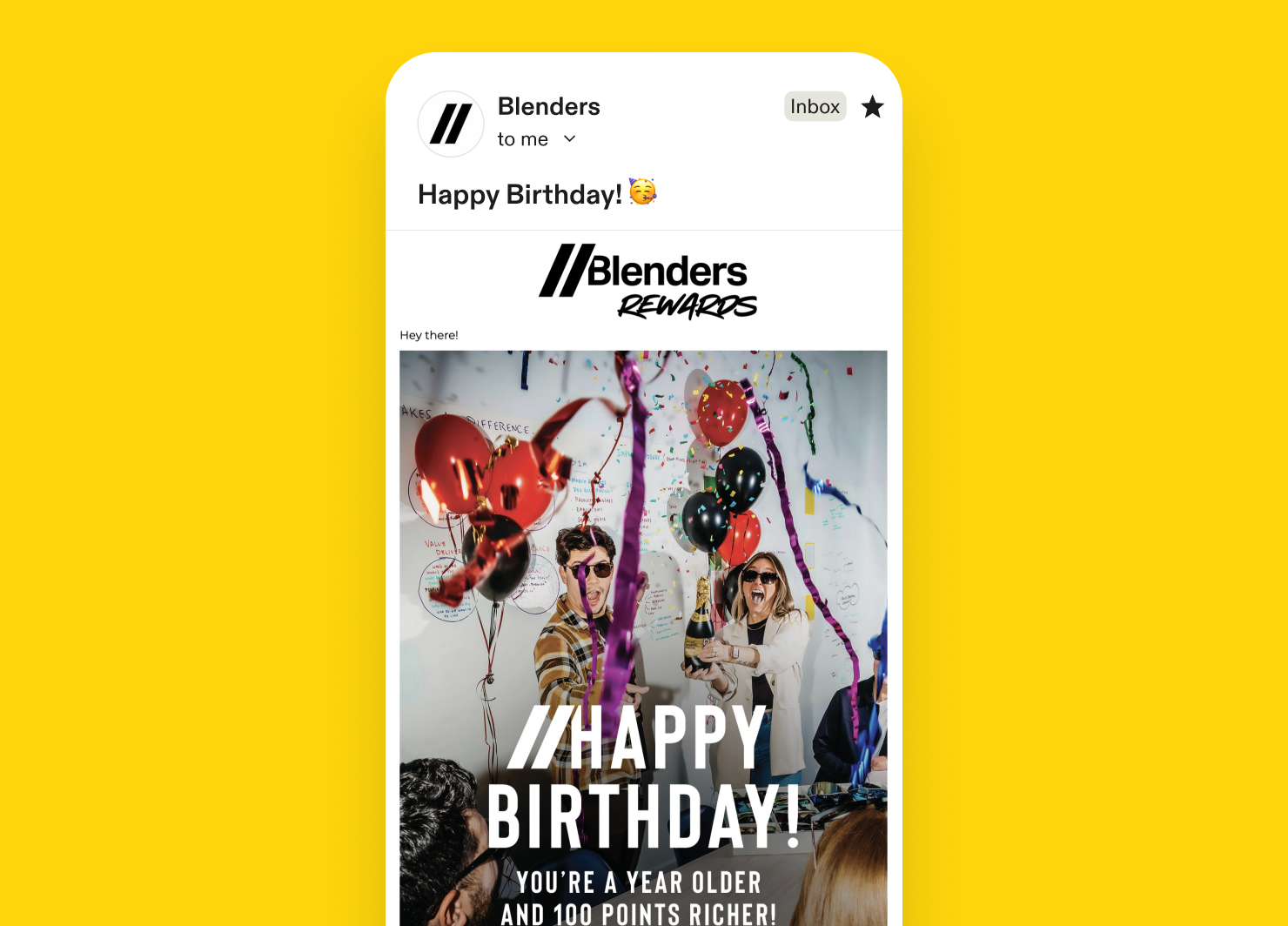
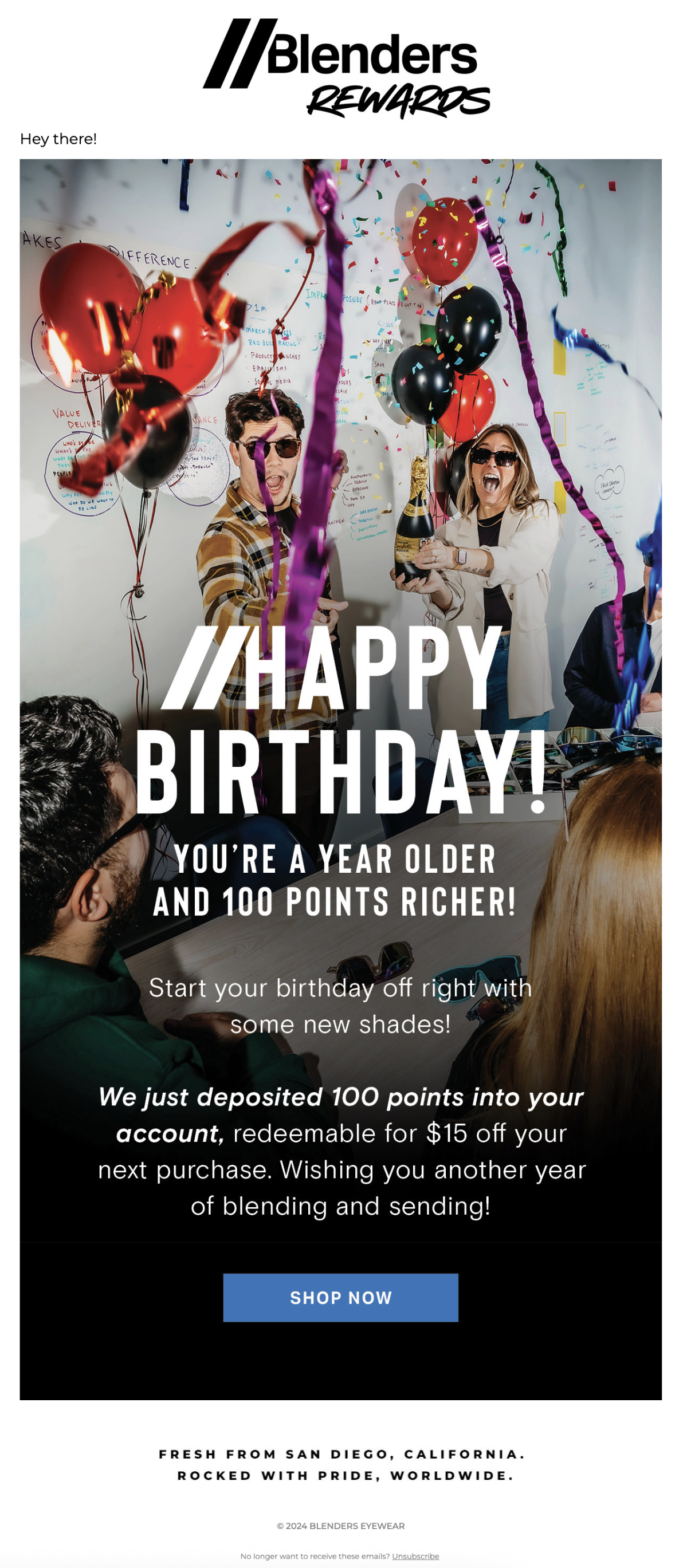
Blenders wishes customers a happy birthday with extra loyalty points to celebrate:
[image-modal-trigger-23] [data-bg="#FFD60B"]
[image-modal-trigger-23]
[image-modal-source-23]
[image-modal-source-23]
Why it works:
- Gives a timely, personal reason to shop that doesn’t read like a standard promotion.
- Adds loyalty points to a customer’s existing account so they could be eligible to redeem a better reward.
24. Winback emails
Goal: Brick back lapsed customers.
Winback emails reach customers who haven't purchased or engaged in a while. The goal is to remind them why they loved you and give a compelling reason to return—often a strong incentive like a discount or credit.
Time them to a customer's typical purchase cycle, so you reach out once someone's gone quiet.
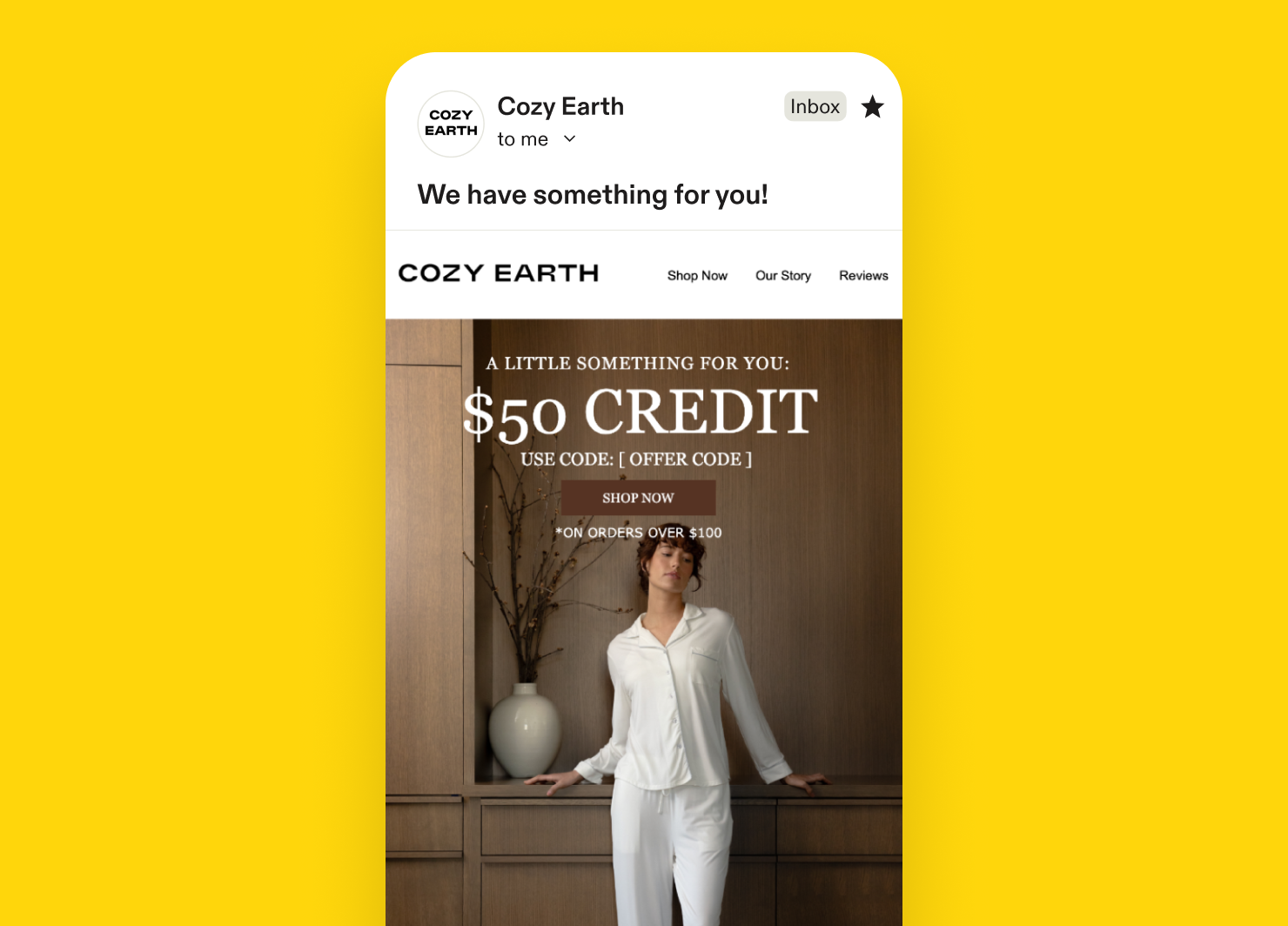
Cozy Earth reaches out to lapsed customers with a generous $50 credit:
[image-modal-trigger-24] [data-bg="#FFD60B"]
[image-modal-trigger-24]
[image-modal-source-24]

[image-modal-source-24]
Why it works:
- Leads with a strong, specific incentive—a $50 credit—giving lapsed customers reason to come back.
- Keeps the tone warm and inviting rather than guilt-tripping.
- Features a variety of products to bring shoppers back in.
25. Sunset emails
Goal: Re-engage inactive subscribers, or cleanly part ways.
Sunset emails are a final outreach to subscribers who've stopped engaging. Give inactive contacts one last reason to stick around while making it easy to opt out.
Removing unengaged subscribers at the end of your sunset flow protects your sender reputation and deliverability, so the people who want your emails keep getting them.
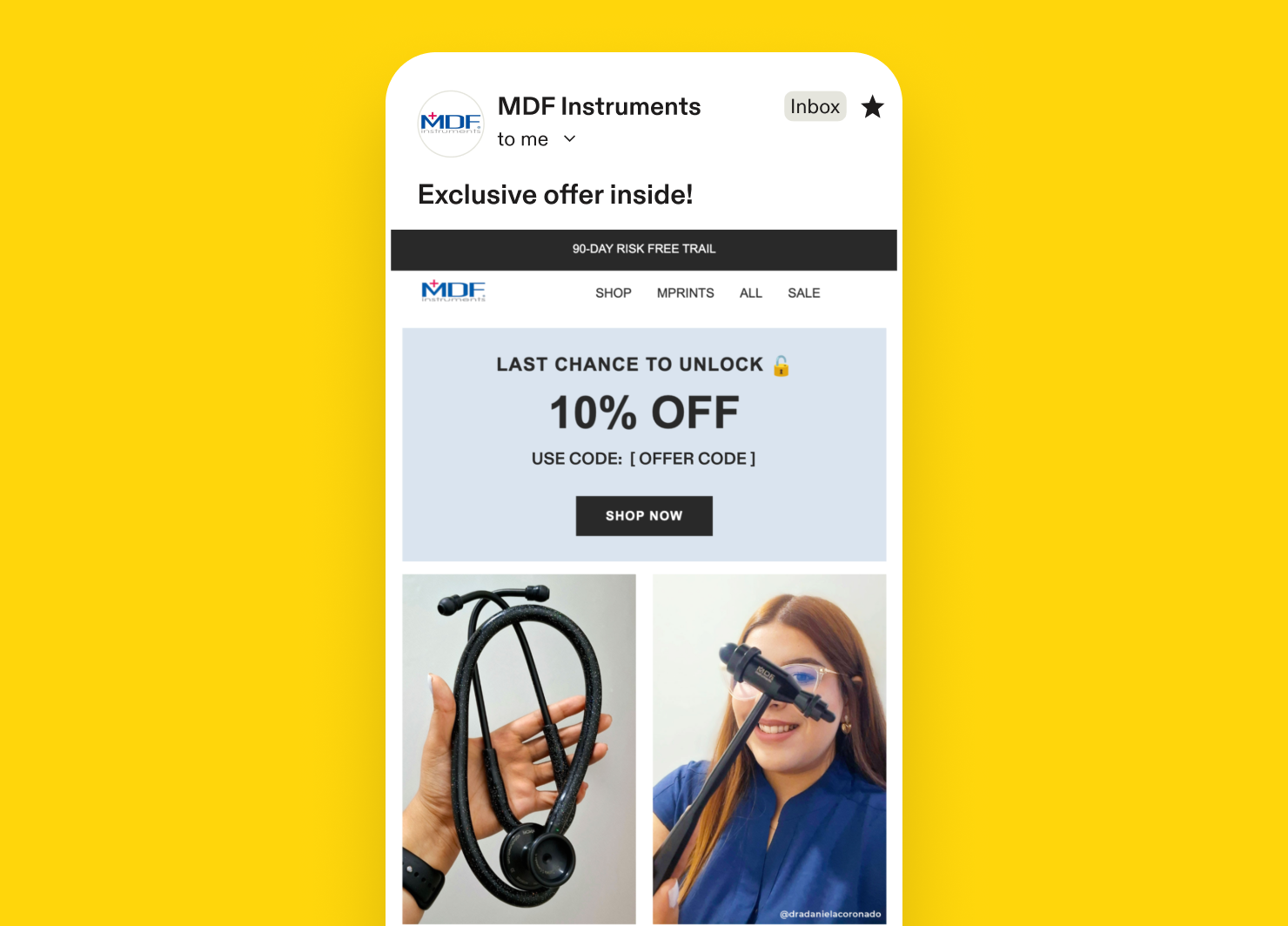
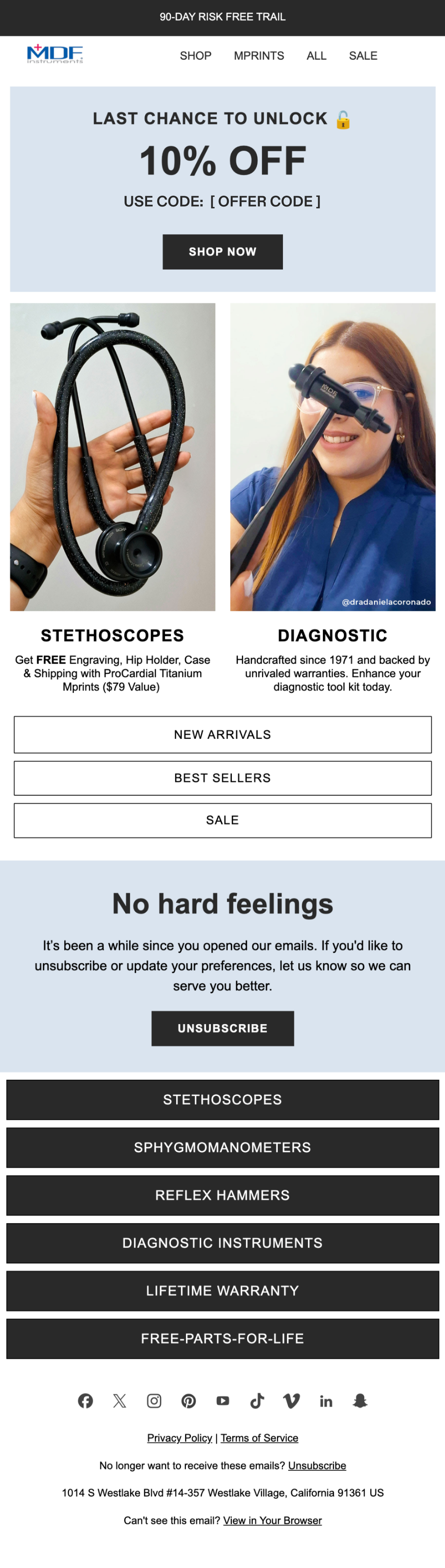
MDF Instruments gives inactive subscribers one last offer before saying goodbye:
[image-modal-trigger-25] [data-bg="#FFD60B"]
[image-modal-trigger-25]
[image-modal-source-25]
[image-modal-source-25]
Why it works:
- Extends a final incentive to win back subscribers who might still convert.
- Makes opting out easy with a prominent unsubscribe link, keeping the list healthy and protecting deliverability.
Use a platform that turns great emails into revenue
Well-designed emails give you the potential to earn revenue—but the platform powering your program determines how much of that potential you capture.
Attentive is built to drive revenue across email, SMS, RCS, and push, with the infrastructure to deliver on it:
- Zero downtime when it counts: Peak periods like BFCM are when the most revenue is on the line. Attentive has maintained zero outages during these high-traffic moments, so your campaigns send right when customers are ready to buy.
- Industry-leading identity resolution: Triggered messages drive the bulk of email revenue, but platforms that recognize subscribers by email address alone miss key signals. Attentive recognizes 20% more subscribers on-site—powering more triggered sends and a 95% lift in triggered email revenue.
- Reliable deliverability: Even the strongest email can't perform until it reaches the inbox. Attentive maintains 99.8%+ deliverability rates, backed by a dedicated team that helps protect your sender reputation.
Learn more about Attentive Email and request a demo to see how you can reach more inboxes—and drive better results.
FAQs
What types of emails get the most engagement?
Triggered (behavioral) emails consistently outperform one-off campaigns because they respond to what a subscriber is actually doing.
Welcome series, abandonment flows, and post-purchase messages tend to see the highest engagement and conversions. The common thread is relevance and timing—emails tied to a specific moment resonate more than batch sends.
Additionally, segmented campaigns tend to get more engagement than batch-and-blast sends. Segment by engagement, purchase history, browsing behavior, interests, and demographics so each message reaches the people most likely to act on it.
Segmenting by engagement is most important as 97% of email revenue comes from recipients who have engaged in the last 90 days.
How can I improve email open rates?
Strong open rates start with two things: reaching the inbox and earning the click. Protect your deliverability with good list hygiene and domain authentication, then send to engaged, well-segmented audiences rather than always to your full list.
From there, the subject line does the work—personalization like a product name or first name tends to lift triggered emails, while campaign subject lines do better short and to the point.
Testing your subject lines helps you learn what your specific audience responds to.
What is a triggered email?
A triggered email is an automated message sent in response to a specific subscriber action or event, rather than scheduled and sent to a whole list or segment at once.
A welcome email when someone signs up, a cart reminder when a shopper leaves items behind, and a replenishment nudge when they're likely running low are all triggered emails.
Because they're tied to behavior, they tend to be more relevant—and more effective—than one-off campaigns.
What’s the best day/time to send emails?
Triggered emails should fire based on the subscriber’s action rather than a fixed schedule. Test the timeframe that works best for each email in your flow.
For campaigns, we’ve found from analyzing 25 billion messages that if your goal is to convert, evening emails perform best. If you’re after a great click-through rate, 12pm–3pm is better.
And higher conversions and lower opt-out rates occur Friday through Monday.
AI-powered send-time optimization takes it further by delivering to each subscriber when they’re most likely to engage rather than a universal send time. Attentive’s Send Time AI boosts email conversions by 17% on average.