
You can increase conversion rates by up to 19%—just by changing your SMS copy. New data uncovers which messages drive the strongest performance.
The right SMS message copy can boost conversion rates by up to 19%, while some elements can reduce CVR by as much as 24%. Until now, no one had the data to prove which specific elements of text messages drive performance—and which ones can hold it back.
We changed that.
In our analysis of over 25 billion SMS campaign messages sent through the Attentive platform, we identified over 100 different content components marketers use when crafting their campaigns. Think: scarcity language, product mentions, tone, and offer formats.
Then, we isolated the true impact of each element, controlling for factors like seasonality, company baseline performance, message timing, and vertical.
The result? The first-ever comprehensive analysis of what SMS content works today.
It's based on the results of real messages that brands sent to customers—giving you actionable insights you can apply to your program right away.
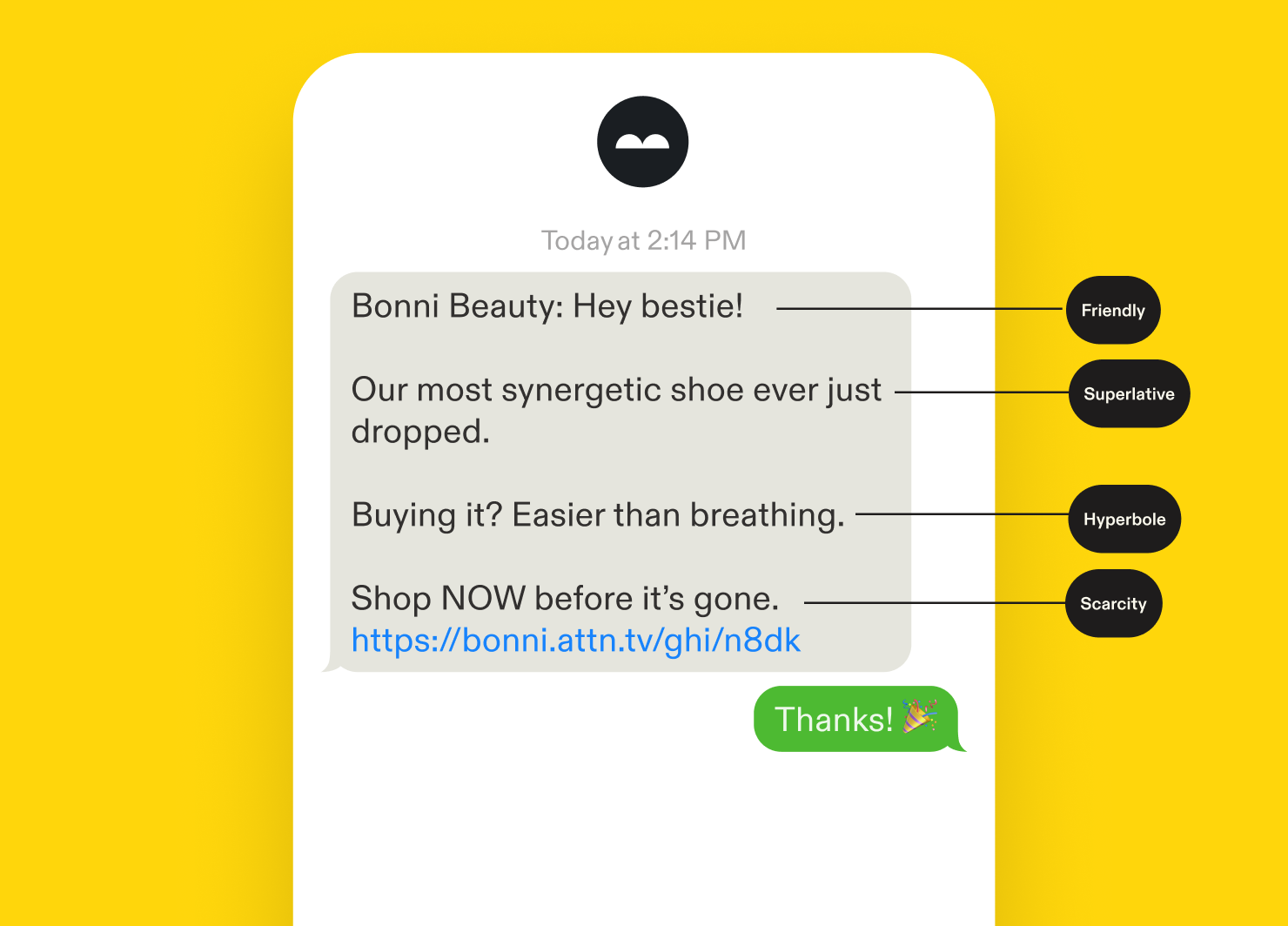
SMS copy directly impacts revenue
A single phrase or tone shift in your SMS copy can have a measurable impact on campaign performance.
Our analysis found that:
- Top-performing content elements can boost conversion rates by up to 19% and click-through rates by up to 10%.
- Lower-performing elements can reduce conversion rates by as much as 24% and click-through rates by 10%.
- The same content element can perform differently depending on whether your message includes an offer and what other elements it's paired with.
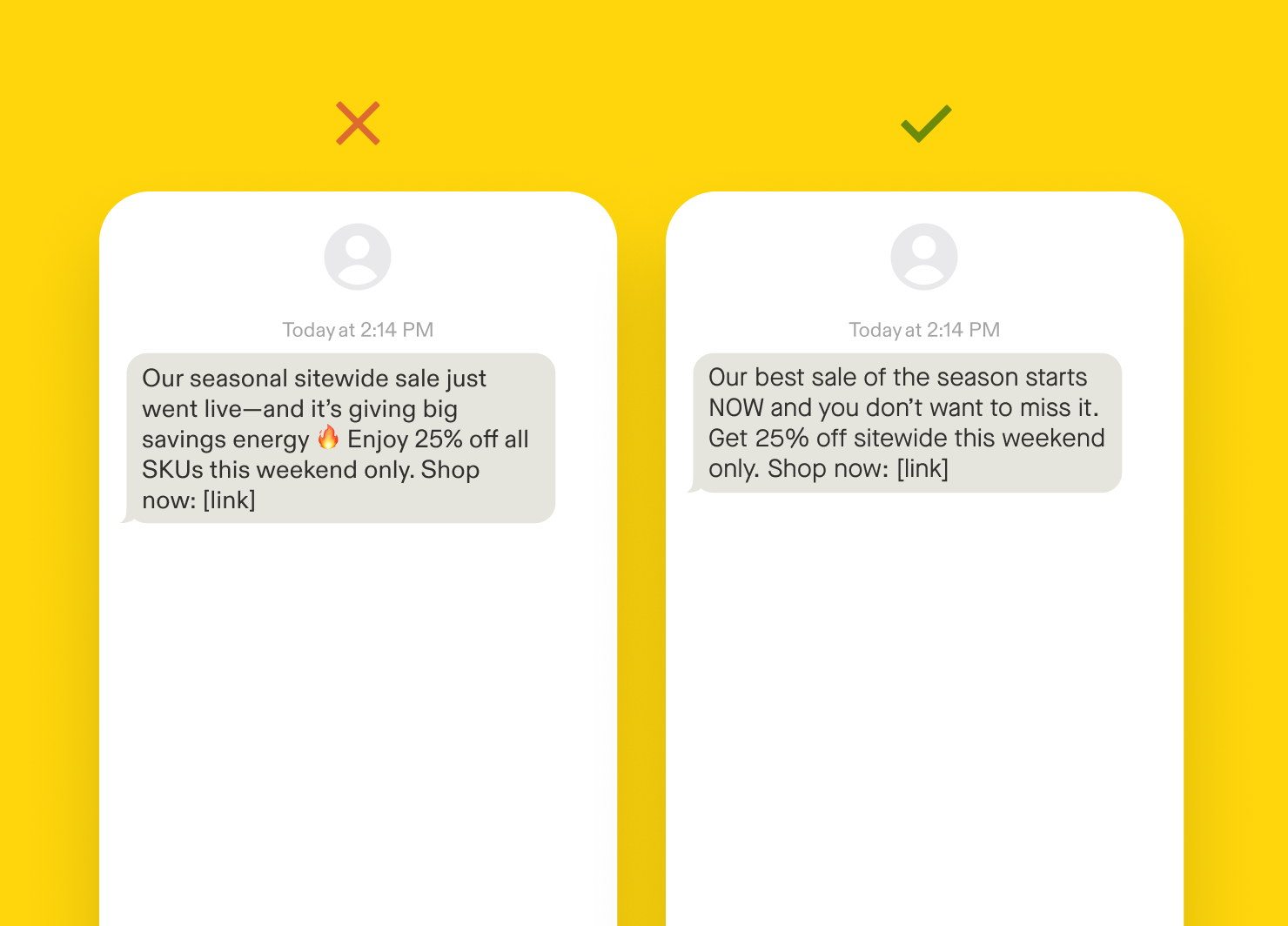
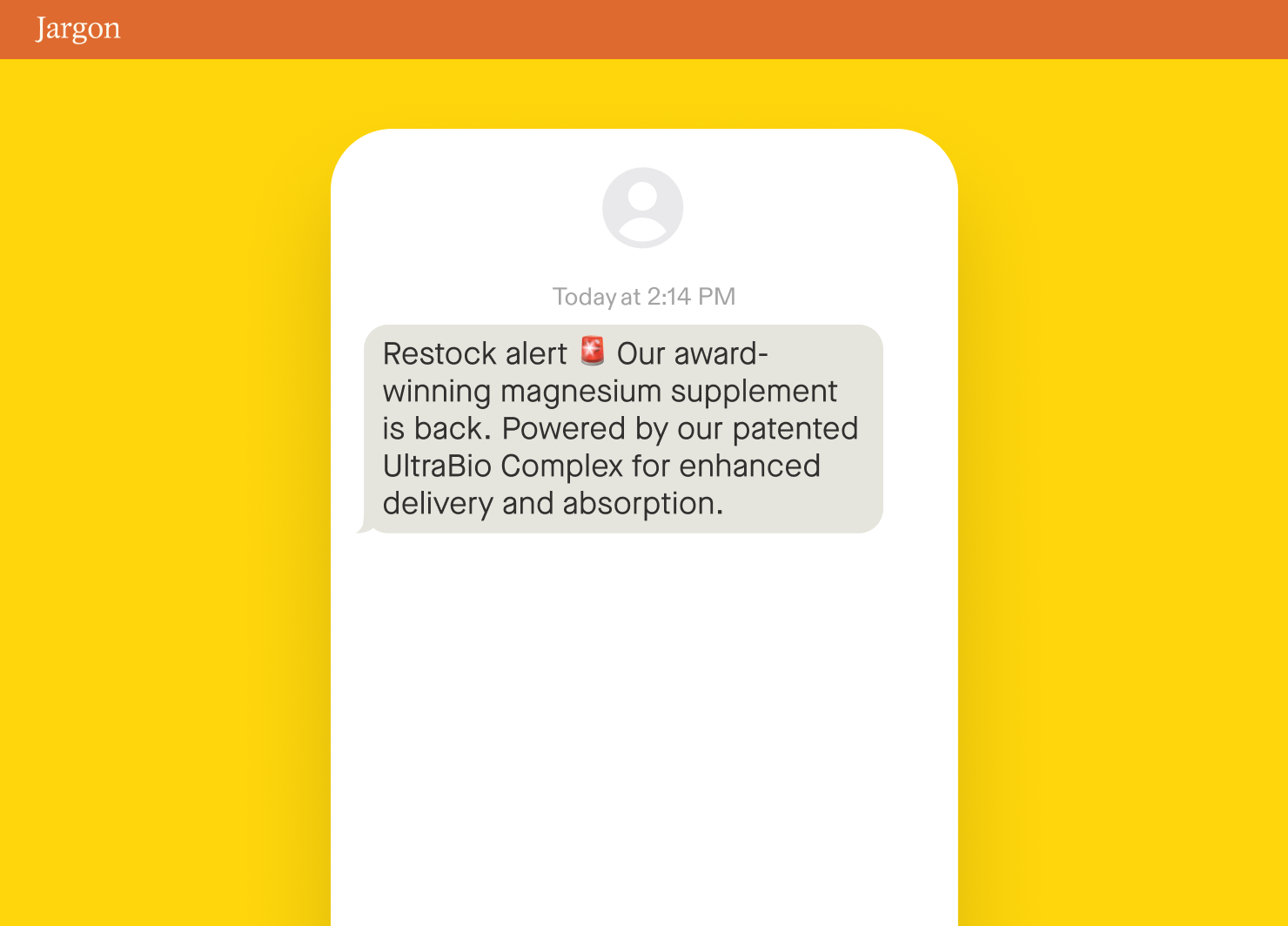
In this example, a weaker SMS message uses a humorous tone and jargon to promote an offer—making the campaign harder for subscribers to connect to.
The improved version uses superlative to emphasize the sale’s value, second-person language to make the offer feel personal, and scarcity to encourage action.
How to improve SMS campaign performance with these insights
These findings offer a clear starting point for improving SMS performance, but every brand and audience is different. Use the data to prioritize smarter tests and learn what works best for your audience.
1. Start with the highest-impact elements.
Focus first on the elements that show the strongest lift for the type of message you’re sending (whether that campaign includes an offer or not).
2. Consider context.
We've separated our findings by offer and non-offer messages because performance can vary significantly by campaign type. So as you test, pay attention to context, including audience and message goal.
3. Run multiple tests.
Content elements rarely exist in isolation. Run multiple varied tests to truly understand what works for your brand and audience.
9 best-performing SMS elements in offer campaigns
The most effective content elements for messages that include an offer often differ from those that don’t.
When your SMS campaigns include discounts, sales, or other promotional offers, subscribers are primed for a deal and ready to act—if your message hits the right notes.
In our analysis, top-performing elements in offer campaigns boosted conversion rates by up to 12% and click-through rates by 10%. But low-performing elements reduced conversion rates by as much as 11% and click-through rates by 5%.
Context matters, too. A feature that performs well on its own might not perform the same way when paired with another element—or it may create an even bigger lift when combined strategically.
Best-performing SMS elements in offer campaigns:
1. Scarcity and urgency: +12% CVR; +4% CTR
Scarcity and urgency language gives subscribers a reason to act now by highlighting limited availability or time constraints. This can include phrases that suggest products are running low, selling quickly, or available for a limited time—making subscribers feel they’ll miss out if they don’t act now.
The best use of scarcity creates genuine urgency through believable time or quantity constraints.
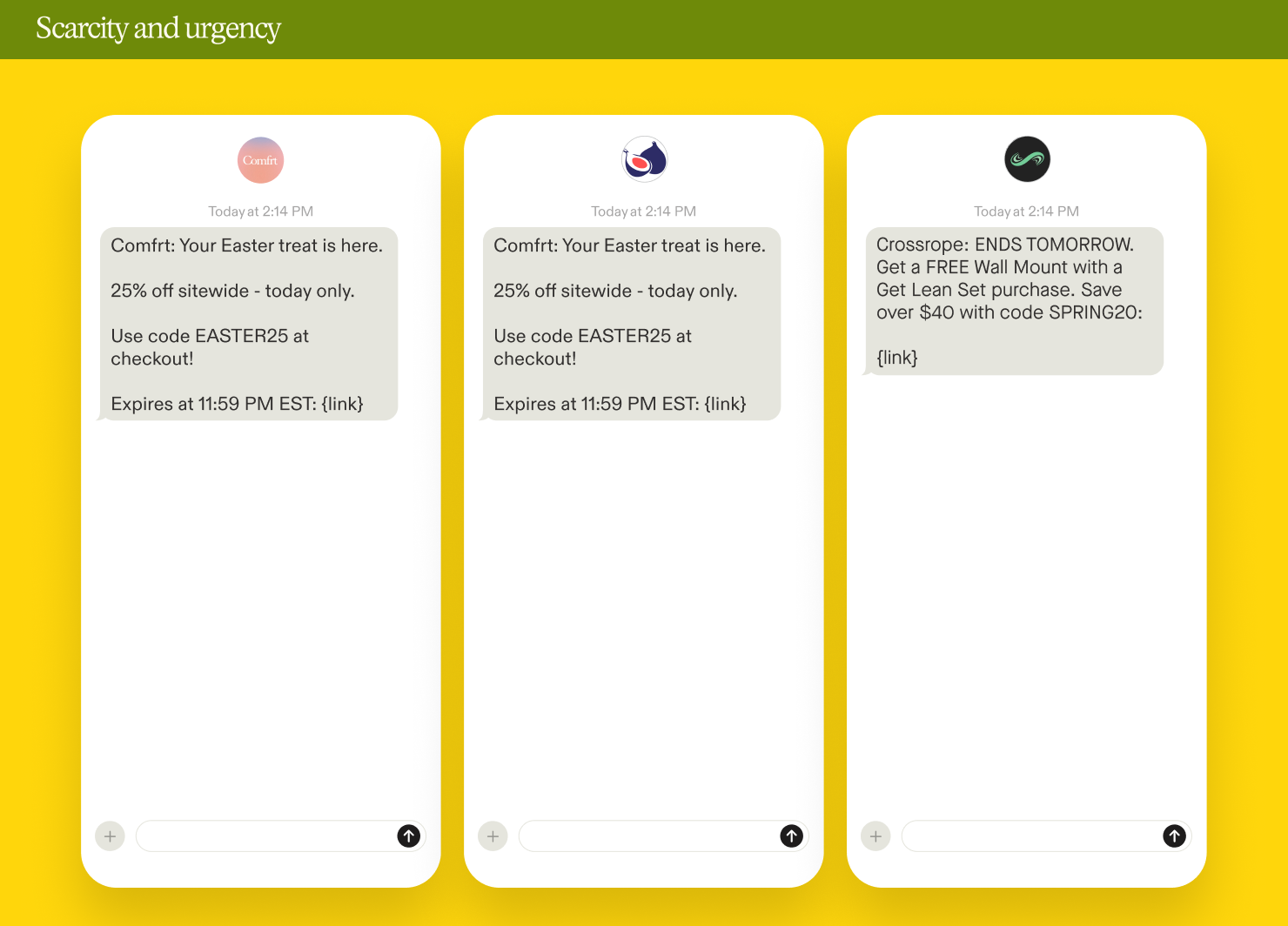
Other elements magnify the impact of scarcity language, creating a compound effect. Compared to all non-scarcity messages, these are the top-performing elements to combine with scarcity:
Scarcity isn’t universally effective. When paired with humor, this combo actually negates the impact of scarcity. Compared to non-scarcity messages, scarcity messages with a humorous tone improve conversions by a mere 0.6% and harm clicks by -0.3%.
The playful tone undermines the urgency you’re trying to create by making your scarcity claims feel less serious.
2. Percentage offer format: +10% CVR; + 0% CTR
Using percentage offer formatting for deals—like “X% off—consistently outperforms dollar amounts like “$X off” when it comes to conversions.
Percentages require less mental math. When someone sees “$20 off,” they need to figure out what they’re buying to understand the actual value. “20% off” immediately communicates value that shoppers can process quickly in the moment they’re deciding whether to buy.
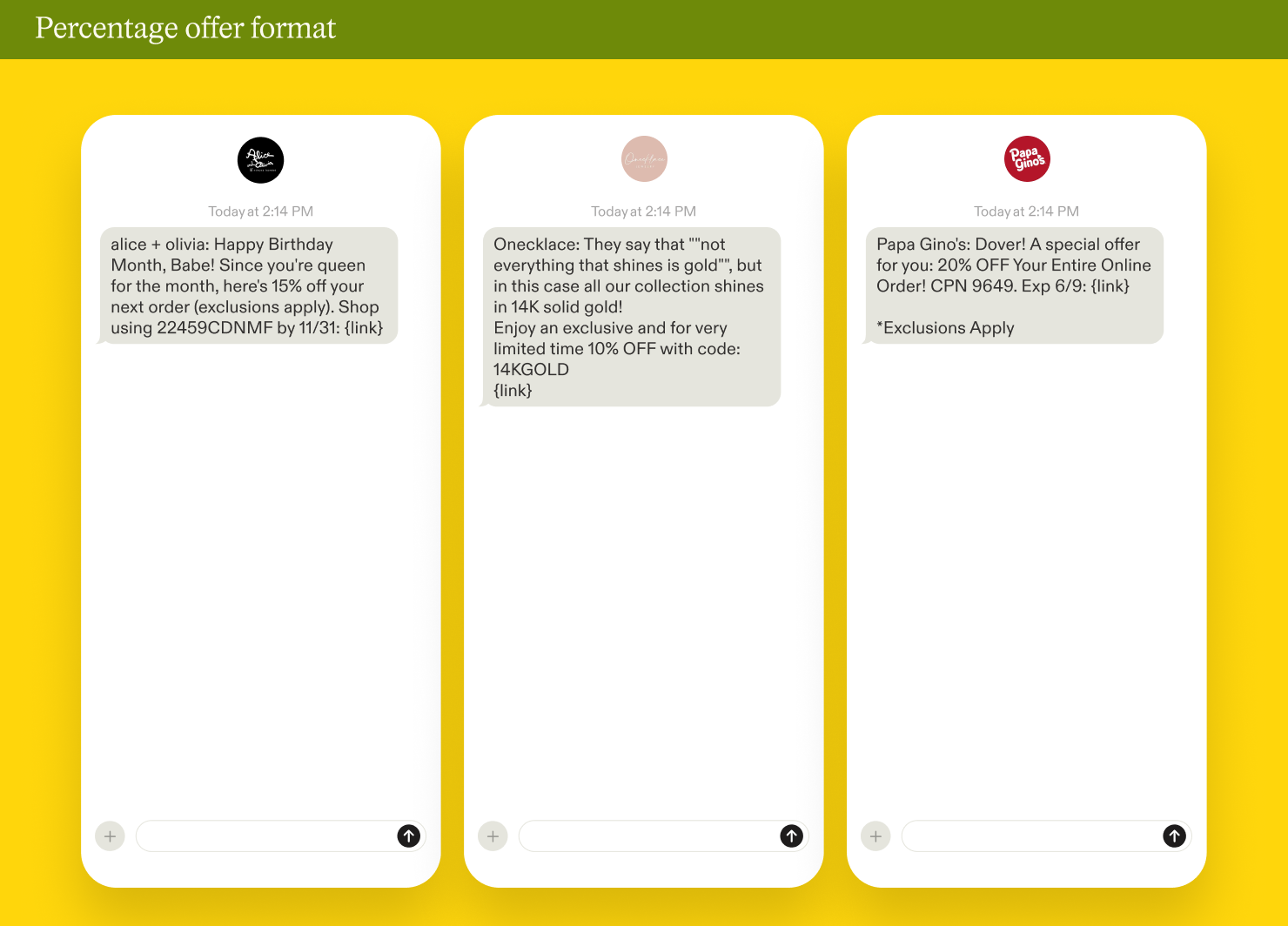
Even if your dollar savings are substantial, consider testing leading with the percentage and including the dollar amount as a supporting detail: “20% off mattresses (save up to $200)”.
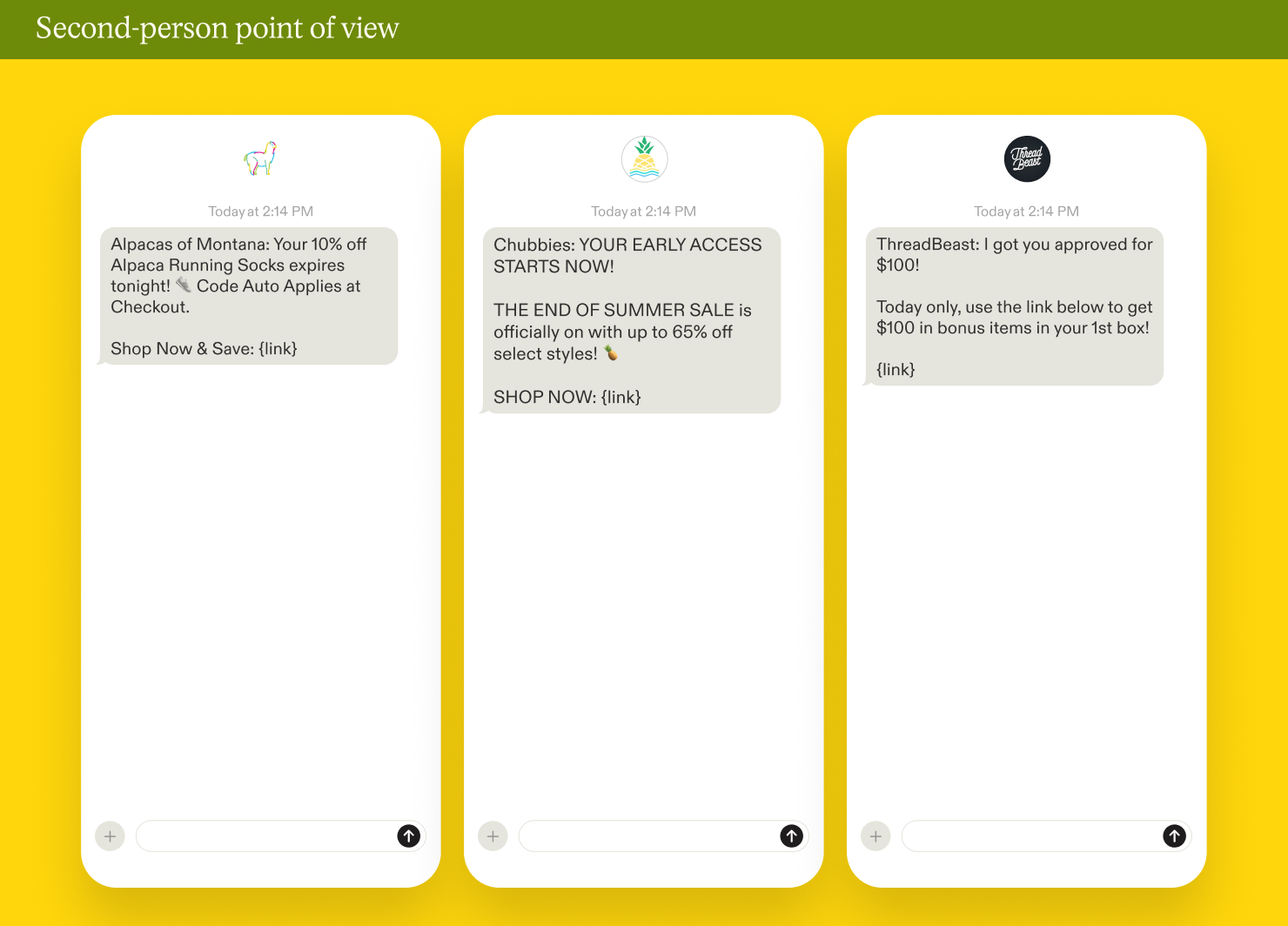
3. Second-person point of view: +9% CVR; +5% CTR
Speaking directly to subscribers with “you,” “your,” and “yourself” in offer messages consistently outperforms generic messaging by making offers feel personally relevant rather than broadcast to everyone—even if they are.
It shifts focus to the subscriber, making the same offer feel tailored rather than mass-distributed.
4. Newness: +5% CVR; +2% CTR
Describing something as “new” increases engagement and conversions by tapping into subscribers’ desire for fresh experiences and the excitement around being among the first to access something.
But it doesn’t always have to be a new product. It could be a new bundle, offer, benefit, or loyalty perk.
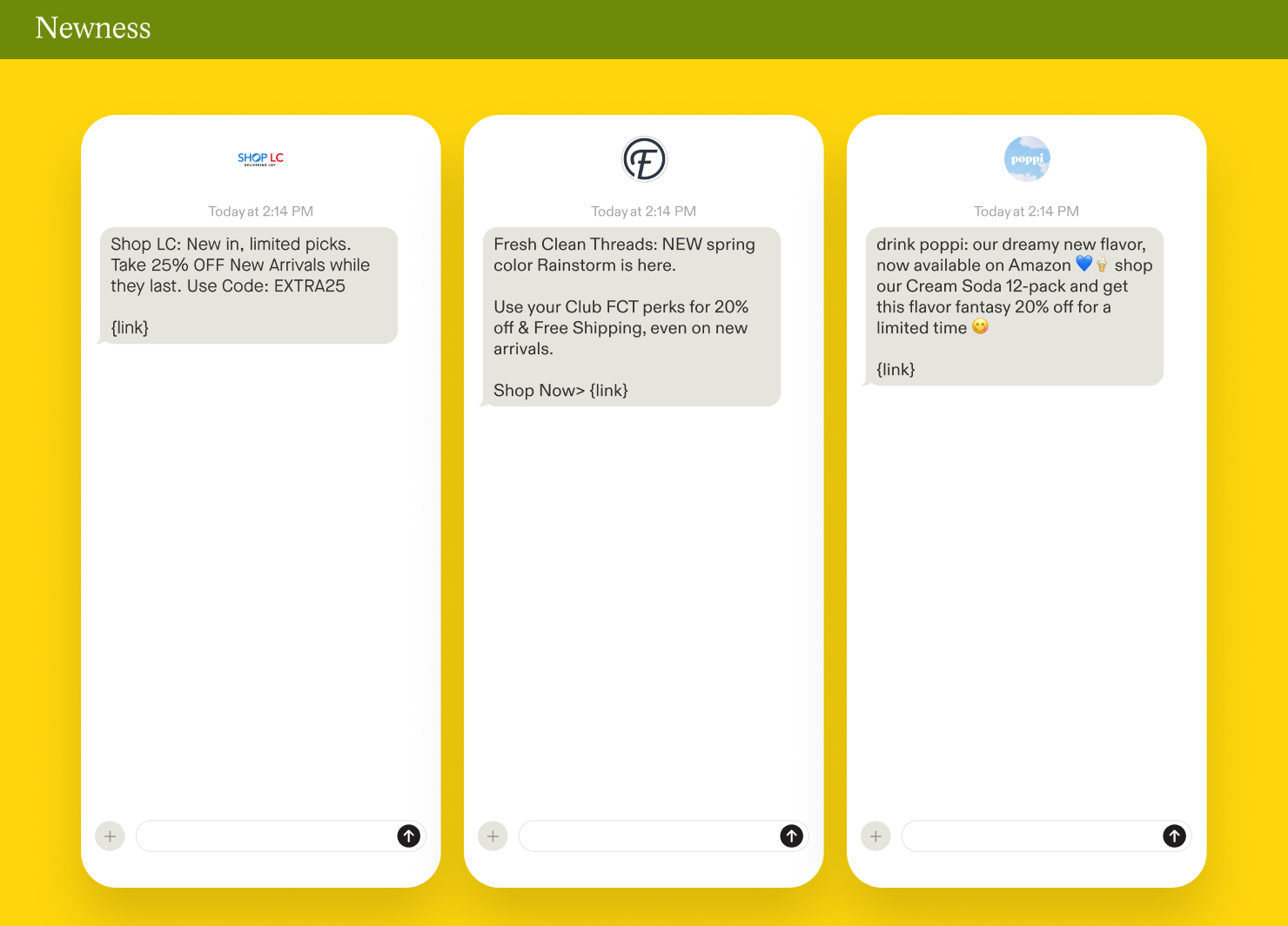
Look for opportunities to frame familiar offers or products through the newness lens—new pricing, new curated collections, new variants.
5. Ease: +5% CVR; +0% CTR
Describing how quick and easy it is to buy or use your product removes friction from the purchasing decision. “Easy” language reassures subscribers that acting on your offer won’t be complicated, time-consuming, or require significant effort.
Subscribers make a split-second decision about whether to engage with your texts. Language that focuses on removing specific friction points—like "easy returns" or "simple set-up"—removes mental barriers before they become deal-breakers.
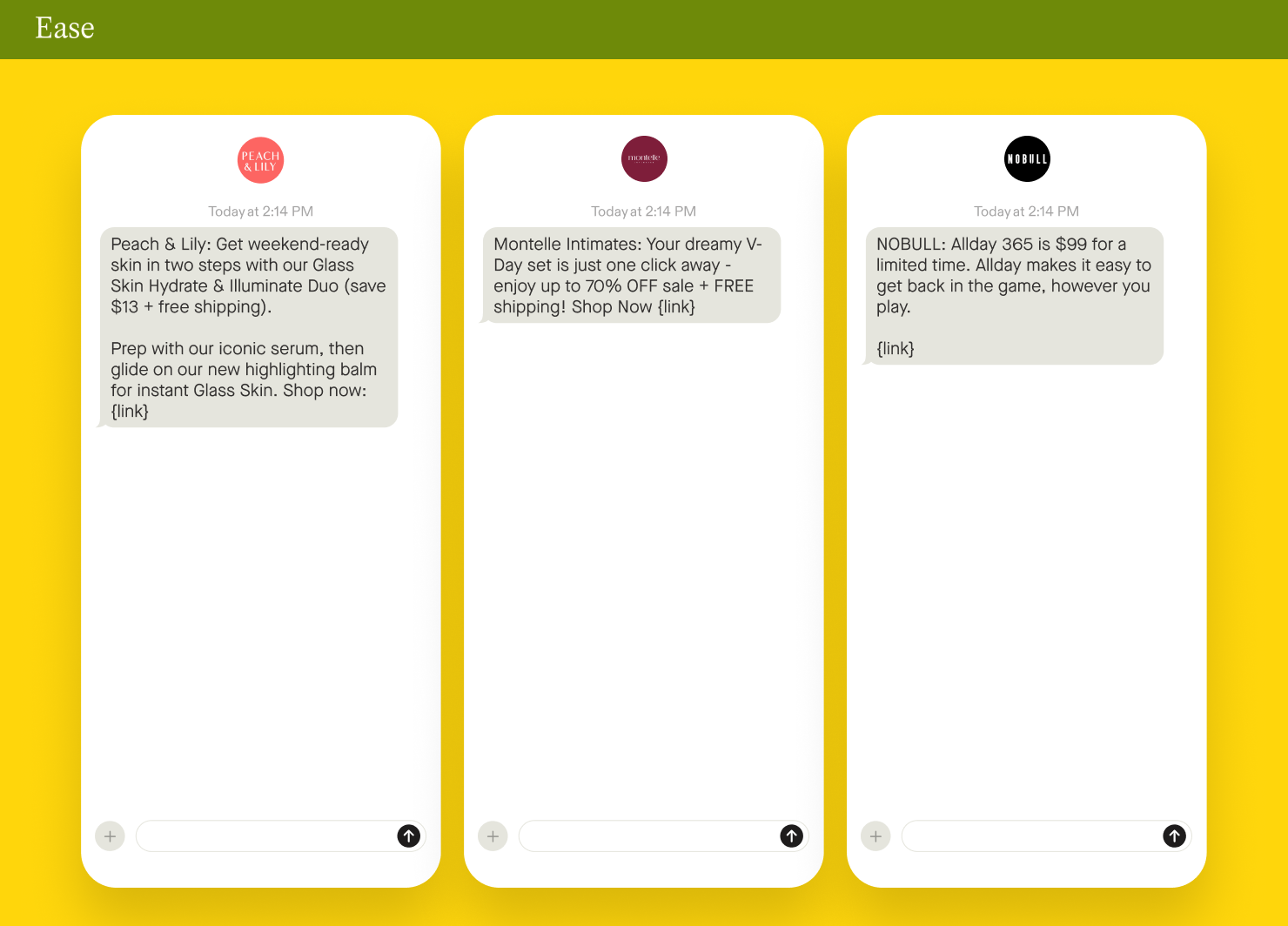
“Easy” language gets a significant boost when paired with other message components:
While “ease” paired with a conversational tone slightly decreases click-through rates, it still boosts conversions. This suggests the combination works better for subscribers who are already engaged—like in follow up messages—rather than for generating initial interest in an offer.
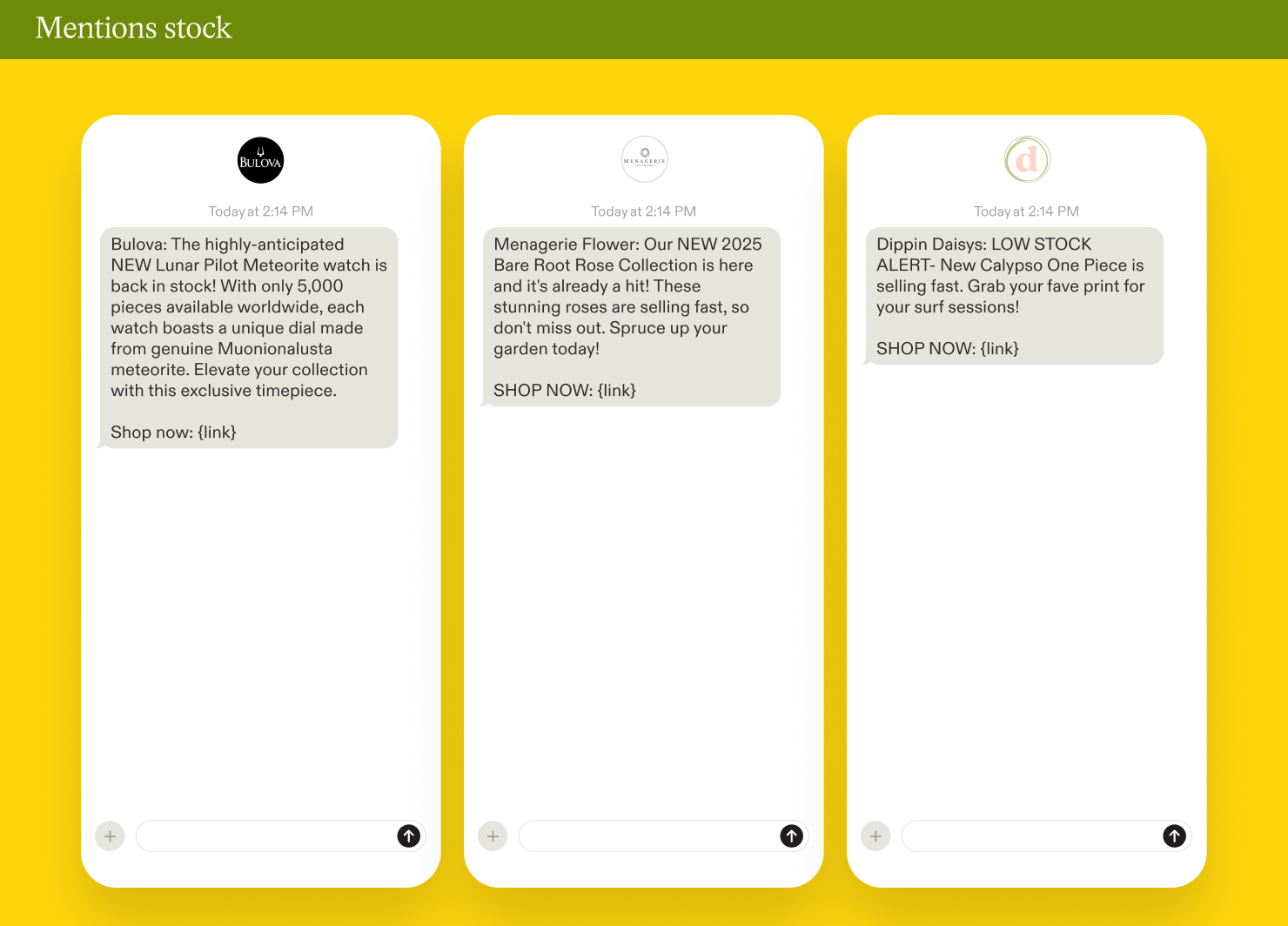
6. Mentions Stock: +4% CVR; +7% CTR
Stock messaging is a specific subset of scarcity and urgency worth calling out. Mentioning that a product is low in stock, has been in high demand in the past, or could be sold out soon creates genuine scarcity that encourages shoppers to act now.
If possible, tie your stock messages to actual inventory levels, like “only 5 left in your size,” rather than using generic promotional language, like “selling out fast.” It makes the scarcity real and gives subscribers quantifiable information they can use to make a decision.
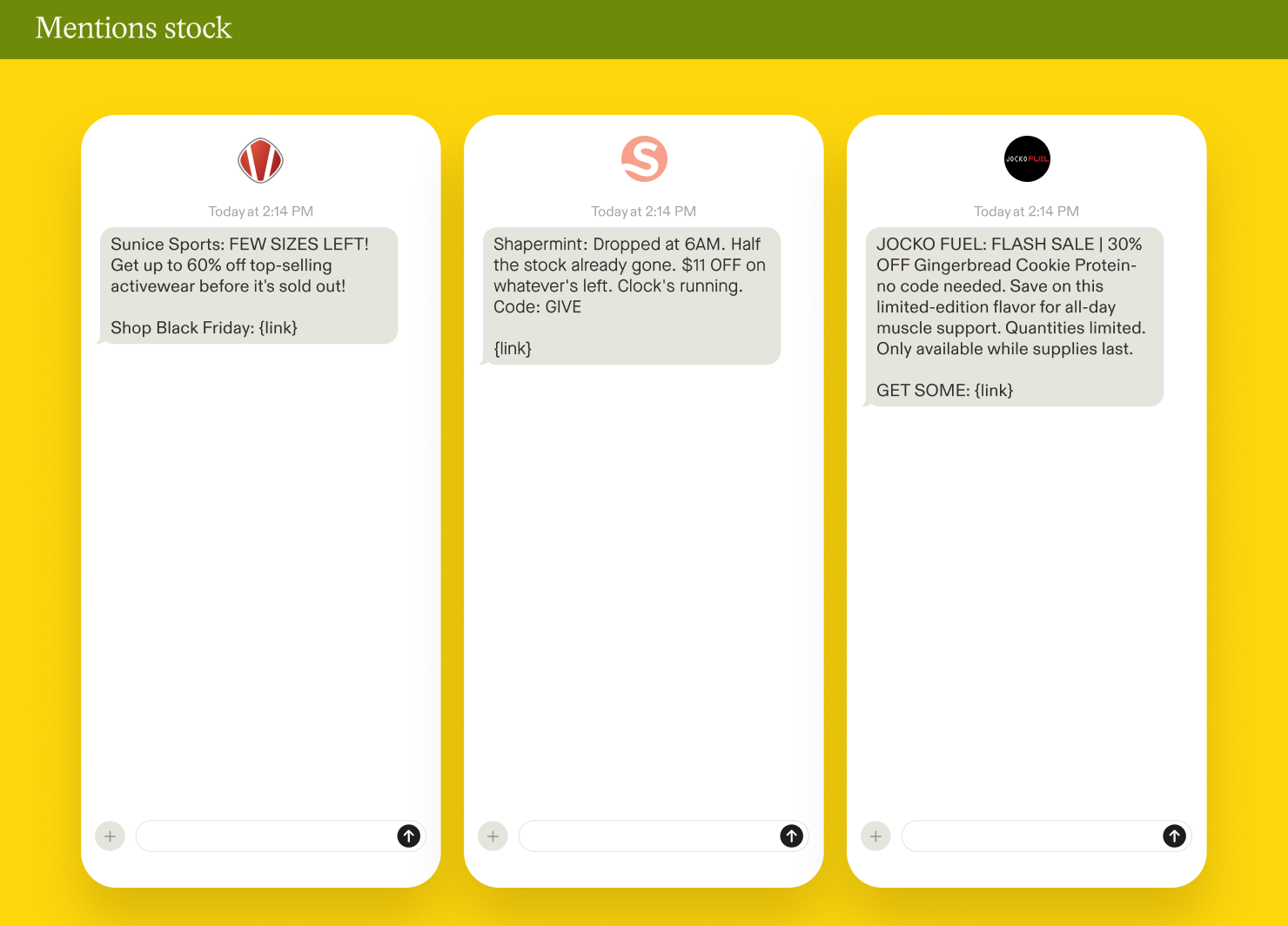
You can also add campaign follow-ups to initial messages to focus stock messaging on users who have clicked but not converted for a targeted approach.
7. Superlatives: +4% CVR; +0% CTR
In campaigns with offers, superlatives are often used successfully to describe the sale or offer. Describing your deal with words like “the best deal of the year” or “the lowest price it’s ever been” boosts conversions by providing justification for acting now.
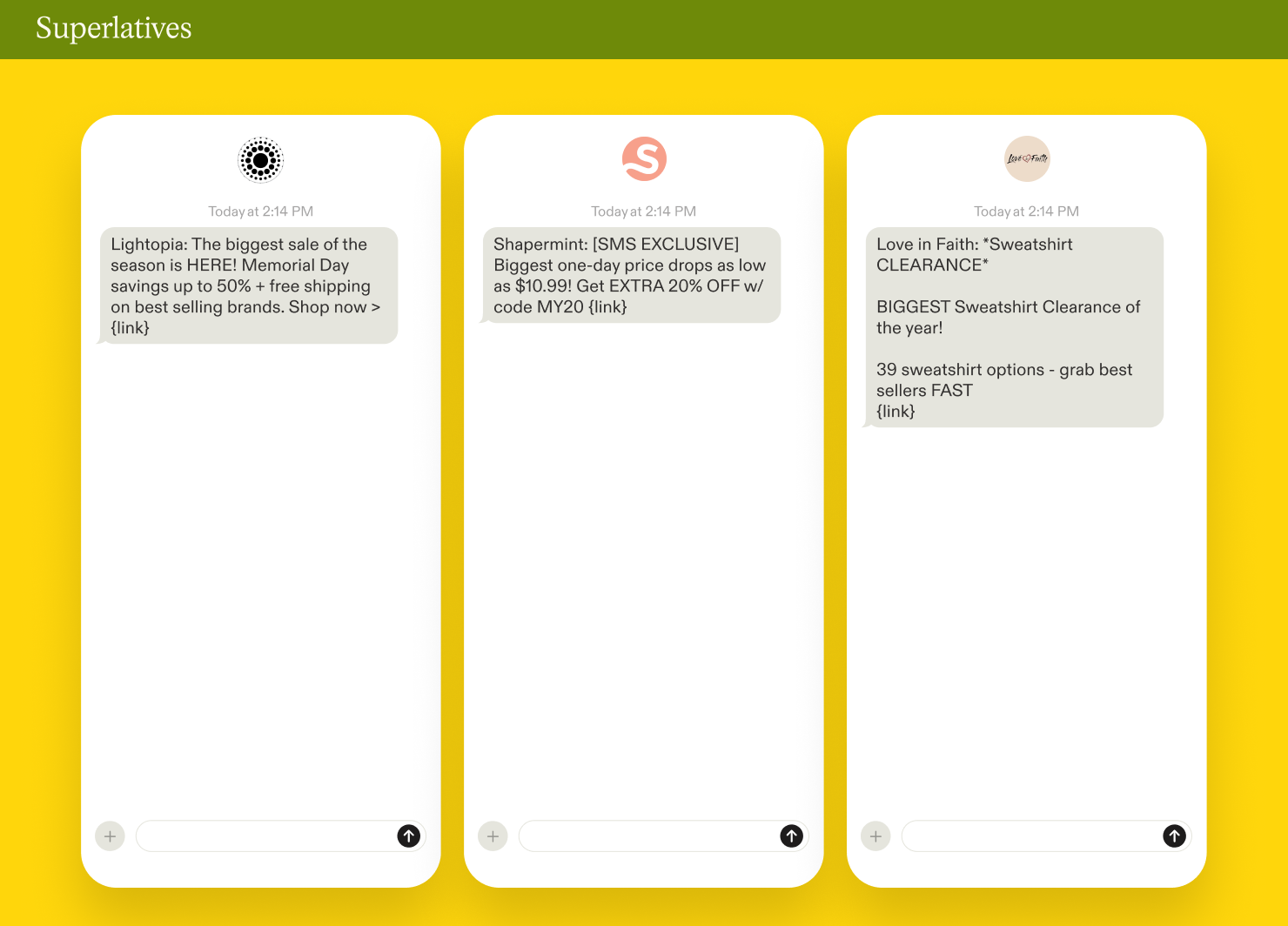
Because superlatives don’t increase click-through rates, this suggests their core benefit is in closing deals rather than creating interest. So support these messages with other engaging elements to encourage more clicks.
8. New product mention: +3% CVR; +6% CTR
New product announcements give subscribers a specific reason to engage right now by tapping into their curiosity about what’s fresh.
You don’t need to limit “new product” messaging to major releases. New colors, styles, or flavors of existing products tap into the same psychology even when the core product isn’t entirely fresh.
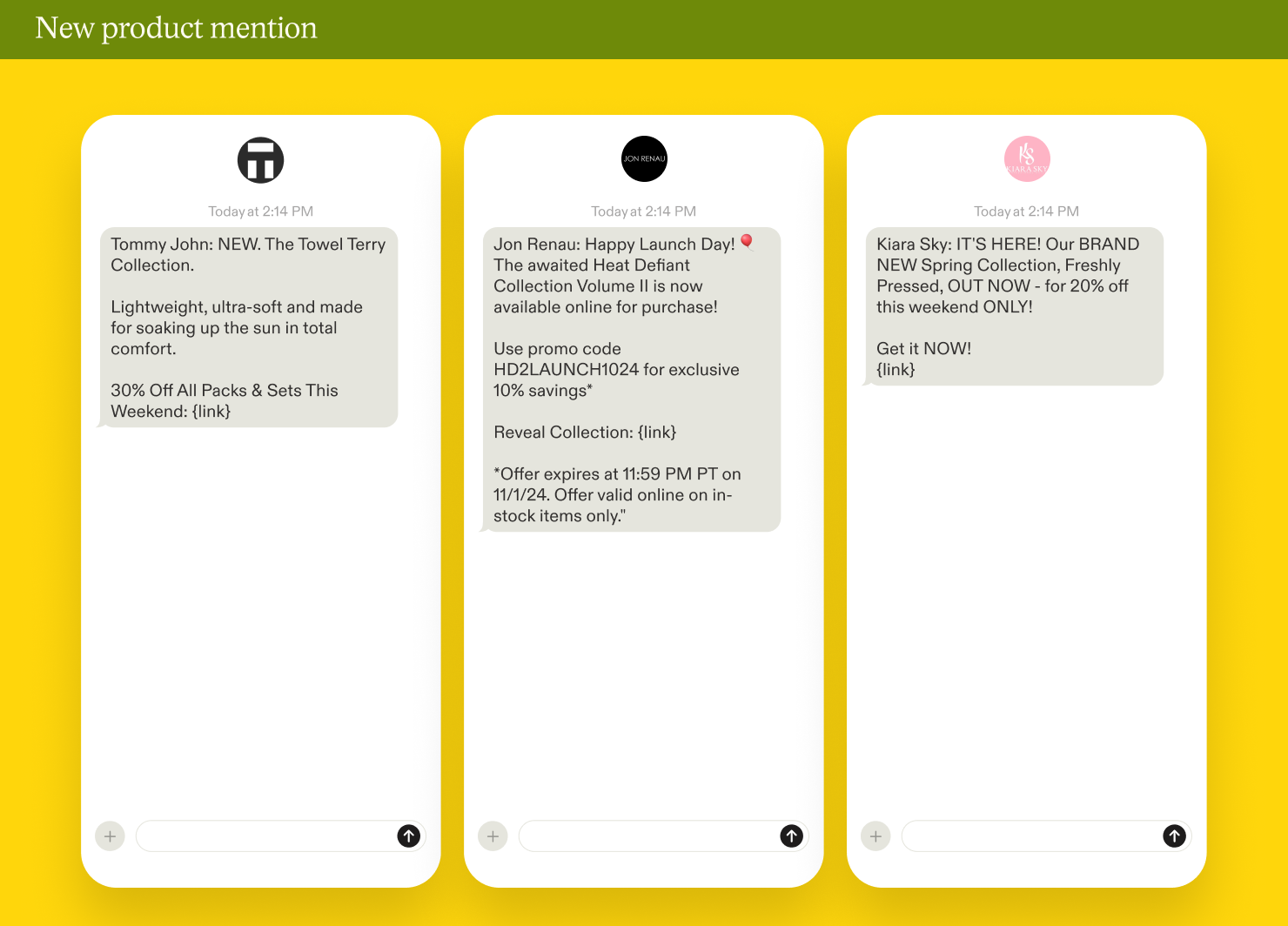
New product messages are great for generating initial buzz. Follow up with conversion-focused messages in follow-up campaigns.
9. Negative-oriented language: +3% CVR; +10% CTR
Using language that focuses on potential loss, urgency, or consequences of inaction drives engagement by tapping into subscribers’ pain points or fear of missing out.
Negative-oriented language works because it emphasizes what subscribers stand to lose or the problems they’ll face if they don’t act. Whether it’s missing out on a deal or continuing to experience the difficulties your product solves.
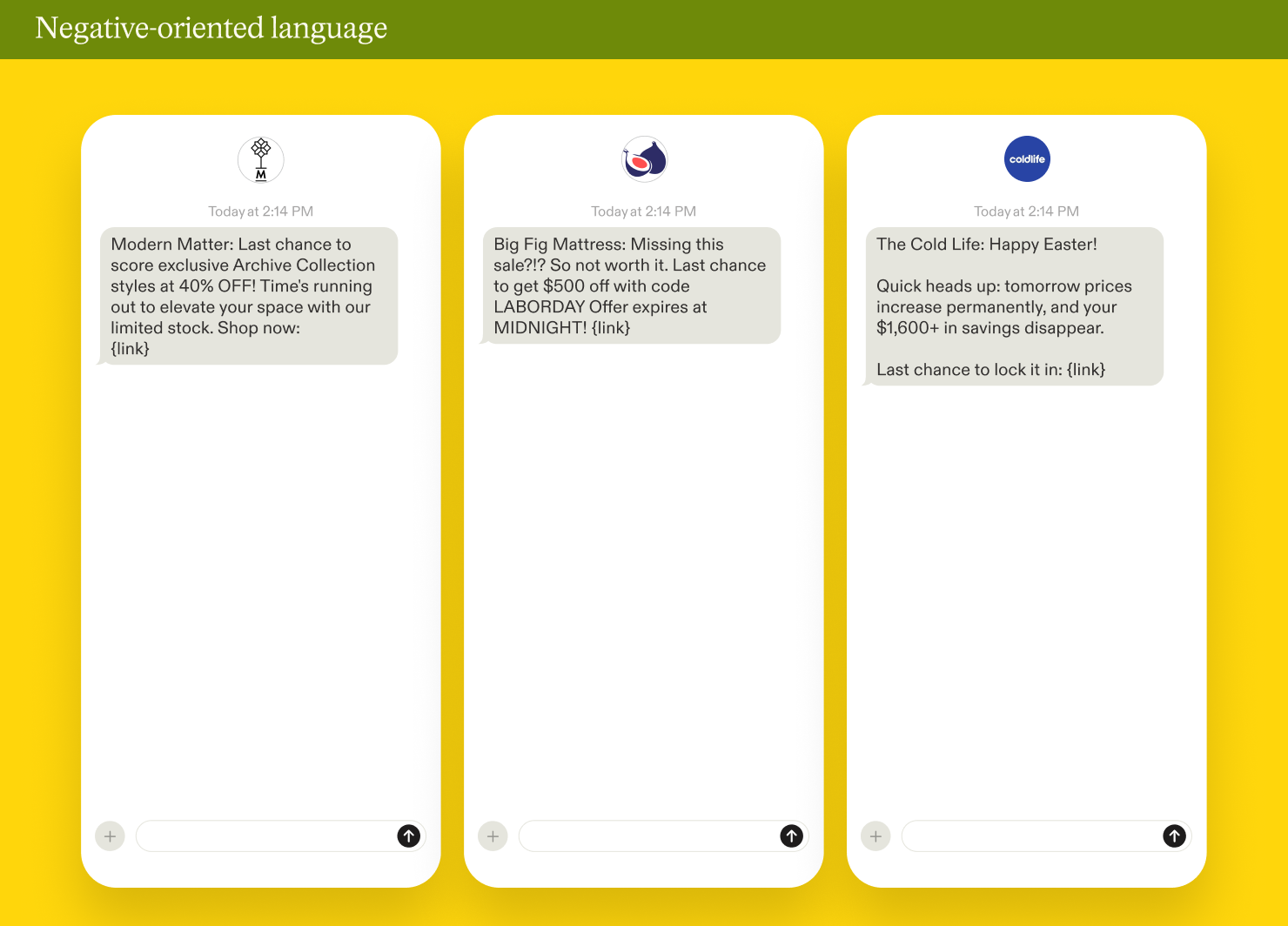
FOMO language is particularly powerful for driving engagement.
Caution: 4 SMS elements that underperform in offer campaigns
In our analysis, we found that certain elements reduce conversion rates in offer campaigns by as much as 11% and click-through rates by 5%. These patterns can help marketers spot which elements are more likely to weaken performance—and where clearer, more effective messaging may lead to better results.
1. Humorous tone: -11.4% CVR; -5% CTR
Using humor, wit, or a playful tone in offer messages—including puns, jokes, pop culture references, or light sarcasm—consistently hurts clicks and conversions.
Depending on the message, humorous messaging can backfire when promoting a discount or sale because it can feel dismissive of the subscriber’s decision-making process. When subscribers are evaluating whether to spend money, humor can come across as flippant or disrespectful—like you’re not taking their financial choice seriously.
A humorous tone can also muddy the message if it’s amusing at the expense of clarity.
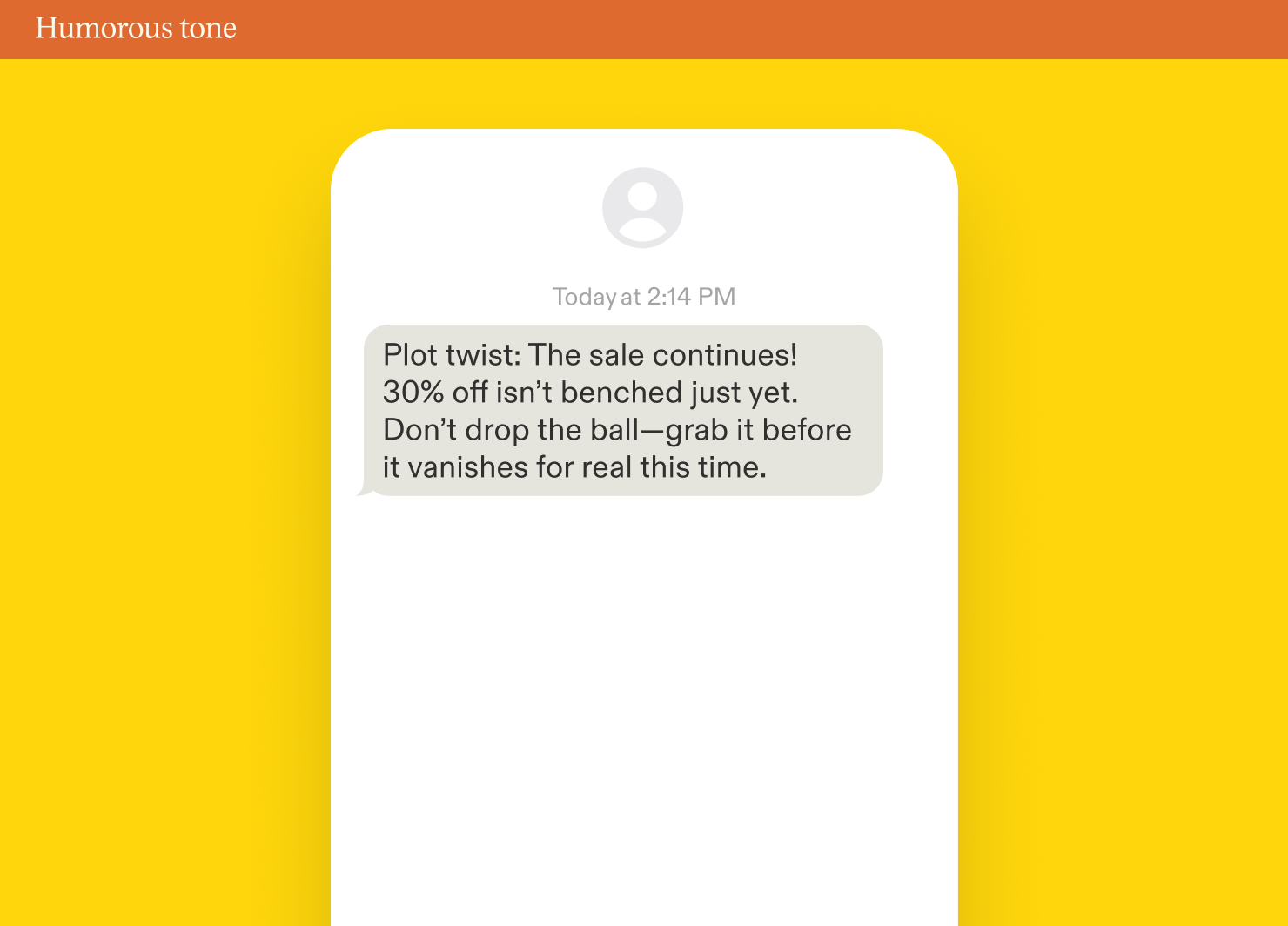
While humor might work in relationship-building messages, it clashes with the purchase decision moment when they’re looking for reasons to trust you with their money.
2. Jargon: -9.8% CVR; -4% CTR
Using industry-specific terms, technical language, or insider phrases in offer messages hurts performance because it forces subscribers to translate your message to figure out what you’re selling before they can evaluate your offer.
Ultimately, subscribers are making quick decisions about whether to engage, so if they can’t immediately understand what you’re offering, they’re likely to move on.
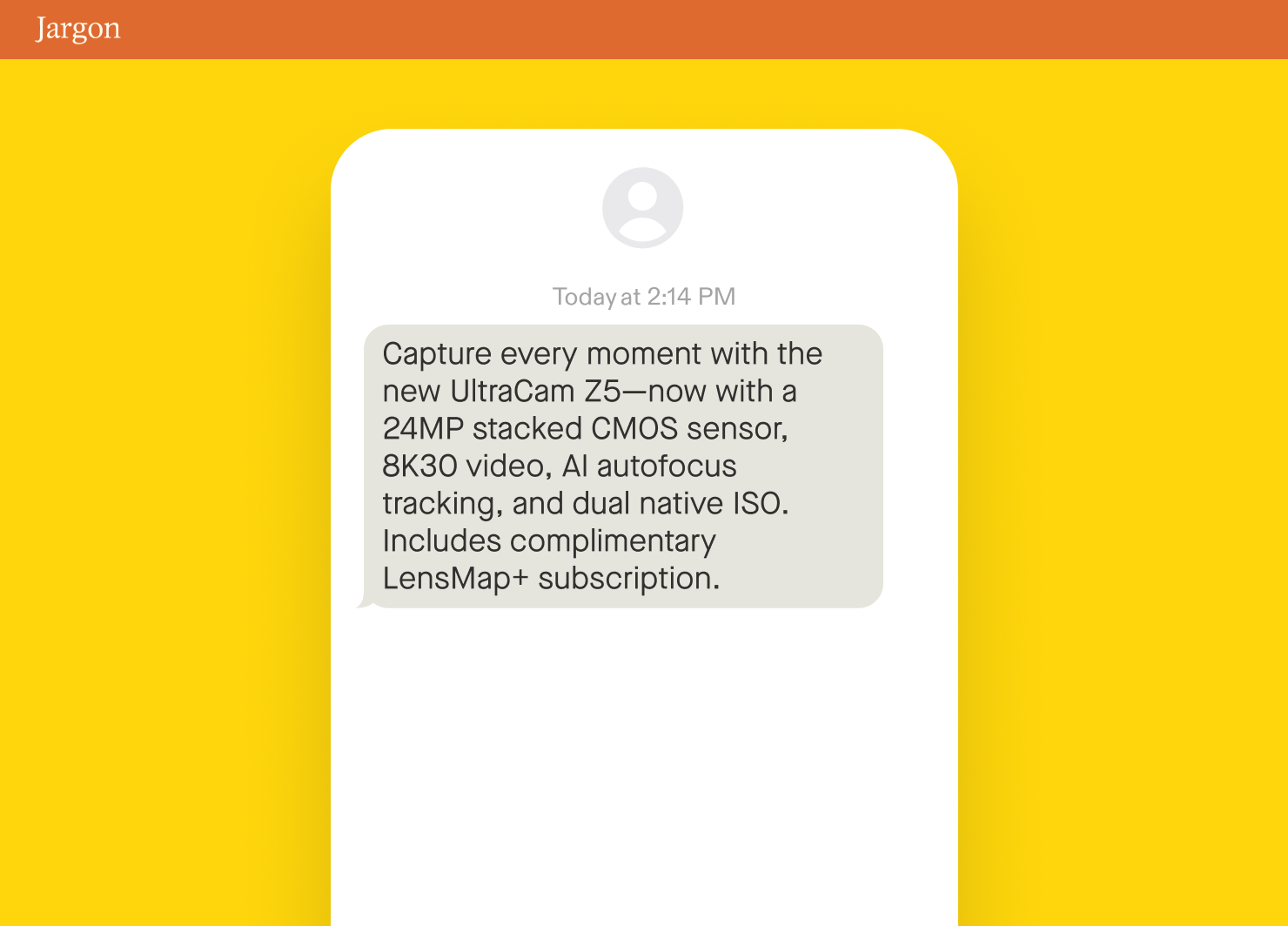
What counts as jargon varies by audience. While "moisture-wicking technology" could confuse casual shoppers, it might resonate with serious athletes. Test your language with actual customers to find the right balance.
The key is using the same language your audience uses, not the language your industry uses to talk about them.
3. Generalization: -8.2% CVR; -3% CTR
Using vague, sweeping statements in offer messages leads to watered-down messaging, giving subscribers nothing to latch onto.
These are usually empty words that don’t help subscribers understand the value of your product or offer better.
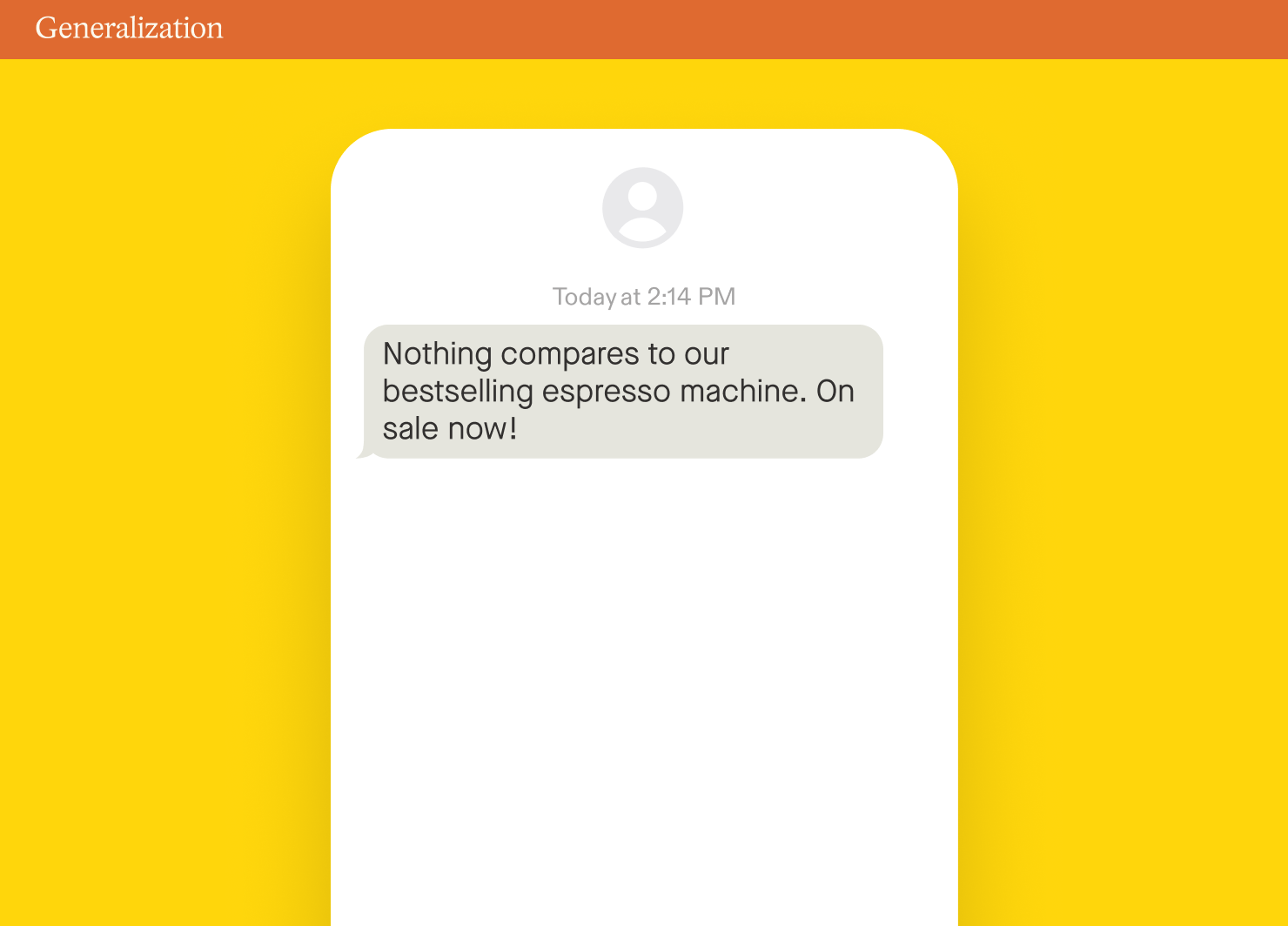
Replace generalizations with concrete details that encourage shoppers to take advantage of your offer.
4. Question + social proof: -6.4% CVR; -4% CTR
The data was not conclusive with regards to including questions or social proof on their own. However, combining these elements consistently weakens performance—likely by creating messages that are too long and unfocused.
Subscribers have to process a question, evaluate a social proof claim, and decide whether to act on your offer all at once.
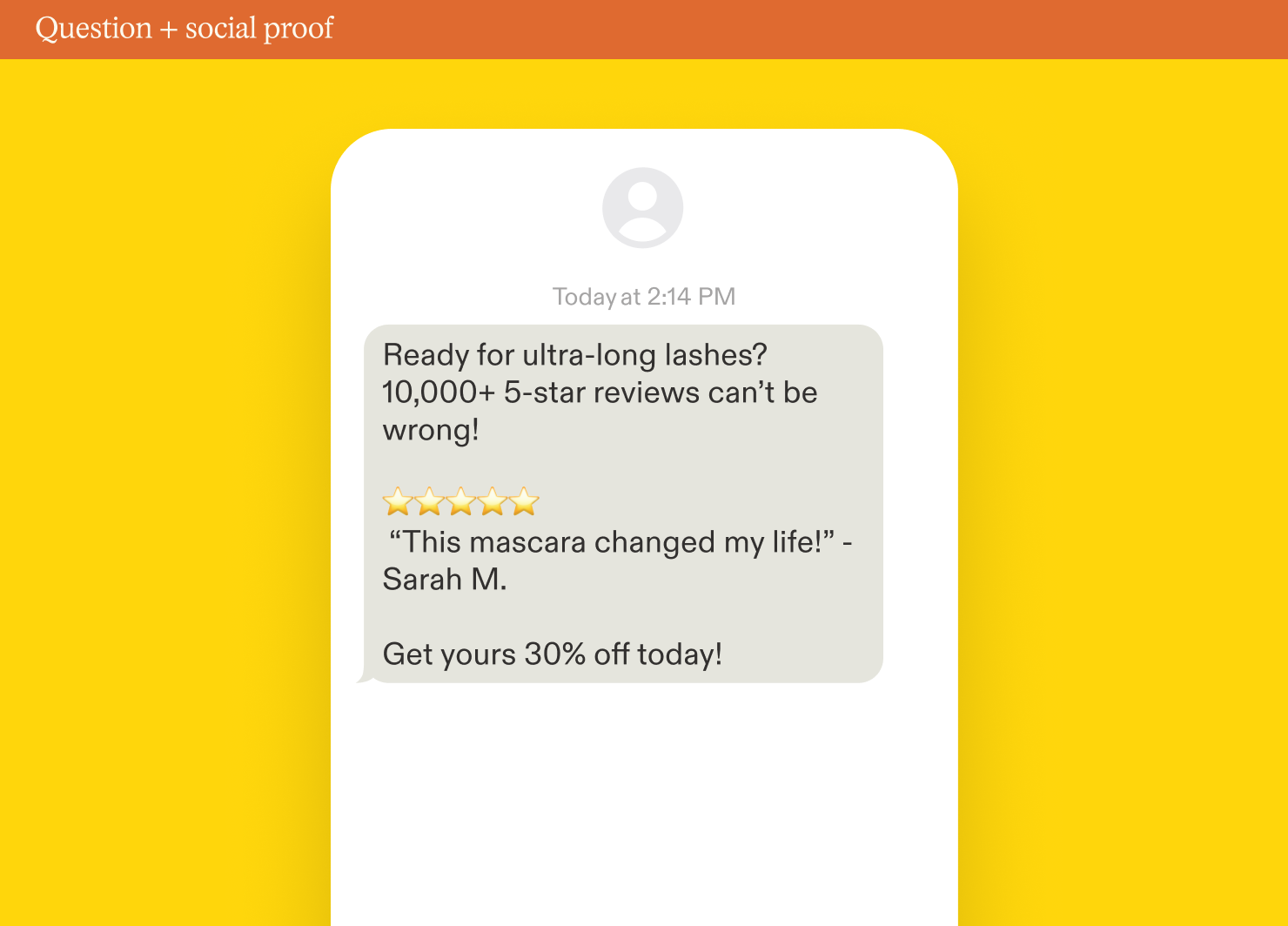
Our data found that messages of more than 240 characters have an 8.5% lower conversion rate than those between 160 and 240 characters. But we recommend keeping SMS copy between 75–115 characters when you can.
6 best-performing SMS elements in non-offer campaigns
Without the immediate hook of a discount or sale, subscribers are evaluating your messages differently based on desirability, timing, and needs rather than deals. So SMS campaigns without an offer need to create interest in other ways.
In our analysis, top-performing SMS elements in non-offer campaigns boosted conversion rates by up to 19% and click-through rates by up to 9%.
Meanwhile, lower-performing elements reduced conversion rates by as much as 11% and click-through rates by 8%.
Combining components here also has an impact—sometimes in different ways compared to messages with offers.
Here’s what data from 25 billion campaign sends across 13 industries has to say about crafting high-performing messages without discounts.
Best-performing SMS elements in non-offer campaigns:
1. Mentions Stock: +19% CVR; +8% CTR
Stock messaging is a powerful motivator to act, no discount required. Mentioning that inventory is limited or a product could sell out is the most effective way to drive purchases in messages that don’t contain an offer.
If you can, use real-time inventory levels to send these messages to subscribers who have shown interest in a product, or to shopper segments likely to be interested based on interests and purchase behavior.
Note: These performance improvements are compared to other messages without an offer, not to offer-based campaigns. So performance of low-stock messages without an offer can’t be compared to low-stock messages with an offer.
2. New product mention: +17% CVR; +9% CTR
New product mentions also perform exceptionally well in campaigns without an offer. Product launches leverage curiosity and natural urgency to get the latest products and styles.
When subscribers are excited for something new, it justifies action even at full price.
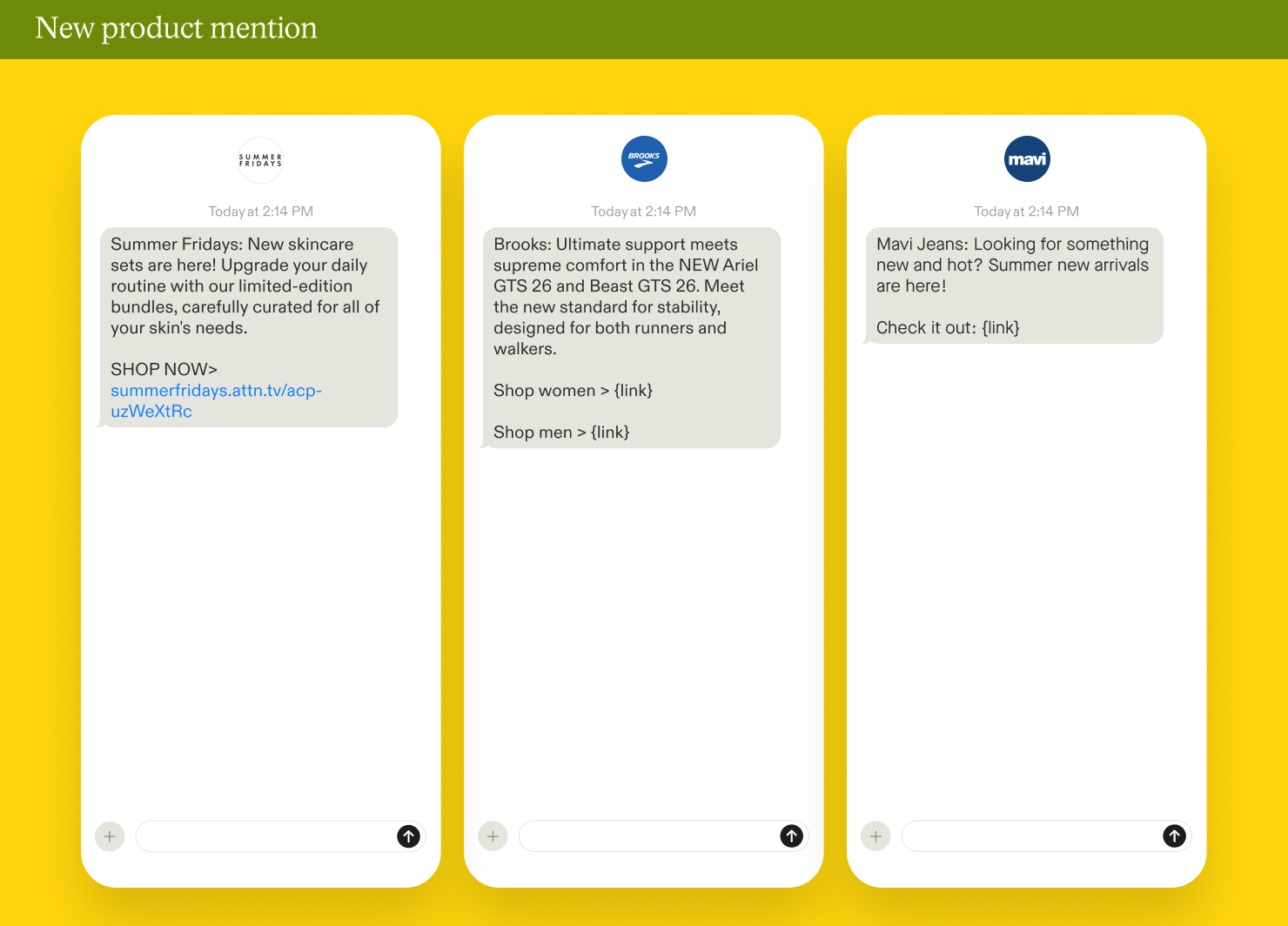
New variants of tried-and-true products can trigger the same response, so these SKUs are also worthy of an announcement.
3. Negative-oriented language: +14% CVR; +6% CTR
Loss aversion is a strong motivator. Using language that focuses on what customers might miss out on creates emphasis around problems your product solves or opportunities that won’t last.
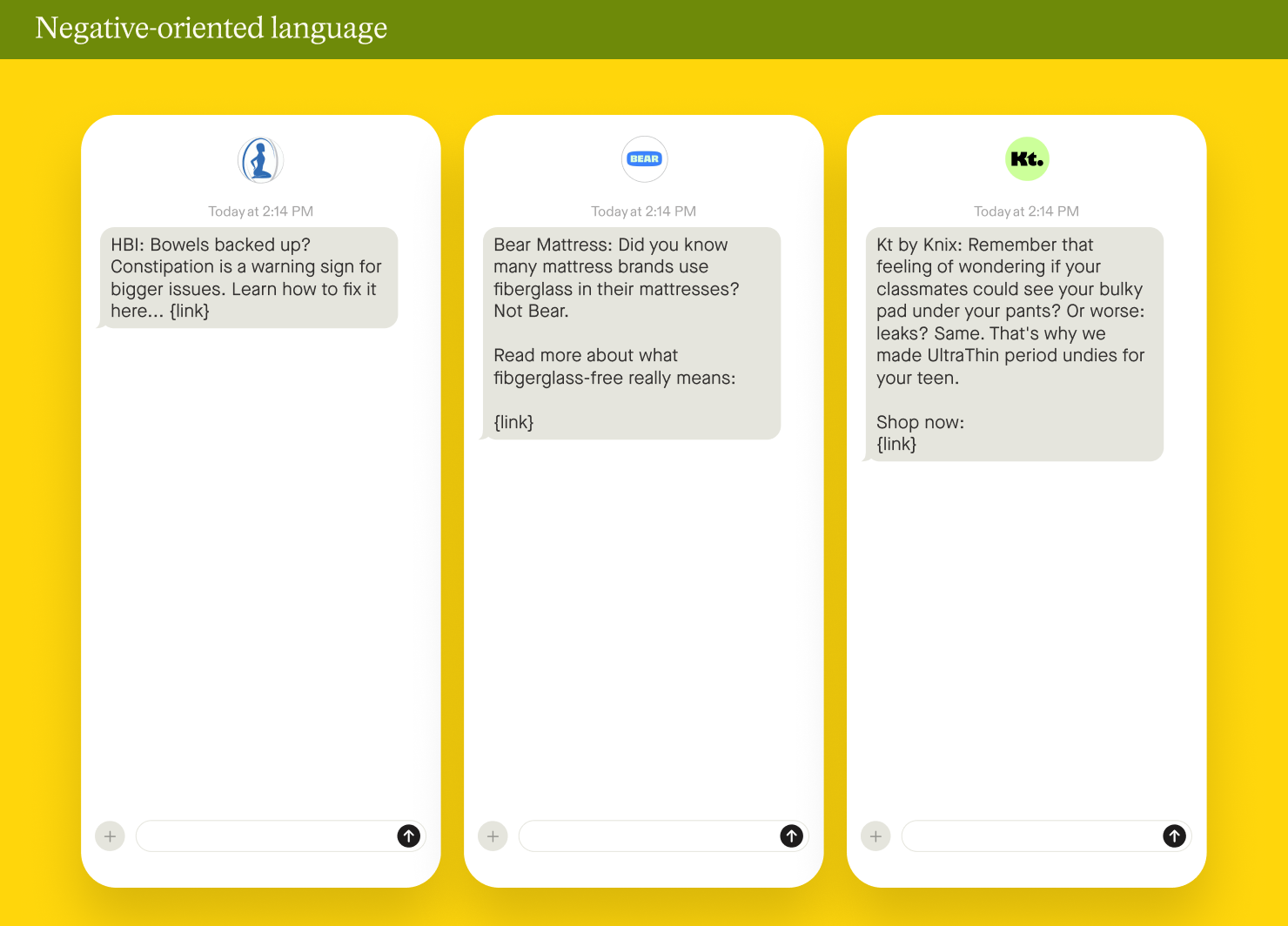
Highlight what could happen if customers don’t act. The key is to make the consequence feel real and immediate.
This is a great approach for limited launches, price increases, and communicating product benefits.
4. Scarcity and urgency: +13% CVR; +7% CTR
Scarcity and urgency boost messages that don’t include an offer by referencing limited quantities, exclusive access, or time-sensitive opportunities to give shoppers a reason to act now.
The key is keeping it authentic and not overdoing it. Genuine limitations work well, but manufactured urgency backfires when customers recognize it as a tactic.
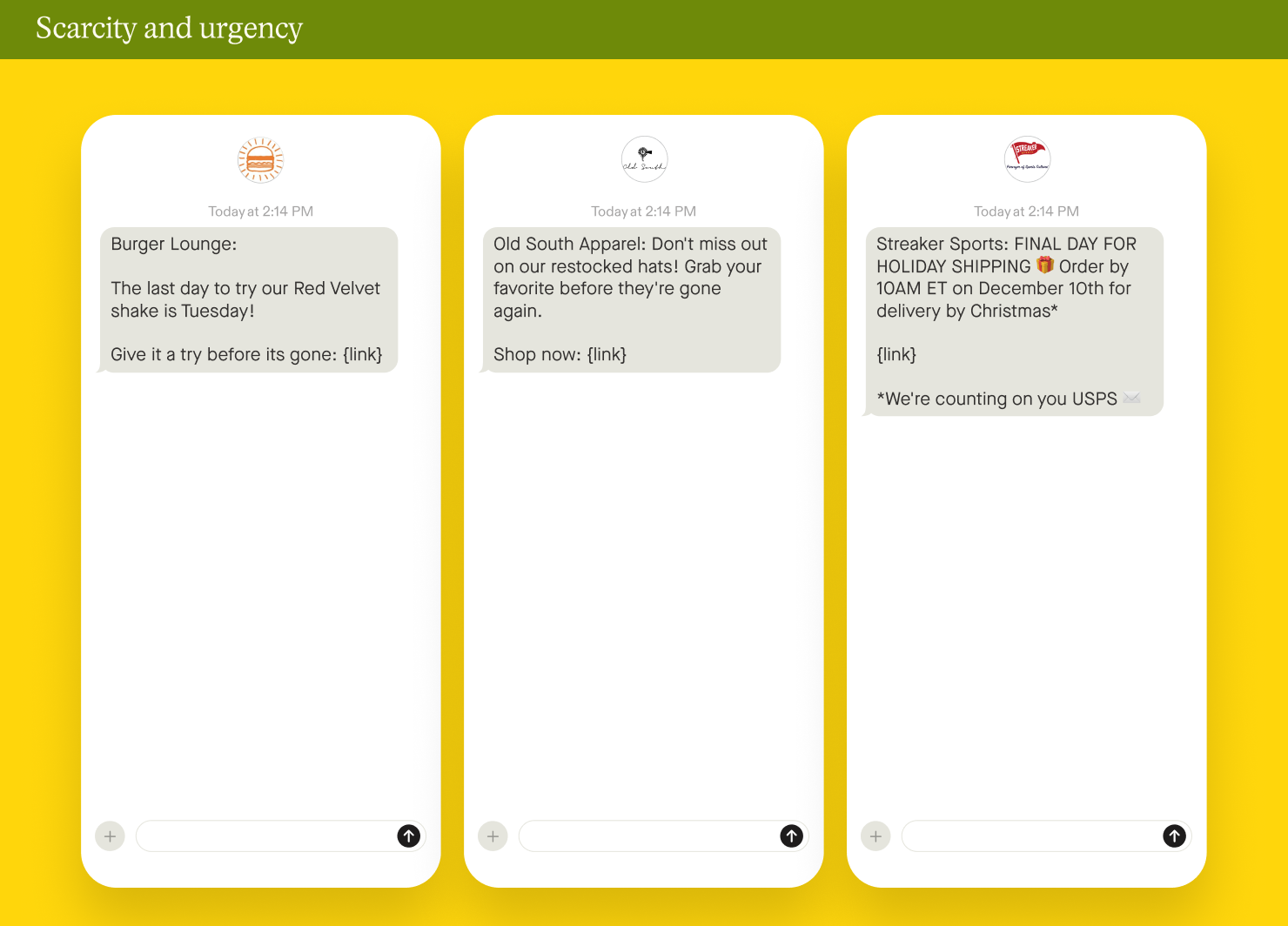
Scarcity messages also get magnified when paired with other elements. Compared to all other messages that don’t include an offer, these are the top-performing elements to combine with scarcity:
5. Hyperbole: +5% CVR; +1% CTR
Exaggerated language can help grab shoppers’ attention and get them excited about your product or brand.
This differs from messages with superlatives, which often use words like “best” or “fastest” to describe a product’s benefits. Hyperbole instead often evokes a strong emotion through over-the-top language, like “this year’s must-read book” or “this backpack is the ultimate adventure companion.”
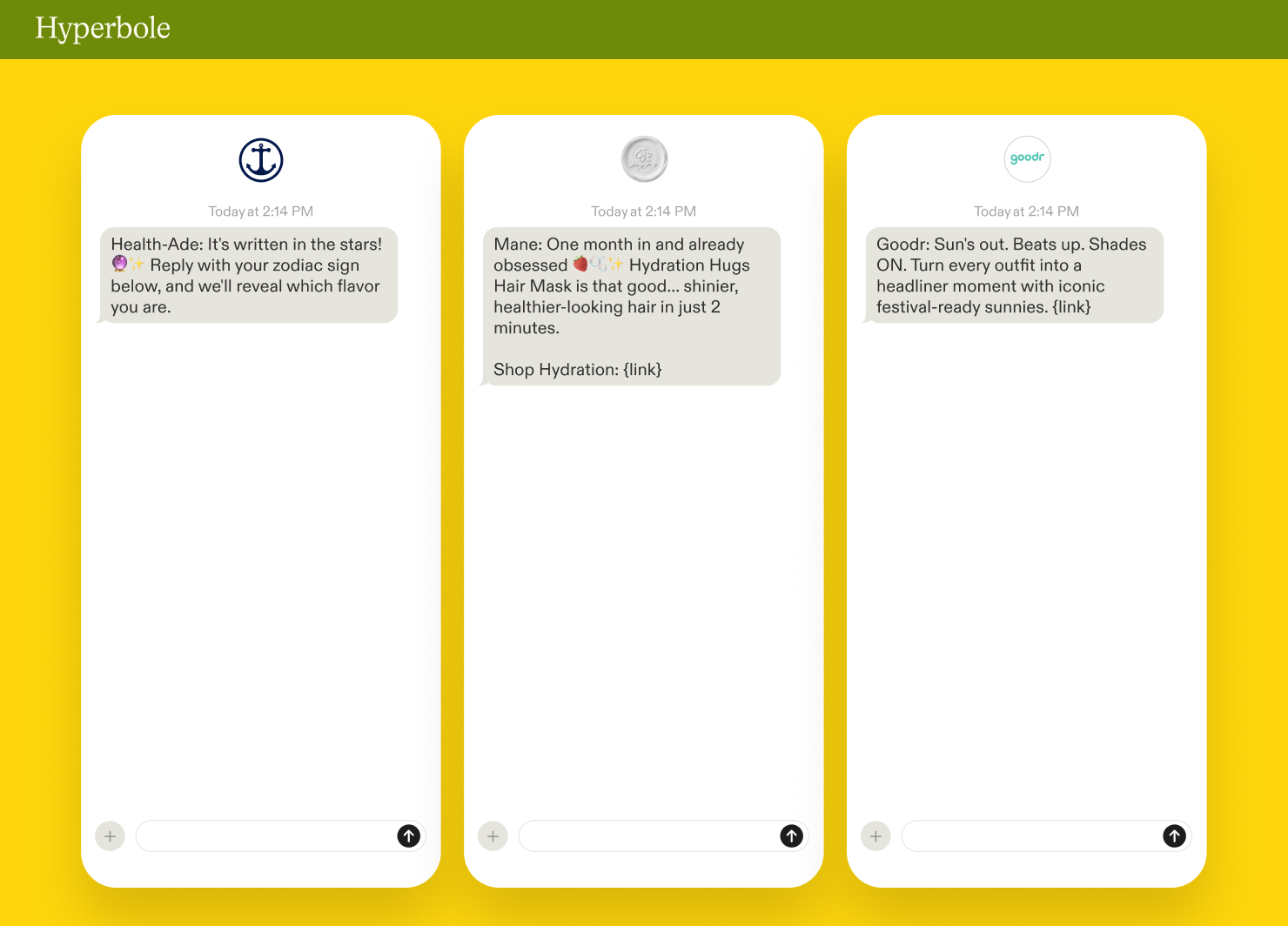
Too much hyperbole in the same message can feel over the top, so we recommend sticking to just one.
6. Conversational tone: +3% CVR; +0% CTR
A conversational tone uses casual language that makes your brand feel approachable, allowing you to build connection and trust with your subscribers.
By mirroring how people naturally talk, it allows your brand to express in a more genuine, less corporate way.
If you opt for a conversational tone, it should feel genuine to your brand voice. It could feel off to subscribers if it doesn’t match your communication across other channels.
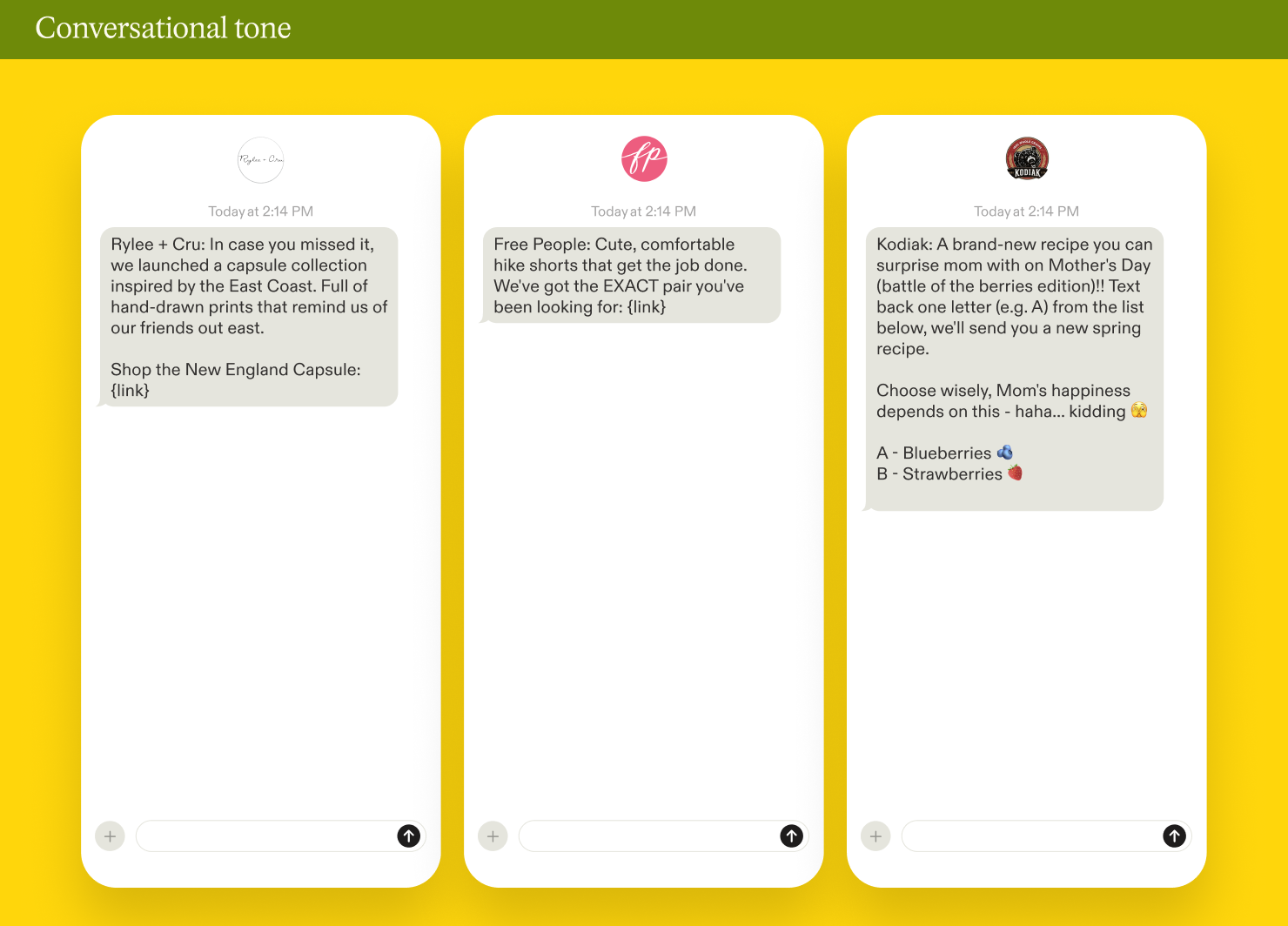
Try pairing your conversational tone with “ease” language that emphasizes how simple it is to buy or use your product. This combo boosts CVR by 6%.
Note that this combo reduces clicks by 0.9%. This slight dip in click-through rates suggests the combo is best for following up with subscribers who are already engaged, like in follow-up messages, rather than generating initial interest.
Caution: 2 SMS elements that underperform in non-offer campaigns
Certain copy choices can make it harder to create interest and drive action. In our analysis, the lowest-performing elements in non-offer campaigns reduced conversion rates by as much as 11% and click-through rates by 8%.
Here’s what’s more likely to weaken performance—and what to do instead.
1. Superlatives: -11.4% CVR; -6% CTR
In campaigns that give a discount, we saw that superlatives were effective when describing the offer. In other campaigns, however, superlatives like “best” and “fastest” are often used to describe the product or its benefits. In these cases, they tend to make messages fall flat.
They can feel repetitive or unbelievable without proof.
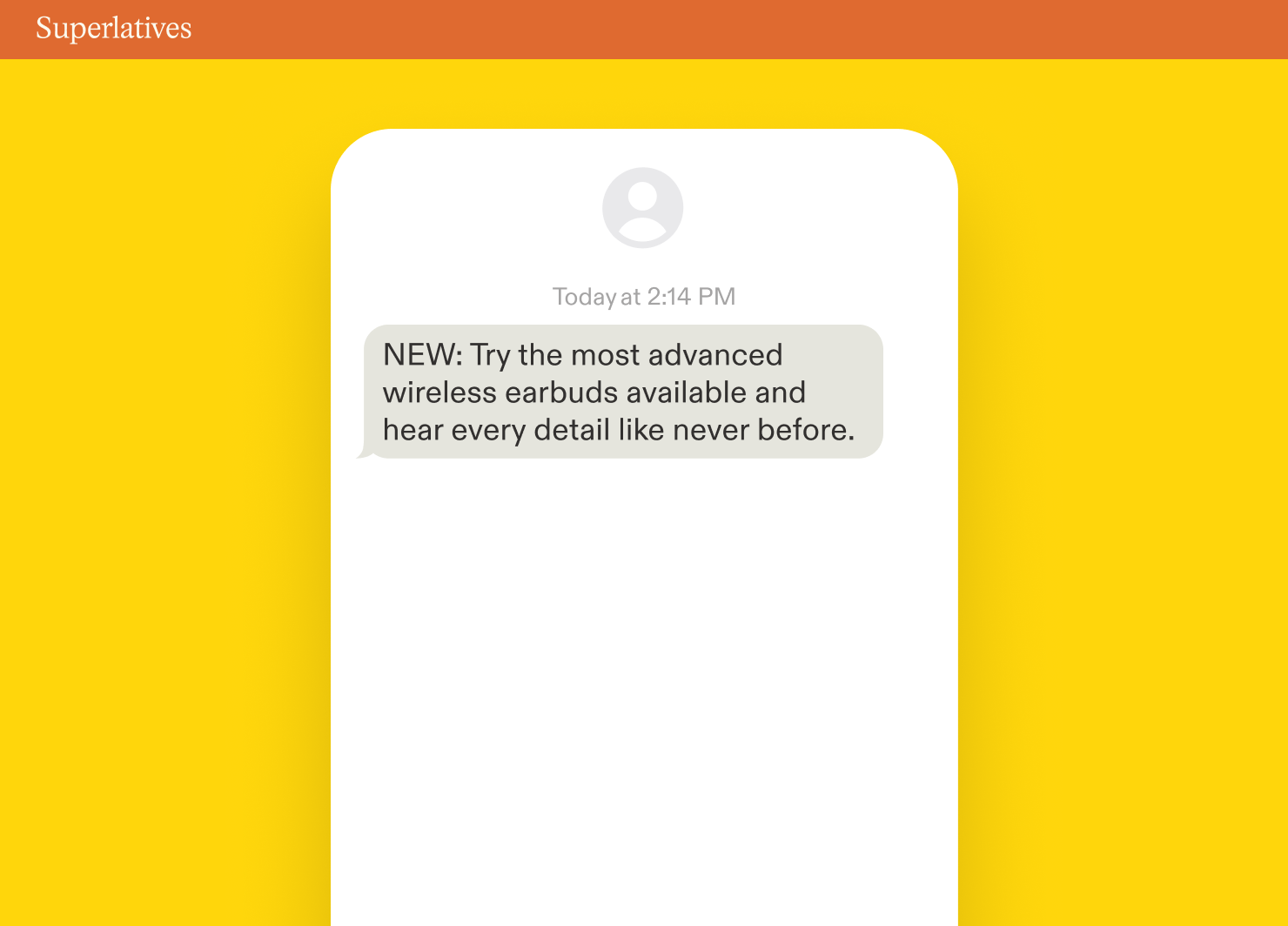
Instead, use concrete, value-driven language that builds interest and trust.
2. Jargon: -7.8% CVR; -6% CTR
Industry-specific terms and technical language hurt performance by creating a barrier to understanding. If a shopper has to translate what you’re saying, they’re likely to ignore your message.
Instead, use language your customers use when talking about their needs and problems. For example, “sweat-proof fabric” might be clearer to casual athletes than “moisture-wicking technology.”
Next steps: Level up your SMS campaign performance
You now have access to the most comprehensive analysis of SMS content performance ever conducted—insights that no other platform could deliver because they don’t have the scale or depth of message data that Attentive does.
But this data is only valuable when you put it to work. Now it’s your turn to turn these insights into higher-performing campaigns:
- Prioritize the highest-impact components for your campaign type that’s relevant to the message you’re sending.
- Validate results through multiple, varied tests to understand what works for your audience.
- Pay attention to elements that consistently boost or weaken performance for easy wins with minimal effort.
When every text message competes for attention, small improvements can create big performance wins. Keep this analysis handy for your next campaign planning session to make smarter decisions that drive better results.
Take action: Learn more about how to create high-impact SMS and email campaigns and build them in Attentive.
Methodology
This research is only possible because of Attentive's unique position in the SMS marketing ecosystem. As the first-to-market SMS marketing software in 2016 and leading provider ever since, we have years of experience and the largest data set on SMS performance in the world.
This groundbreaking analysis delivers insights with:
Unprecedented scale and scope.
We analyzed a massive amount of SMS campaign data in a way that has never been done before—over 25 billion messages from thousands of brands across 13 industries. There are near infinite combinations of message content, so to narrow it down, we drew on what we’ve learned from working with thousands of marketers to build a comprehensive content framework. This allows us to then identify and tag more than 100 different message components, from emoji usage to complex features like tone, language styles, product mentions, and offer formats.
Advanced causal analytics.
The biggest challenge in analyzing message performance is separating correlation from causation. Confounding factors like seasonality or company baseline performance can skew results.
Our solution: We built a sophisticated analytics engine that removes bias from over 50 confounding factors to determine the true impact of each messaging feature. The engine is powered by a Propensity Score Matching (PSM) algorithm—a similar methodology used by companies like Airbnb and Netflix to determine causal effects from data. PSM works by finding “identical twins”: messages that are similar in every way except for the feature being analyzed. Any performance difference between those messages is therefore attributable to that feature.
The result: The first-ever SMS message analysis engine that gives the clearest possible view of what each element contributes to performance—giving you insights you can trust and act on.
The learning compounds as we continue developing our framework, test new strategies, and identify new content elements that lead to conversions.



.png)