
What we heard, what it means, and why the answer to the AI era might be more human than you'd expect.
There's a particular energy that takes over a conference when an entire industry is wrestling with the same question at the same time. ShopTalk 2026 had it in full force. Every booth, every session, every hallway conversation circled back to AI—not as a boardroom talking point, but as something actively reshaping how consumers shop, how brands communicate, and what the customer journey even looks like anymore.
It felt, at times, like AI hysteria. People were looking for answers. Everyone was at a different point in their maturity. The anxiety was real, because the honest truth is that nobody has this fully figured out yet.
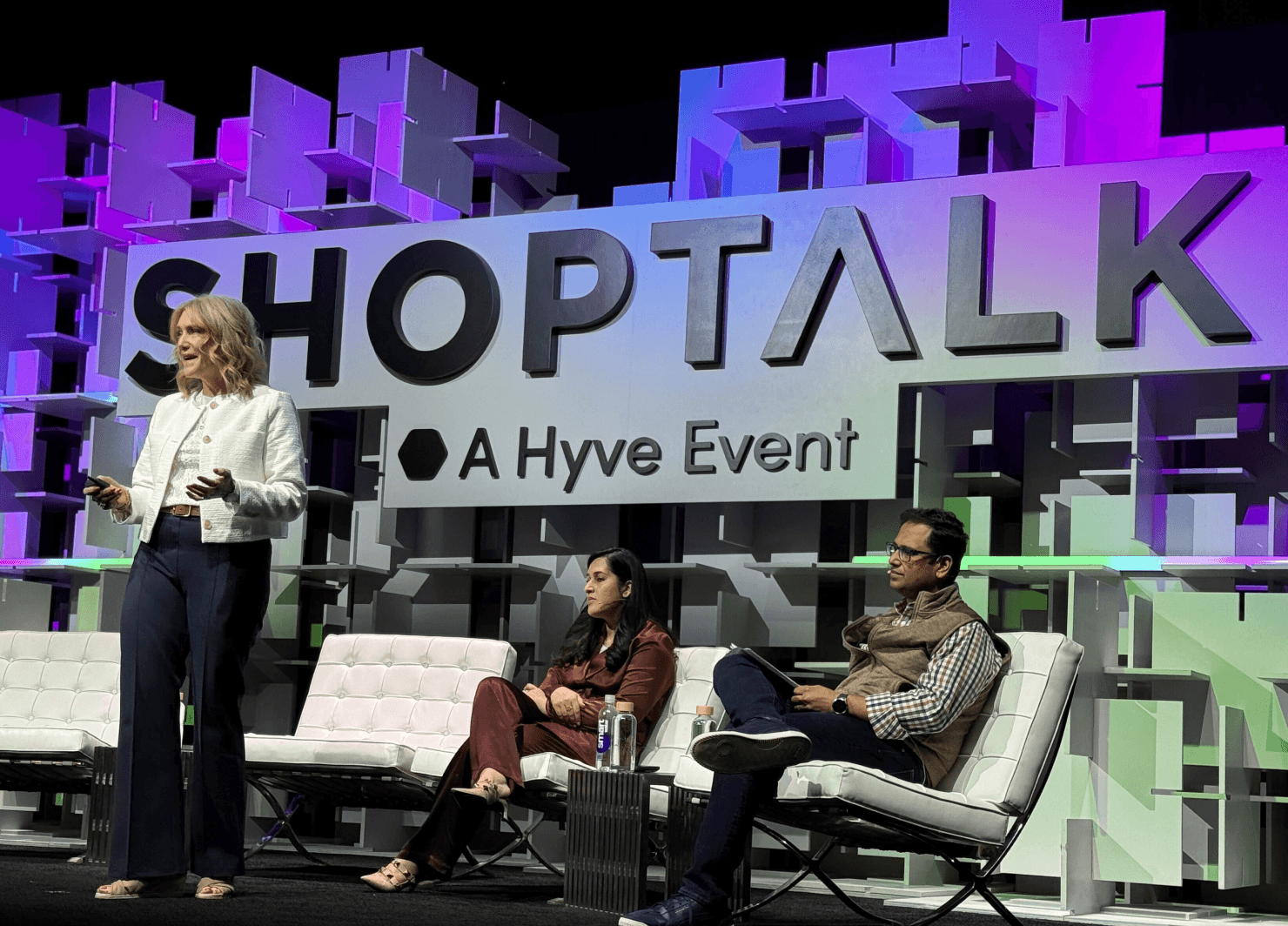
Attentive CMO, Keri McGhee, took the stage to make exactly that point: the brands winning right now aren't the ones who just started experimenting with AI. They're the ones who've spent years getting their data right, building the infrastructure quietly, and deploying AI in ways their customers never see. Over 75% of consumers will leave a brand for one that delivers a genuinely personalized experience — and the gap between brands who can do that and those who can't is widening fast.
But beneath the noise, the most important signal wasn't about chatbots, or answer engines, or the boldest product demos on the show floor. It was this: the brands generating the most genuine excitement were the ones using AI in ways their customers would never detect.
The front door has moved
For years, discovery was a brand's home turf. A shopper finds you on Google, navigates to your site, and you own the experience from that moment forward. Marketers built entire careers optimizing that path.
That model didn't just evolve at ShopTalk. It was declared, by a remarkable consensus across categories, to be fundamentally over.
"The front door to your brand has changed," as Adobe's Bruce Richards put it. AI assistants are now browsing on the consumer's behalf, and when they surface a recommendation, most shoppers don't look past it. The primary audience you need to reach is increasingly not a human. It's the AI agent that human has delegated their decision to.
This created a new obsession at the conference: AEO, or Agent Engine Optimization. What does Amazon's Rufus actually look for? The answer was clarifying: bestseller status, 15,000+ reviews, and a 4.6+ star rating are the benchmarks that meaningfully improve your chances of being recommended. Meanwhile, Reddit has become the most cited source across AI engines because it's messy, authentic, and human. In a world drowning in AI-generated content, real voices from real people are the highest-value asset in your marketing stack.
The old playbook of owning discovery is gone. The new game is feeding the algorithms the most human content you have.
Three things nobody has fully solved
Recognizing the shift is one thing. Building the infrastructure to capitalize on it is another. ShopTalk surfaced three real, unresolved tensions every commerce brand is navigating right now.
1. The broken cart. There is no universal API to accept agentic orders. An AI agent can know exactly what a shopper wants across three merchants, but the plumbing to actually execute that cart doesn't exist in any standardized form. Gap Inc. announced an early partnership with Google's Universal Commerce Protocol (UCP) to pipe its pricing, loyalty programs, and localized experiences directly into Gemini. OpenAI is expanding its ACP protocol from checkout into full discovery. Two competing standards, both early-stage, both racing to become the default. The brands that move early here are the ones that won't get disintermediated when the infrastructure catches up.
At Shoptalk, we hosted a series of executive events with Attentive and Shopify, where we connected with brands navigating the next phase of commerce. Across those conversations, agentic commerce came up consistently. There is strong interest and momentum, but also a clear recognition that it is still early. The focus now is on translating that vision into real use cases that can scale across the business and deliver measurable results.
—John Avex, Founder and CEO at Avex
2. The trust paradox. 80% of consumers distrust AI. And yet 70% are heavily influenced by AI recommendations when deciding what to buy. People are relying on the thing they don't trust. You can't resolve that tension by leaning harder into AI-forward messaging, which is exactly why invisible deployment matters so much.
3. The consolidating consumer. Over 60% of shoppers are making fewer trips and shifting toward lower-priced retailers. And 97% of e-commerce growth is going to marketplaces right now, with just 11 companies controlling 83% of global marketplace volume. Standalone brands are competing for the remaining 3%. If your customers are increasingly transacting on Amazon or TikTok Shop, the question becomes: do you still have a relationship with them, or have you effectively outsourced your customer file?
Invisible AI—and why it works
The brands that spoke about AI with real conviction at ShopTalk weren't deploying public-facing chatbots. They were using AI entirely out of sight.
David Yurman was emphatic: the technology needs to be invisible. The emotional connection a customer has with a luxury brand is fragile, and a chatbot announcing itself as AI is the fastest way to shatter it. But AI quietly empowering a human? That's a superpower no one notices.
This model—AI amplifying human judgment rather than replacing human interaction—was the consistent throughline for every brand that actually had results to show. It's the same principle that drives how integrations work best: not flashy, just seamless.
Integrations are a huge priority for us. They're how we make our entire tech stack work as one. When our platforms speak to each other seamlessly, it means less manual work for our team and a better experience for our customers.
— Lydia Di Capua, CXO at Happy V
The flip side: AI shopping agents are ruthless. They don't care about beautiful landing pages or brand storytelling. They hunt for the best outcome and move on. The brands that will survive this aren't trying to impress the bots. They're building experiences the bots can't commoditize.
The answer that emerged consistently was experiential loyalty. Not discounts—VIP access. Not points—moments. Goodr offers top customers one-on-one meetings with the founders. Active loyalty participants are significantly less price sensitive which means they can't be poached by an AI engine hunting for a 10% better deal elsewhere.
We want to use AI to remove the friction. We don't actually want to kill the joy of shopping altogether.
— Keri McGhee, CMO, Attentive
The most important counter-trend
Despite all the AI energy in the room, the loudest counter-trend at ShopTalk 2026 was analog. The return to physical stores as social "third places." The insistence from brand after brand that human connection is the ultimate differentiator. The declaration from Victoria's Secret CEO Hillary Super that CAC as a singular KPI is "dangerous" and that long-term health of the customer file is what actually matters.
90% of transactions still happen in physical stores. People still like going places, touching things, talking to other people. That hasn't changed.
Shoptalk 2026 showed that the future of commerce is AI-powered, but human-centered. Winning brands are blending AI + human experience, not choosing one. With a renewed focus around brand authenticity in an AI-powered landscape, brands leveraging Mobile Push can have an outsized advantage in building trust & deeper connection with customers.
— Jon Knott, Director, Ecosystem Partnerships at Tapcart
The implication for owned channels—SMS, email, push—is significant. These aren't just conversion tools. They're the relationship infrastructure that survives the discovery getting handed to AI, the transaction happening on a marketplace, and the experience being delivered in a store you don't control. The brands maintaining a direct line to their customers are the ones that won't get disintermediated. Regardless of how the rest of the landscape shifts.
What struck me most at Shoptalk was how aligned everyone is around AI and personalization — the goals are the same across the board. The real challenge now is figuring out what actually makes your brand different. And increasingly, that answer isn't the technology. It's the human connection behind it.
— Victoria Parsons, Event Marketing Manager at Movable Ink
The front door has moved. But the relationship still belongs to the brands who know their customers.
We were at ShopTalk 2026 across sessions, workshops, and the show floor. If you want to talk through what any of these trends mean for your strategy, your Attentive team is ready.