

What is conversational analytics? Learn how AI-powered marketing reporting works, and the five things to check before you trust the answers.
You open the dashboard, see that revenue moved, and still don’t know what to do about it. So you pull a second report, adjust the date range, export something to a spreadsheet, and 20 minutes later you have a guess. All you wanted was a straight answer and a next step.
Marketing reporting is beginning to work that way. Instead of navigating to an answer, you now can ask for one in plain language and get back a number, a chart, and a view on what to look at next. If you’ve already tried this by pointing ChatGPT or Claude at your marketing data, you’ve seen part of it work and part of it fall short.
In this post, we cover what conversational analytics changes, why reporting is a higher bar than most AI use cases, the five things to check before you trust any AI reporting tool, and why the tool you choose changes the answer you get.
What is conversational analytics, and what does it change about marketing reporting?
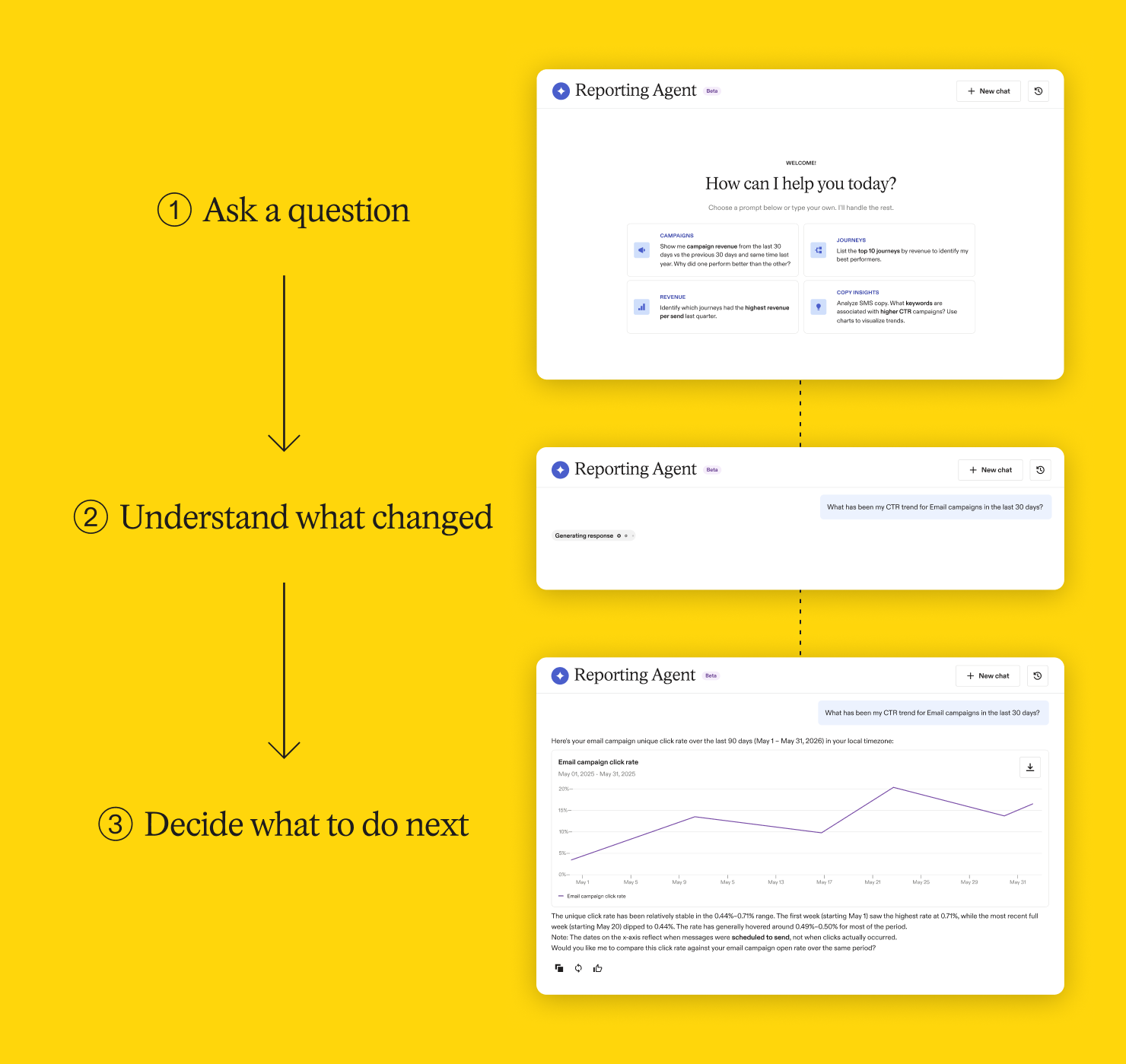
Conversational analytics means asking a question in plain language and getting a usable answer back, rather than navigating menus and filters to assemble one yourself.
What is conversational analytics?
Conversational analytics lets a marketer ask a performance question in natural language and receive an answer, often with a chart, a comparison, and a suggested next step. The experience is closer to working with an analyst than pulling a static report.
The questions look like the ones you or a colleague would ask out loud:
- What were my top-performing campaigns last month?
- How did journey revenue change compared to the previous 30 days?
- Show me list growth by channel in a chart
- Why did performance change, and what should I look at next?
The value isn't that it's conversational. It's that the path from question to action gets shorter, and three shifts come with that:
- From “where do I find this?” to “what does this mean?”
- From “what happened?” to “why did it happen?”
- From “what should I report?” to “what should I do next?”
The third one is where the time goes. Most reporting work is deciding what the number is telling you.
Why AI reporting is a high-trust use case
Here's the part that decides whether any of this gets adopted.
Marketers will take an imperfect first draft of campaign copy and fix it. They will not take an answer that misstates revenue, conversion rate, or campaign performance. Those are two different tolerances for the same technology, and reporting sits on the demanding side of the line.
A fast answer that's wrong creates more work. The cost there is optimizing the wrong campaign, misreading customer behavior, or carrying a bad number into an executive update and finding out later. Which is why nobody retires their dashboard on a promise of speed. Speed is what makes conversational analytics appealing. Accuracy is what makes anyone willing to use it twice.
5 things to check before you trust AI reporting
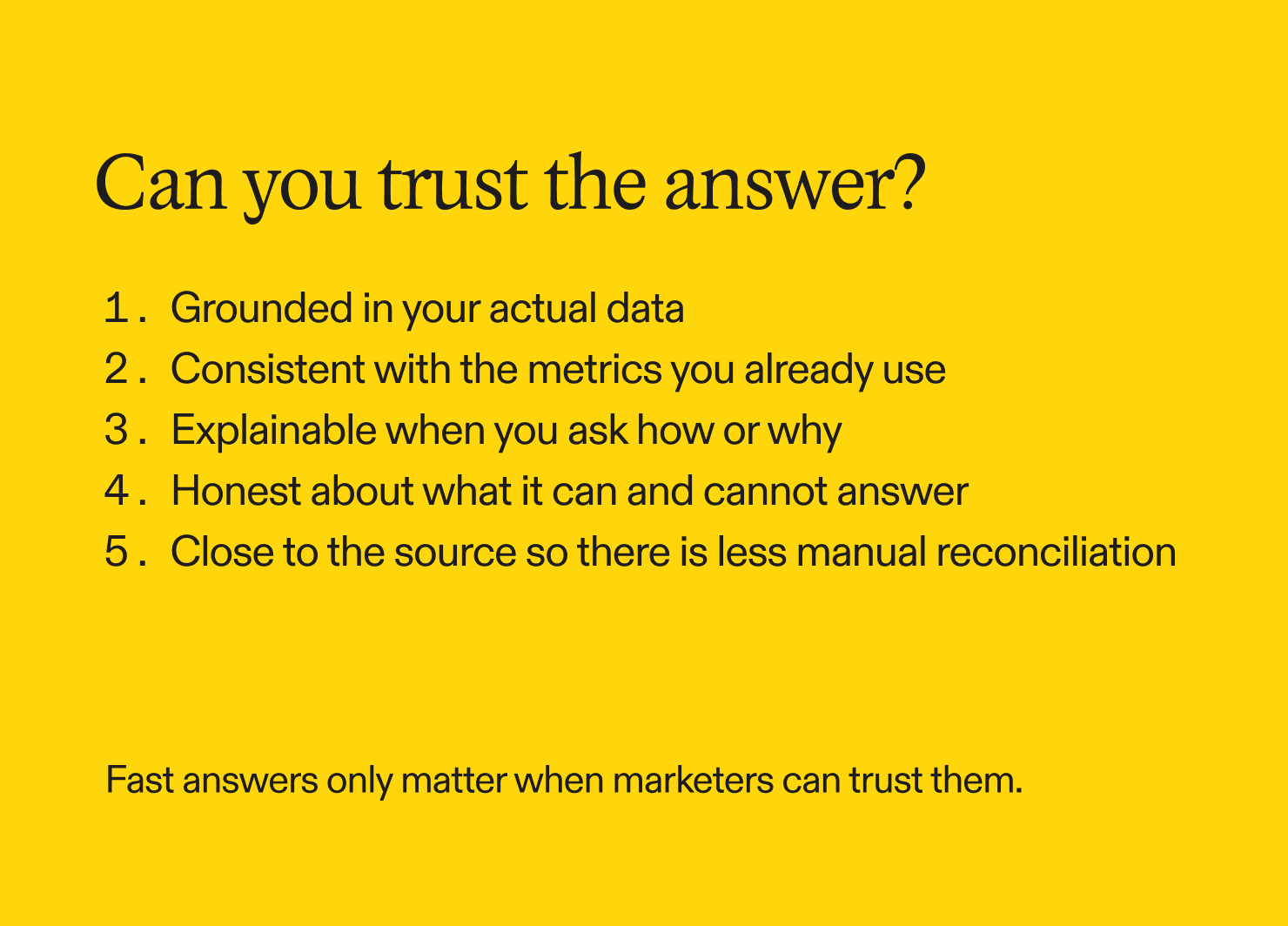
Before you act on an AI reporting answer, run it through five checks. They apply to the answer itself, not to the tool that produced it.
1. Grounded in your own data. Answers should be drawn from your platform data rather than generated to sound plausible. In reporting, an invented answer is more dangerous than no answer, because it arrives looking authoritative.
2. Consistent with the metrics you already use. Revenue, click-through rate, conversion rate, and attribution should match the definitions in your reports. Small discrepancies cost confidence faster than large ones, because they're harder to catch and easier to carry into a decision.
3. Explainable when you ask how or why. You should be able to ask how a number was calculated and why the tool reached its conclusion, then inspect the assumptions underneath it.
4. Honest about what it can and cannot answer. A tool that says it doesn't have the data is worth more than one that always produces something. Declining to answer is a feature.
5. Close to the source. The further a tool sits from your data, the more exporting, reconciling, and validating lands on you. Working inside the platform means fewer gaps to close by hand.
A general AI tool can clear some of these checks, including the first and the fifth. What it won’t have is the instinct a marketer brings to the question: which metrics matter for a campaign versus a journey, and which comparison to reach for next. A tool built for marketing performance analysis starts from those assumptions instead of waiting to be told.
One more thing a good tool does: when it names likely drivers behind a change, it presents them as areas to investigate rather than settled causes. Performance rarely has a single clean explanation, and a tool that offers you a starting point for investigation is more useful than one that hands you a verdict.