
May is the month your customers finally open their wallets—here's how to make sure they're spending with you.
May is permission month.
Tax refunds have landed, winter coats are in storage, and your customers have mentally moved on from "should I?" to "why not?" The caution of Q1 is gone. May shoppers aren't budgeting carefully, they're living like summer is already here.
The calendar backs them up. Mother's Day gives them emotional license to spend. Memorial Day frames itself as the official start of something—grilling season, vacation mode, the summer they've been waiting for. Between those tentpoles, you've got Star Wars Day for the pop culture obsessed and Mental Health Awareness Month for purpose-driven campaigns.
May rewards brands that show up with energy, specificity, and a point of view. The ones that do more than acknowledge a holiday. The ones that understand what their customers are actually feeling.
This is your playbook: the dates that matter, the behaviors behind them, the benchmarks worth measuring against, and campaign ideas built for speed.
Key marketing dates in May
May's calendar isn't just busy, it's layered. You've got the big commercial tentpoles (Mother's Day, Memorial Day) that drive massive spending intent. But between them, there's texture: Star Wars Day for fandoms, Mental Health Awareness Month for brands with something real to say, Teacher Appreciation Day for everyone who slept on Mother's Day messaging.
Below is the full May calendar. Star the dates where your brand wants to show up. Ignore the rest.
Quick reference: May marketing holidays
All month:
- Mental Health Awareness Month
- Asian American and Pacific Islander Heritage Month
Early May:
- Star Wars Day — May 4
- Early May Bank Holiday (UK) — May 5
- Cinco de Mayo — May 5
- National Teacher Appreciation Day — May 6
- National Nurses Day — May 6
- Nurses Week — May 6-12
- Europe Day — May 9
- Mother's Day — May 10 ⭐
Mid-May:
- International Day of Families — May 15
- Armed Forces Day — May 16
- FA Cup Final (UK) — May 17
- World Baking Day — May 17
Late May:
- National Wine Day — May 25
- Spring Bank Holiday (UK) — May 25
- Memorial Day (US) — May 26 ⭐
- National Sunscreen Day — May 27
- National Creativity Day — May 30
May SMS and email benchmarks
May SMS Benchmarks
May Email Benchmarks
May SMS strategies and examples
May's SMS calendar is contradictory by design. You need to be heartfelt for Mother's Day, irreverent for Star Wars Day, purposeful for Mental Health Awareness Month, and relentlessly urgent for Memorial Day—sometimes within the same week. The brands that execute well across that range aren't the ones shouting loudest. They're the ones that understand context better than volume: when to lead with emotion, when to lean into humor, and when your subscriber just needs you to tell them what's on sale and for how long.
Below are the strategies that move revenue in May—the full playbooks for your biggest opportunities, plus quick executions for the moments worth acknowledging but not overthinking.
Strategy 1: Mother's Day as a Multi-Touch Gifting Campaign
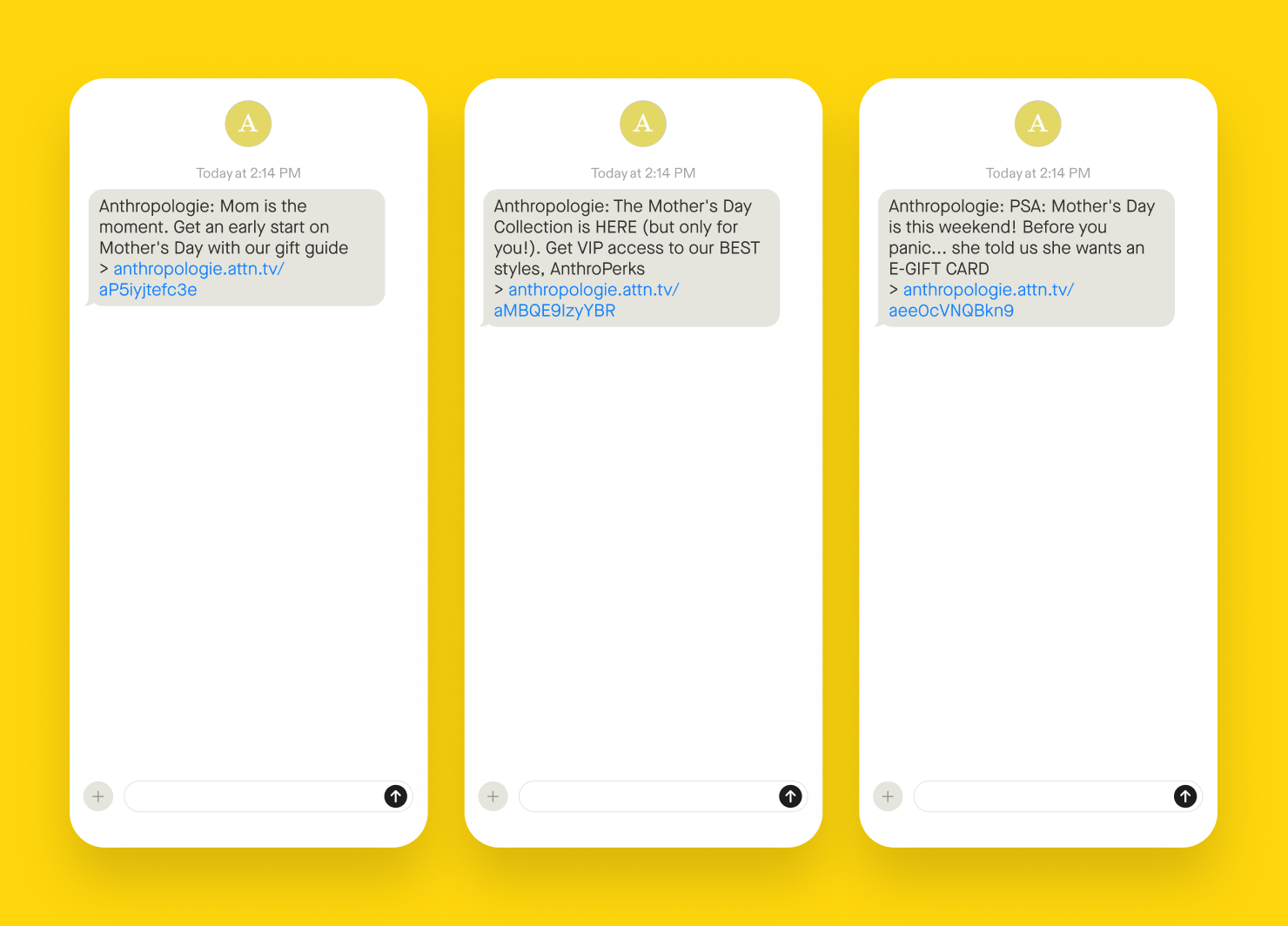
Mother's Day is May's biggest commercial moment, but the window to capture it is shorter than most brands realize. Gift shopping starts earlier than you think and it ends earlier too. Brands that wait until the Friday before have already missed the planners. Brands that stop messaging on Saturday miss the procrastinators.
📊 What top performers did last year: Brands that sent 4 SMS campaigns for Mother's Day drove 7x higher revenue per send than those who sent just 1
Volume isn't noise, it's coverage. You need multiple touches to reach shoppers across the entire consideration window.
Why this works:
Gift intent is time-sensitive: Planners finalize purchases by Wednesday or Thursday of the week before. Procrastinators need a nudge on Saturday. If you only send once, you're leaving half your audience on the table.
Curated experiences cut through decision fatigue: 70% of shoppers feel overwhelmed shopping online, often delaying purchases or abandoning entirely. Brands that use conversational gift-finder quizzes in SMS—letting subscribers narrow options through interactive prompts—see a +37% lift in conversion rate. Less friction, more completed checkouts.
Urgency is built in: Shipping deadlines and the emotional stakes of "getting it right" create natural scarcity. You don't have to manufacture pressure. You just have to surface it.
Opt-out options protect your list: Not everyone wants to receive Mother's Day messaging. A one-tap opt-out signals empathy, reduces unsubscribes, and ensures your sends go to subscribers who are actually ready to engage. It's list hygiene disguised as customer care.
Orchestration tip: Start your campaign early (late April) with a gift guide or quiz. Follow up with shipping deadline reminders, then pivot to instant delivery (gift cards, digital products) for last-minute shoppers.
Strategy 2: Memorial Day as a Long-Weekend Revenue Play
Memorial Day isn't one day, it's a four-day window where shoppers have time, permission, and intent to spend. High performers treat it like a mini Black Friday: early access for VIPs, momentum-building mid-weekend sends, and aggressive final-hours urgency.
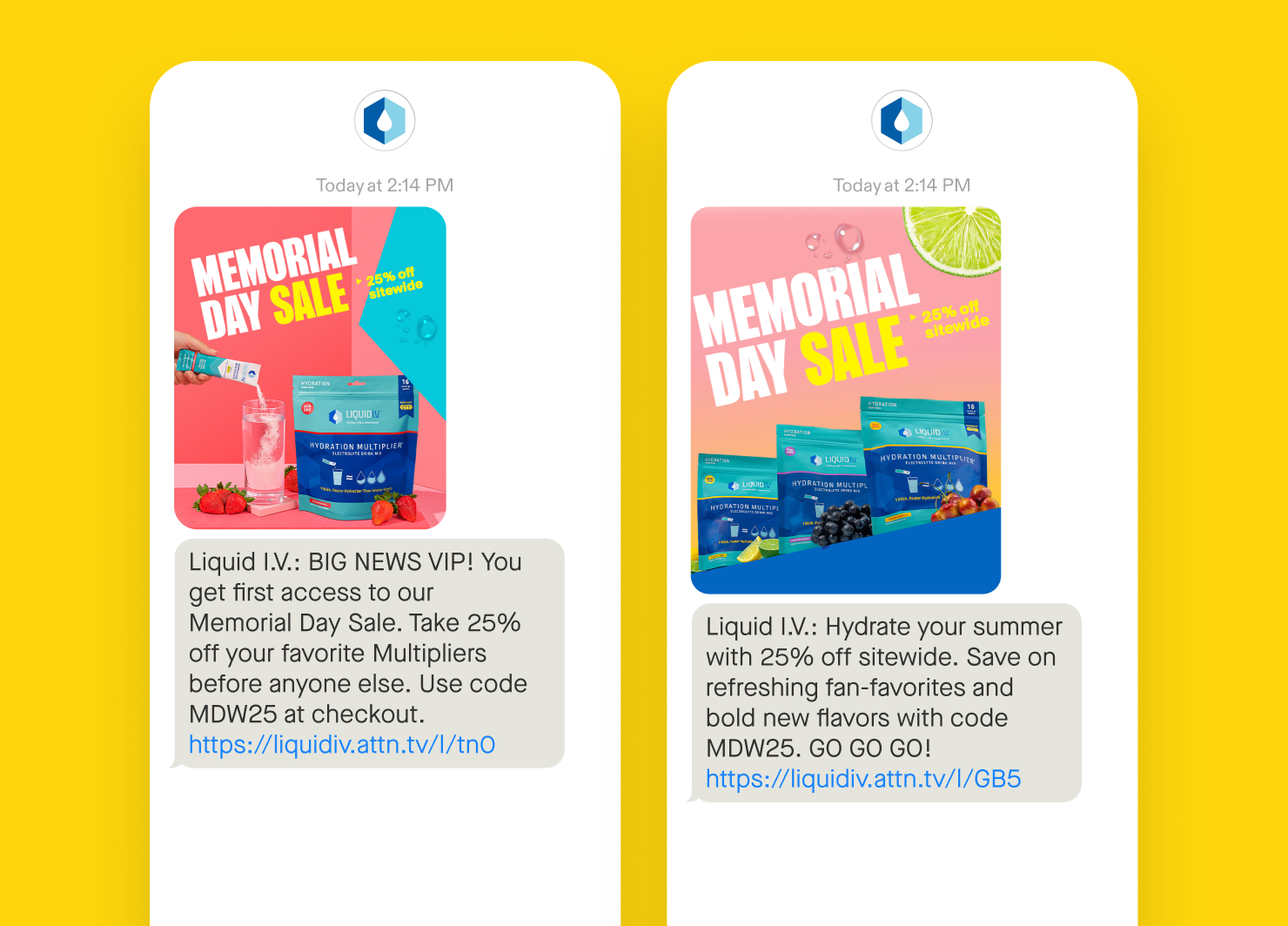
Top recommendations for strong performance:
- Start early: 46% of consumers make their Memorial Day plans at least 1-2 weeks in advance. Kick off with SMS and email in early May as shoppers begin planning.
- Build momentum: Increase send frequency during the week leading up to Memorial Day and throughout the weekend.
- Follow up: Send at least one post-weekend message to capture lingering demand and cart abandoners.
Channel strategy: Use email for personalized recommendations; leverage SMS for urgency and time-sensitive promotions.
Orchestration tip: Send a pre-sale "save the date" message in early May. Launch the sale Thursday with early access for SMS subscribers. Continue messaging through the weekend with product spotlights, flash offers, and urgency-driven final hours alerts. Send one recovery message on Tuesday for non-converters.
Strategy 3: Mental Health Awareness Month as a Month-Long Values Play
Mental Health Awareness Month gives brands an opportunity to do something genuinely useful, not just promotional. The brands that win here aren't the ones who slap a ribbon on a sale. They're the ones who make their subscribers feel seen, not sold to.
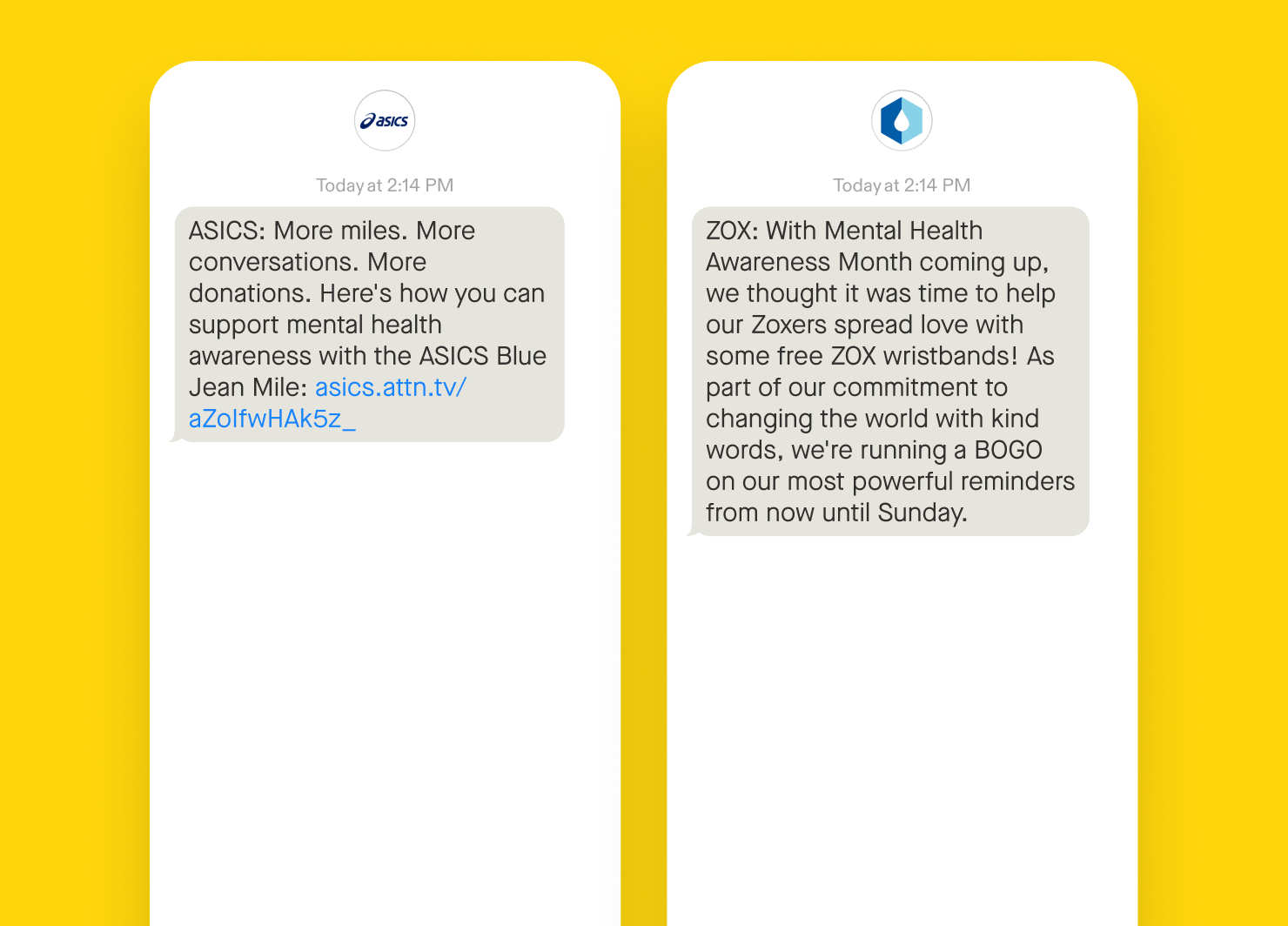
Why this works:
Purpose-driven content earns outsized engagement: Subscribers are more likely to save, share, or respond to messages that feel meaningful. Mental health content—done thoughtfully—clears a much higher engagement bar than a standard promo.
You have 31 days to build a narrative: You don't have to do everything in one send. A month-long approach lets you layer educational content, community moments, and a purposeful offer without cramming it into a single message. Spread your touches across the month.
The right offer doesn't have to be a discount: A charitable donation mechanic (10% of sales go to a mental health organization), an exclusive self-care collection, or a subscriber-only wellness resource can perform just as well. And says more about your brand than 20% off.
Authenticity matters here more than anywhere else: If your brand doesn't have a natural connection to mental health, don't force it. Partner with an organization, share resources, or simply acknowledge the month without making it about your products. Subscribers can smell opportunism from a mile away.
Orchestration tip: Kick off the month with an awareness message (no ask, just a resource). Follow with 1-2 mid-month messages that spotlight your products in a helpful, non-pushy way. In week 3, introduce a donation or giving-back offer. Close the month with a thank-you message and one final resource or offer.
Copy-and-paste SMS messaging ideas for May
Mother's Day (May 10)
Mother's Day is {X} days away 🌷 Shop our gift edit and find something she'll actually love: {LINK}
We know Mother's Day isn't for everyone. Reply PAUSE to skip all Mother's Day messages this year. We'll see you in June 💚
Memorial Day (May 25)
Our Memorial Day sale starts NOW 🍉🎉 Save {X%} through Monday. Early access for SMS subscribers. Shop first: {LINK}
FINAL HOURS: Memorial Day sale ends at midnight. Don't miss {X%} off everything: {LINK}
Star Wars Day (May 4)
The Force is strong with this sale. 25% off sitewide TODAY ONLY. May the 4th be with you: {LINK}
National Teacher Appreciation Day (May 6)
We 🫶 teachers. In honor of Teacher Appreciation Day, we're offering 50% off for educators. You deserve it. Shop now: {LINK}
Europe Day (UK, May 9)
It's Europe Day. A great time to dream about your summer plans. What's your ideal European escape? Reply with a number:
1 – Mediterranean beach
2 – Nordic adventure
3 – English countryside
4 – Historic city break
National Sunscreen Day (May 27)
It's National Sunscreen Day! ☀️🌴 Don't let those sneaky rays cramp your summer vibes. Stock up on SPF essentials with {X%} off all sunscreen. Today only. Soak up the sun responsibly: {LINK}
Five SMS Best Practices for May
- Lead with the occasion, follow with the offer. In a month packed with emotionally resonant dates, subscribers respond better when they feel the message is about them, not just about a discount. Name the moment first ("It's Mother's Day," "Memorial Day starts now"), then make the offer. Context beats urgency every time.
- Segment Mother's Day by relationship. Not all your subscribers are buying for their mothers. If you have data on gender, age, or past purchase behavior, use it to split your list between "gift for Mom" messaging and "treat yourself" messaging. One size does not fit all.
- Keep Memorial Day sends tight. A Thursday or Friday launch, a Saturday mid-weekend momentum message, and a Sunday/Monday final hours alert is a complete sequence. More than that risks fatigue. Less than that leaves money on the table.
- Use Two-Way Journeys™ strategically. Interactive messaging (like quiz-style prompts or "reply with a number") drives engagement, but only when the payoff is immediate and relevant. Don't ask for input unless you're ready to deliver a personalized response within seconds. Lag kills the magic.
- Don't force relevance on niche holidays. Star Wars Day works if your brand has permission to be playful. National Sunscreen Day works if you sell SPF. If the holiday feels like a stretch, skip it. Subscribers reward authenticity, not effort.
May email strategies and examples
Email in May is the channel where you can show, not just tell. You're building visual gift guides for Mother's Day, recipe-forward entertaining content for Cinco de Mayo, purposeful re-engagement sequences for Mental Health Awareness Month, and conversion-heavy flash sale campaigns for Memorial Day.
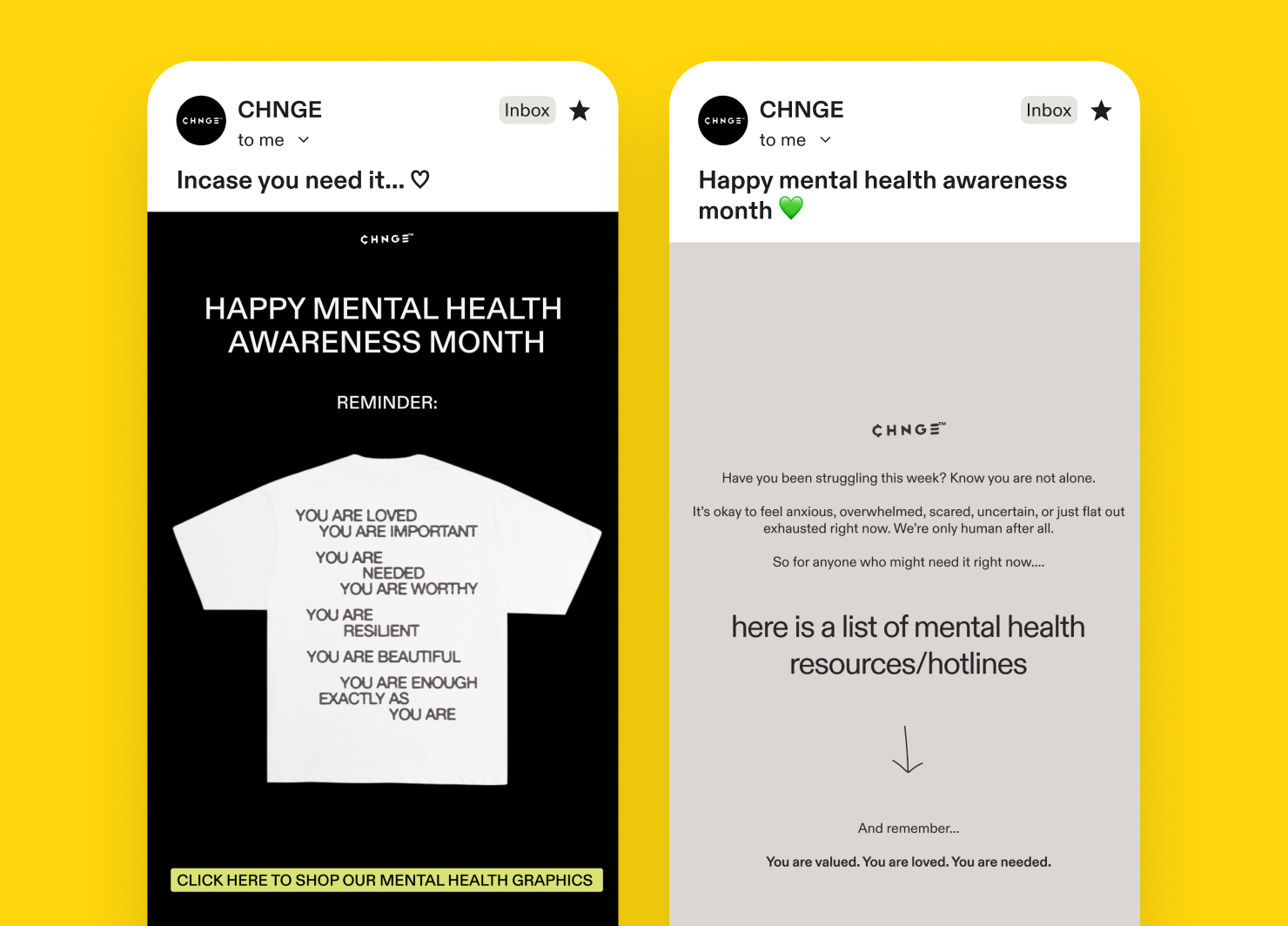
Below are the email strategies that drive revenue in May: fully flushed out campaign ideas for moments that deserve depth, plus single-send campaign ideas for dates worth acknowledging without overcomplicating.
Strategy 1: Mother's Day segmentation—gifters, self-gifters, and opt-outs
Mother's Day means different things to different people. For many of your subscribers, it's a celebration. For others, it's complicated. Brands that recognize this want to communicate thoughtfully and the good news is, there's a lot you can do to connect with your customers in meaningful ways.
Build a three-segment Mother's Day email program. Suppress opt-outs entirely, send gift-finding campaigns to gifters, and send "treat yourself" messaging to self-gifters. Different audiences, different needs, different campaigns.
When you offer flexibility and choice in how subscribers engage with your Mother's Day messaging, you're not just being considerate. You're creating opportunities to deepen relationships and build trust that extends far beyond the holiday itself.
Why this works:
Opt-out options earn trust: Giving subscribers the ability to skip Mother's Day messaging signals that you see them as people, not just revenue opportunities. That kind of brand behavior gets remembered and rewarded with long-term loyalty.
Curated gift experiences reduce overwhelm and drive conversion: 70% of shoppers feel overwhelmed shopping online, leading to delayed purchases and abandoned carts. Brands using personalized recommendations see a +37% lift in conversion rate. A well-built gift guide—segmented by recipient type, price point, or interest—does the work of a personal shopper at scale.
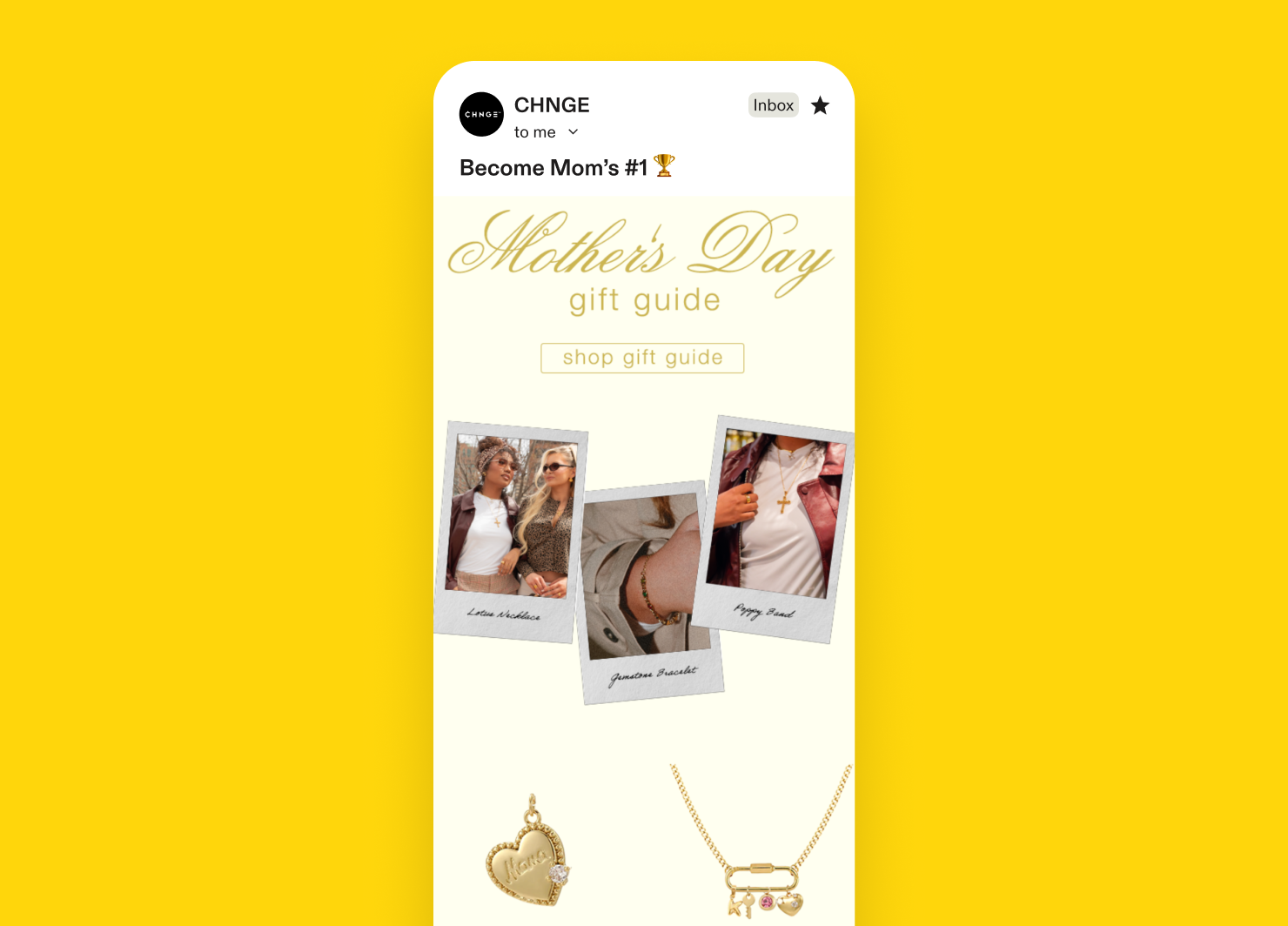
Self-gifters are a separate audience worth targeting: A significant portion of your list isn't shopping for someone else. "You deserve it too" messaging, sent to the right segment, regularly outperforms generic gift guide emails on conversion. Don't miss this revenue opportunity.
Mother’s Day email campaign ideas:
Campaign 1: The Opt-Out Offer (Send: Late April)
- Subject: "Want to skip our Mother's Day emails? Here's how"
- Description: Plain-text style email that acknowledges Mother's Day messaging is coming and offers a clear one-click opt-out. Keep tone warm and empathetic, not performative. This builds trust and protects your list.
Campaign 2: The Gifter's Guide (Send: May 1-3)
- Subject: "The gift edit she'll actually want this year"
- Description: Segmented to subscribers likely buying for someone else (based on past purchase data, demographics, or preference center). Curated gift guide organized by price point, interest, or relationship type. Heavy visual content, minimal copy, clear CTAs.
Campaign 3: The Self-Gifter Send (Send: May 1-3)
- Subject: "You deserve something nice this weekend too"
- Description: Sent to a different segment (non-gifters). Frame Mother's Day as permission to treat yourself. Feature products that are indulgent, self-care focused, or aspirational. Completely different copy and imagery from gifter version.
Strategy 2: Cinco de Mayo as a multi-day entertaining series
Cinco de Mayo is more than a one-day promotion. It's an opportunity to position your brand as an entertaining resource. The brands that win here don't just offer a discount. They help their subscribers do something: host a party, cook a meal, create an experience. Email is your medium for this kind of content-forward approach.
Why this works:
Entertaining content drives consideration early: Shoppers don't decide to host a Cinco de Mayo party on May 4th. They plan ahead, usually a week or more. A multi-email series that builds anticipation, offers planning help, and surfaces products in context captures intent earlier in the decision cycle.
Recipe and how-to content earns engagement beyond sales: Subscribers save, share, and return to emails that teach them something useful. A Cinco de Mayo recipe email with links to ingredients or cookware performs better than a generic "20% off" blast because it gives shoppers a reason to buy, not just an incentive.
Visual storytelling is email's advantage: You can't build a tablescape in an SMS. Email lets you showcase styled photography, ingredient lists, step-by-step guides, and aspirational lifestyle content that makes shoppers want what you're selling.
The hospitality angle broadens your audience: Not everyone celebrates Cinco de Mayo culturally, but many celebrate it socially. Positioning your brand as the "entertaining made easy" resource opens the door to a wider subscriber base than a purely cultural angle.
Cinco de Mayo email campaign ideas:
Campaign 1: The Party Planning Kickoff (Send: April 28-30)
- Subject: "Your Cinco de Mayo party starts here"
- Description: Anchor email that sets the stage. Include a party planning checklist, suggested menu, shopping list, and links to curated product collections (tableware, glassware, ingredients, decor). Heavy visual content with styled photography. CTA: "Shop the Cinco Collection."
Campaign 2: The Recipe Spotlight (Send: May 2)
- Subject: "The only margarita recipe you need this weekend"
- Description: Deep dive on one signature recipe (margaritas, tacos, salsa, etc.). Include ingredients list, step-by-step instructions, pro tips, and links to purchase key ingredients or tools. If you sell food/beverage, this is your moment. If not, focus on serveware, glassware, or entertaining essentials. Include user-generated content if you have it.
Orchestration tip: Kick off the series a week before Cinco de Mayo with planning content. Follow with recipe/how-to content mid-week. Send urgency-driven last-minute message on May 4th. Close the loop with a post-event UGC request. Use SMS for last-minute reminders ("party starts in 3 hours—order now for delivery"). Email handles the storytelling, SMS handles the urgency.
Quick-Hit Email Campaign Ideas
FA Cup Final (UK, May 17)
Why it works: The FA Cup Final is a cultural event for UK audiences. Even casual fans tune in. Brands with sports, hospitality, or entertainment positioning can own the moment with time-limited offers and match-day content. (This can also be applied to the UEFA Champions League Final on May 30)
Why it works: The FA Cup Final is a cultural event for UK audiences. Even casual fans tune in. Brands with sports, hospitality, or entertainment positioning can own the moment with time-limited offers and match-day content. (This can also be applied to the UEFA Champions League Final on May 30)
Campaign idea:
- Subject: "Match day = deal day. 20% off fan gear before kickoff"
- Description: Visual email featuring sports merchandise, fan apparel, or entertaining essentials for watch parties. Include countdown timer to kickoff for urgency. CTA: "Shop before the match starts."
Orchestration tip: Send the email morning of the match. Follow up with SMS at 2-3 hours before kickoff for final urgency push.
World Baking Day (May 17)
Why it works: Baking is therapeutic, social, and highly visual—perfect for email. Sharing recipes and curated product collections positions your brand as helpful, not just transactional.
Campaign idea:
- Subject: "Happy World Baking Day! Here's our favorite recipe (and everything you need to make it)"
- Description: Feature one signature recipe with step-by-step photos, ingredient list, and links to purchase baking tools, ingredients, or add-ons. If you don't sell food items, focus on cookware, aprons, or kitchen essentials. Include user-generated content if available.
Orchestration tip: Use SMS to drive urgency ("20% off baking essentials today only") and email to deliver the full recipe and visual storytelling.
National Wine Day (May 25)
Campaign idea:
- Subject: "It's National Wine Day (and you should pour yourself a glass)"
- Description: Feature wine pairings, entertaining tips, or curated wine accessories (glasses, bottle openers, decanters). If you sell alcohol, this is straightforward. If not, focus on the lifestyle angle—charcuterie boards, cheese knives, picnic gear. Keep it fun and aspirational.
Orchestration tip: Send this on May 25th as a standalone campaign. Use SMS to drive same-day urgency ("Wine Day flash: 25% off all barware today only"). Email handles the storytelling and lifestyle content.
National Creativity Day (May 30)
Campaign idea:
- Subject: "Unleash your creativity. Here's what our community is making"
- Description: Showcase customer projects, DIY tutorials, or creative use cases for your products. Include a CTA to "share your creation" (incentivize with a discount code or contest entry). Feature new arrivals in your creative/DIY category. Make it community-focused, not just sales-focused.
Orchestration tip: Send a post-purchase journey that encourages new buyers to snap photos of their projects and tag you on social. Use this holiday as a natural moment to collect UGC for future campaigns.
Three Email Best Practices for May
- Preview text is your second subject line. May inbox competition is fierce, especially during Mother's Day and Memorial Day week. Your subject line and preview text need to work as a unit—the preview should extend the story, not repeat the subject. Treat them as a two-part pitch.
- Design for the skim. May email volume is high. Subscribers aren't reading, they're scanning. Hero image, headline, single CTA. If your offer requires three scrolls to understand, it's too complex. Make the value proposition clear in the first screen view.
- Use email for depth, SMS for urgency. Email is your storytelling platform Use it for gift guides, recipes, tutorials, lookbooks, and narrative-driven content. SMS is your urgency driver—use it for shipping deadlines, flash sales, and final hours alerts. When both channels are working in sync, they compound each other's effectiveness.
May push strategies and examples
The brands that use push well in May understand its limitations as much as its strengths. Push isn't for storytelling. It's not for education. It's for triggering action right now. Use it sparingly, target it precisely, and make every notification worth the interruption.
Strategy 1: Use push for time-sensitive Mother's Day moments
Push excels at urgency. Mother's Day shipping deadlines, last-call gift reminders, and "you left something in your cart" nudges all benefit from push's immediacy. But the key is timing: send too early and it's noise; send at the right moment and it's a helpful reminder.
When to use push for Mother's Day:
- Shipping deadline alerts: "Order in the next 3 hours for Mother's Day delivery 🚚"
- Cart abandonment recovery: "Still thinking about that gift for Mom? It's waiting in your cart 💐"
- Last-minute gift cards: "It's Mother's Day morning Send a gift card in 60 seconds 🎁"
- Post-purchase thank you: "Your Mother's Day order is on its way! Track it here 📦"
Push copy examples:
- ⏰ Last chance! Order by 2PM for Mother's Day delivery
- You left a gift in your cart. Mom's day is tomorrow 🌷
- Forgot? Digital gift cards = instant happiness. Send now ✨
- Your order shipped! It'll arrive Saturday—just in time 💝
Best practice: Only send shipping deadlines and cart abandonment pushes to users who've browsed or added items. Mass-blasting "last chance" push to your entire list creates opt-outs, not conversions.
Strategy 2: Use push for flash moments on Memorial Day weekend
Memorial Day is a long weekend with fluctuating purchase intent. Push notifications are perfect for triggering impulse purchases during high-intent micro-moments: Saturday morning coffee, Sunday afternoon scrolling, Monday final-hours panic.
When to use push for Memorial Day:
- Weekend flash sales: "Saturday only: Extra 20% off clearance 🍉"
- Final hours urgency: "3 hours left. Our biggest sale ends at midnight ⏰"
- Browse abandonment: "You were just looking at this. It's 30% off today 👀"
- Exclusive push-only deals: "App exclusive: Free shipping all weekend, no minimum 📦"
Push copy examples:
- 🎉 Flash deal: Extra 20% off clearance TODAY ONLY
- ⏰ Final hours! Memorial Day sale ends at midnight
- Still looking? That item you browsed is 30% off right now
- App-only: Free shipping all weekend. No code needed 📲
Best practice: Layer push with SMS and email. Push is your "top of the hour" nudge. SMS is your mid-campaign reminder. Email is your visual showcase. They work together, not in isolation.
Four push notification best practices for May
- Don't over-send. Push has the highest opt-out rate of any channel. In May's crowded calendar, limit push to 2-3 notifications per week max, and only for genuinely time-sensitive or high-value moments. Save storytelling for email. Save urgency for SMS. Use push for the micro-moments that truly can't wait.
- Personalize based on behavior, not demographics. The most effective push notifications are triggered by user actions: browse abandonment, cart abandonment, back-in-stock requests, price drops. These feel helpful, not intrusive, because they're contextually relevant to what the user was already doing.
- Test send times ruthlessly. Push performance varies wildly by time of day. For Mother's Day shipping deadlines, test morning (8-10AM) vs. evening (6-8PM). For Memorial Day flash sales, test mid-morning Saturday vs. Sunday afternoon. Small timing shifts can double open rates.
- Use emojis strategically. Push notifications are tiny—emojis add visual weight and help your message stand out on a cluttered home screen. But use them purposefully. One or two well-placed emojis (🔥, ⏰, 🎉) work. Five emojis look desperate.

.png)