

68% of brands improved messaging performance YoY. The data shows what separates them from the brands that didn’t.
Louder marketing is no longer the answer. Bigger discounts, generic batch-and-blast sends, repetition across channels—these aren’t the path to profitable growth.
The goal for 2026? Efficient growth.
The pressure is coming from both directions: Brands’ costs are rising and shoppers are being more deliberate about how they spend.
That environment puts a premium on marketing that works. Not louder—smarter.
To understand what that looks like in practice, we surveyed 208 Attentive customers in March 2026 about their marketing strategies, priorities, and messaging tactics. What emerged is a clear playbook: the best programs are more coordinated, more personalized, and more deliberately built.
Here’s the blueprint.
TL; DR: What separates high-performing messaging programs
Before we unpack all of the findings, here’s what the data shows sets apart high-performing messaging programs from the rest:
- They personalize to drive revenue. Brands that personalize are 3.5x as likely to see improved messaging performance year-over-year. They improve relevance with journeys and segmentation—and use AI to scale.
- They send more—but keep it relevant. 56% of higher-performing brands increased message frequency year-over-year, compared to 23% of brands whose performance stayed flat. But as they scale sends, they improve personalization to keep engagement high.
- They coordinate across channels. The more coordinated a brand’s communications are across channels, the more likely they are to report improved performance. They give each channel a clear role, then ensure data is flowing across channels for cohesive customer experiences.
- They invest in identity resolution. 79% of brands actively investing in identity resolution report improved performance, versus 59% of brands that don't prioritize it. Subscriber recognition creates the foundation for behavioral flows, accurate personalization, and seamless cross-channel coordination.
- They use discounts deliberately. Higher-performing brands lean on targeting and personalized content to drive engagement—not bigger offers. They reserve sitewide promos for key acquisition moments, use targeted offers to activate specific segments, threshold offers to boost AOV, and value-adds like free shipping and loyalty points to motivate action without cutting into margin.
- They're protecting SMS inbox placement for iOS 26. Using Attentive’s two-tap ™ sign-up units is the #1 way marketers are ensuring they show up in subscribers’ main inbox. It’s the most complete solution, since it classifies your number as a Known Sender from day one.
- They're building for AI discovery. 83% of marketers are improving their chances of showing up in LLM conversations. The highest-leverage moves are improving PDPs, creating content that answers pre-purchase questions, and investing in detailed reviews that AI assistants can pull from. Once that interest is captured, brands can take advantage of high-intent on owned channels to convert that traffic faster.
Big-picture strategy: Balancing profitability and market share while lifting core metrics
In 2026, profitable growth is the focus—and means improving conversion, list growth, engagement, and retention while protecting both margin and market share.
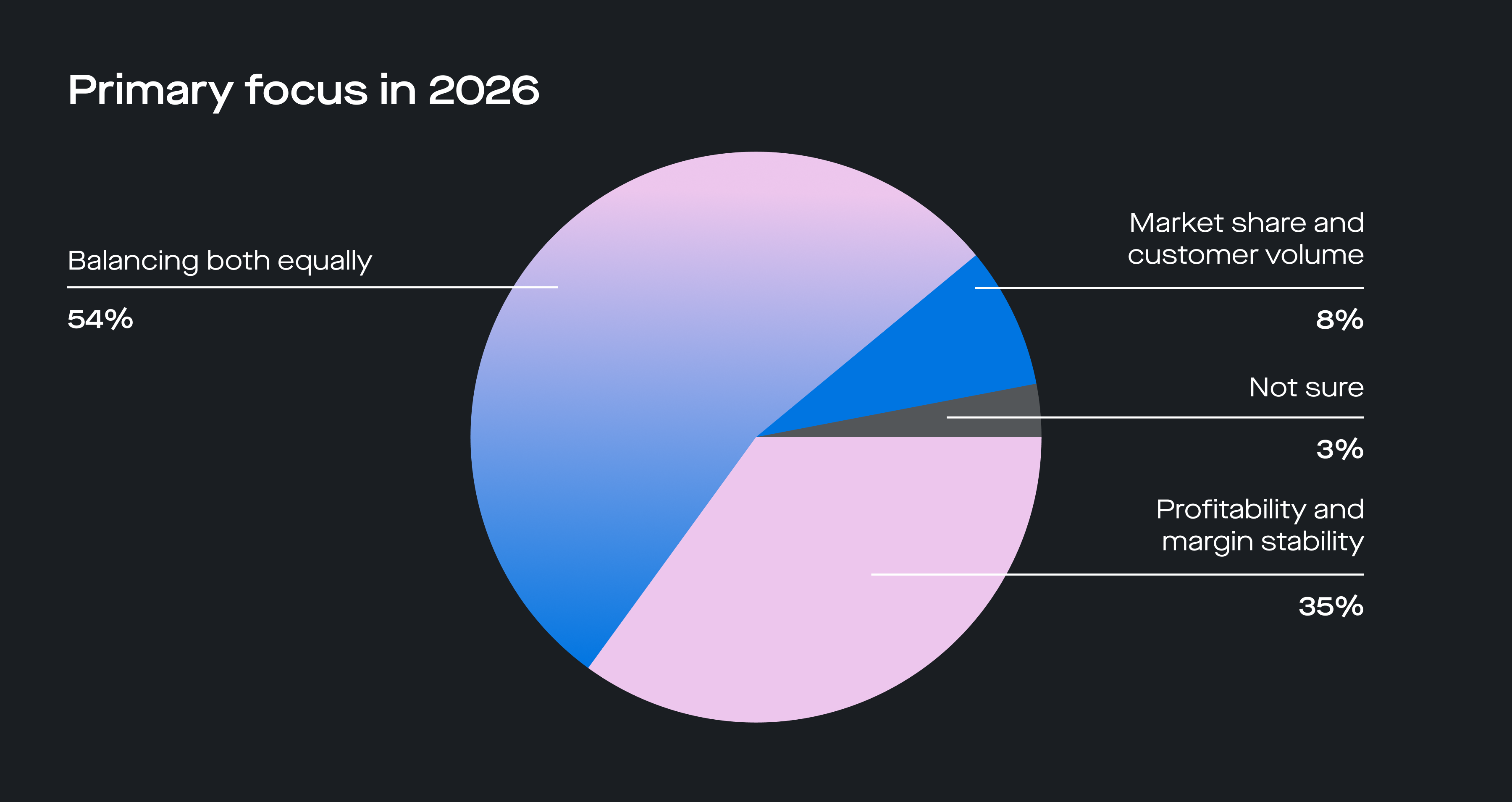
89% of brands seek profitability in 2026
Marketers’ focus in 2026:
- 54% are balancing profitability and market share equally
- 35% are primarily focused on profitability and margin stability
- 8% are prioritizing market share and customer volume
Overall, 89% say profitability is at least part of their 2026 strategy.
If that’s true for your brand too, growth will likely depend less on broad discounting and more on improving how efficiently your marketing engages, converts, and retains customers.
The core challenges tied to profitable growth: conversions, list growth, engagement, and retention
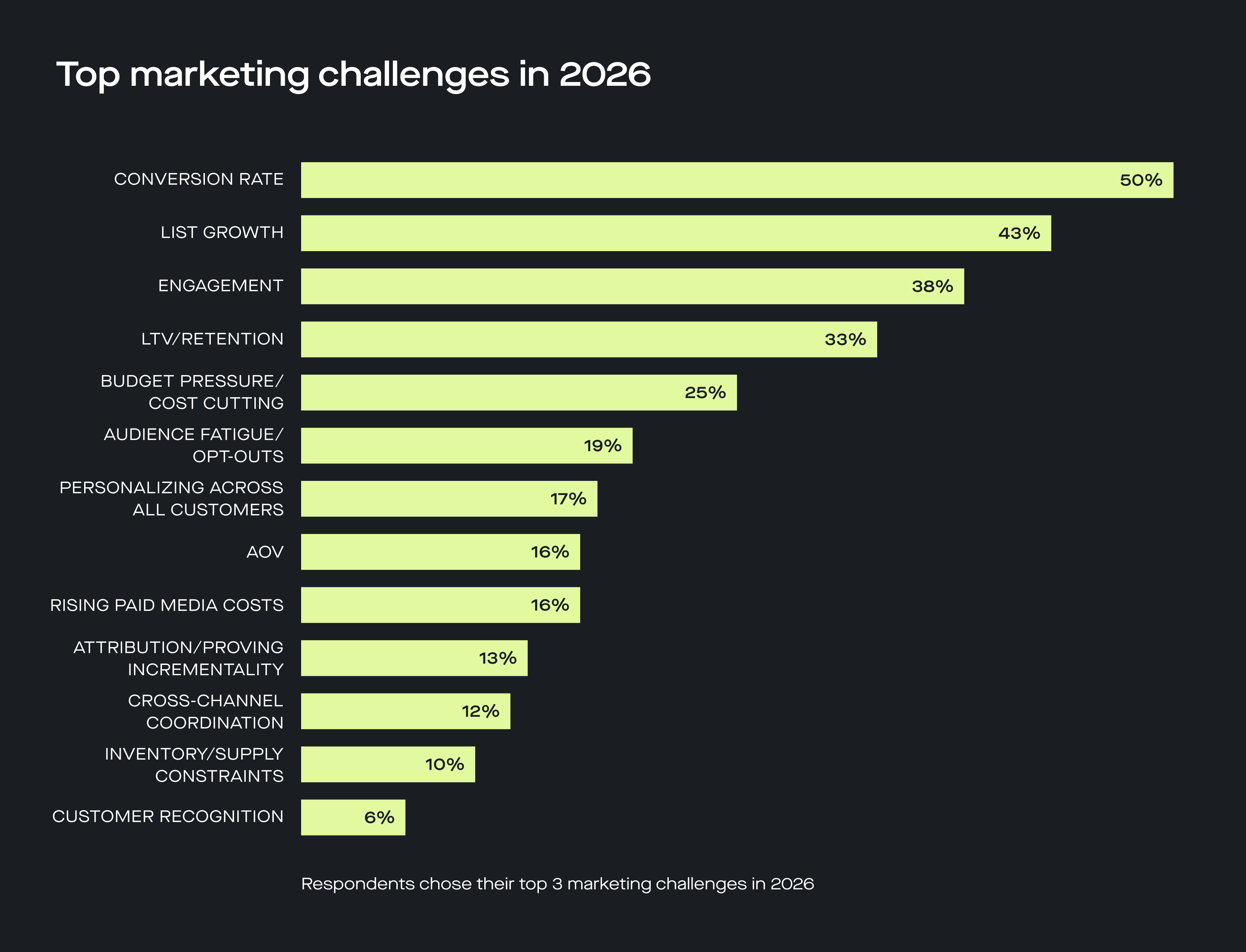
To grow sustainably, brands are focusing on improving four core metrics:
- 50%: Conversion rate
- 43%: List growth
- 38%: Customer engagement
- 33%: LTV/retention
The conversion challenge is especially understandable in today’s shopping environment. In our 2026 Personalization Trends report, 70% of shoppers said online shopping can feel overwhelming, uncertain, or time-consuming. When shoppers have a hard time deciding, they can delay their purchases or abandon them altogether.
For brands, that means relevance, timing, and clarity are even more important for turning customer interest into action.
Personalization, cross-channel coordination, and customer recognition aren’t ends in themselves. But as the rest of this report reveals, these are the tactics that move the metrics that matter: conversion, engagement, list growth, and retention.
Take action: Improve conversions while protecting profitability
If your goal is efficient growth, prioritize the tactics most likely to improve conversion, list growth, engagement, and retention without adding pressure to margins:
- Add high-intent behavioral flows to lift conversions.
- Optimize your sign-up experience to improve list growth—testing your offers, copy, formats, timing, and placement.
- Improve engagement with more relevant audience segmentation.
- Refine cross-channel coordination to drive more conversions and stronger engagement.
- Boost retention profitability by focusing on earned discounts and value-adds.
We’ll go into these in more detail throughout the report.
Channel mix: SMS and email earn more budget, while AI advertising enters testing mode
With sustainable growth as the north star, owned channels are leading the way. SMS and email remain the most stable parts of the channel mix. RCS, push, and AI advertising are emerging as areas to test.
Owned channels keep delivering
Messaging performance is giving brands a reason to keep leaning in: 68% of marketers say performance for their messaging programs (SMS, email, push, and RCS as relevant) has improved year over year.
Among respondents with visibility into the channels:
- 45% are investing more in SMS and 50% are keeping investment the same
- 36% are investing more in email and 61% are holding steady
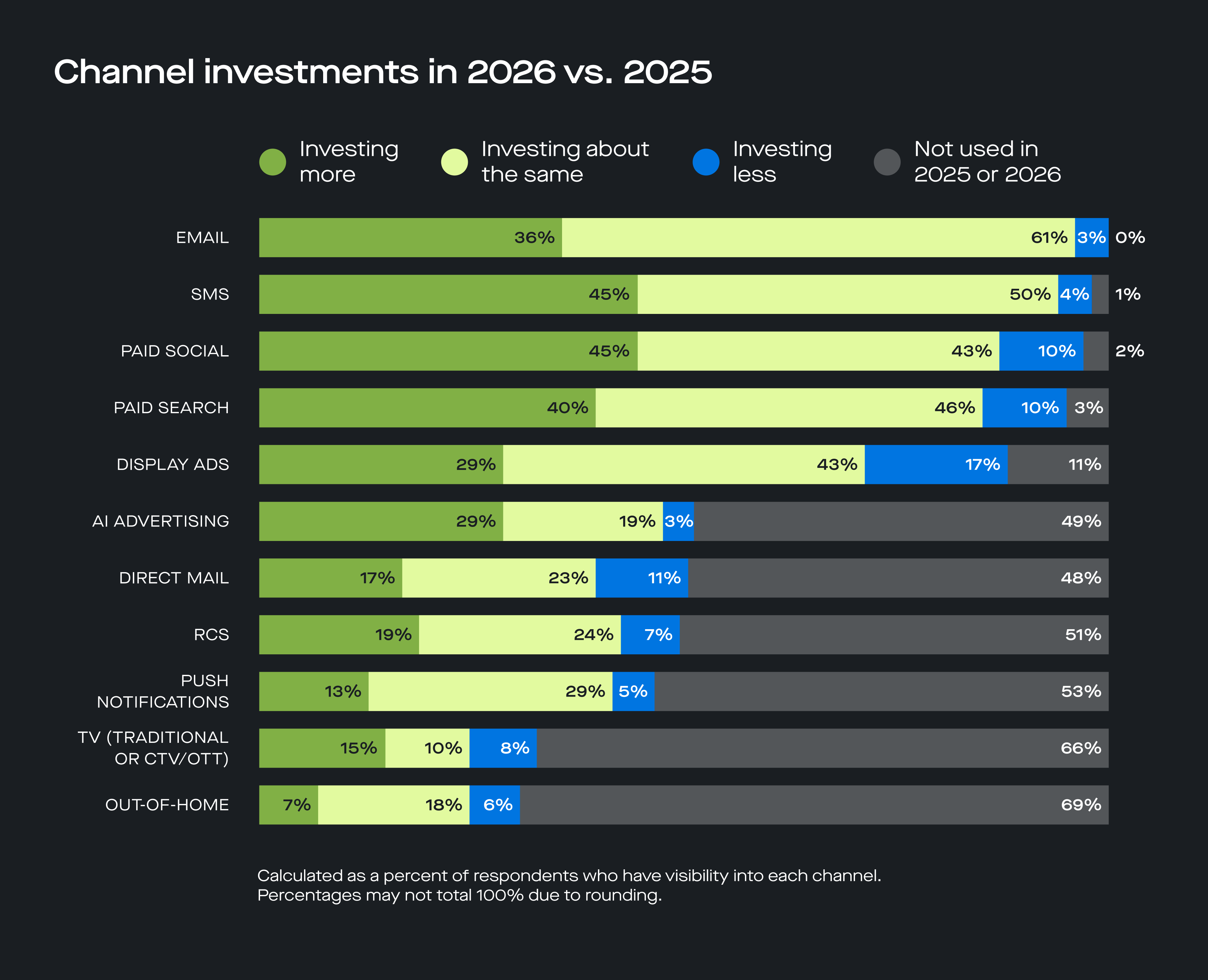
That’s a strong signal for brands deciding where to re-allocate budget. While some legacy channels are seeing more pullback, SMS and email continue to hold up because they give brands a direct, measurable way to drive traffic, conversion, and repeat engagement.
Tracy Yoon’s perspective helps explain what this looks like in practice. At Resident, stronger new SMS subscriber volume coming out of BFCM naturally led the brand to invest more in the channel. A larger audience has made tighter targeting more important to get the most out of their messaging efforts.
“We’re investing more in SMS this year after an uptick in new subscribers from BFCM. As our investment has grown, it’s required us to be even more thoughtful about segmentation to maintain high engagement and reduce wasted sends. We’ve already tightened our evergreen audiences, and now we’re personalizing more deeply—for example, by mattress size—to get the most out of SMS.”
- Tracy Yoon, Senior CRM Manager, Resident
RCS and push are emerging opportunities to expand owned messaging
RCS and push stand out as meaningful next-channel opportunities for brands prioritizing growth through owned channels.
Adoption is still early, but the brands using these channels are generally not pulling back.
RCS shows early momentum:
Among respondents with visibility into the channels, 49% say they are using or plan to use RCS in 2026. And of the brands already investing in RCS, 87% are maintaining or increasing investment.
This makes sense, as 92% of shoppers say at least one RCS feature would improve their shopping experience. And early results show that RCS delivers 20% higher conversions at 14x lower cost-per-click compared to SMS.
Push notifications are also high-impact:
Push notifications have been around for longer, but brands are slower to adopt. Still, 47% of brands are using or plan to use push notifications in 2026. And 89% of brands already investing in push are maintaining or increasing investment.
Data from Tapcart shows that mobile apps see a 63% higher conversion and 35% increase in LTV compared to mobile websites.
If SMS and email are already performing well, RCS and push may be worth evaluating as ways to create richer experiences through coordinated messaging.
AI advertising attracts interest as shoppers spend more time in chatbots
In the January 2026 Attentive Consumer Pulse, 70% of consumers said they’ve used AI to help with a shopping-related task in the past three months, so it makes sense that AI advertising is starting to draw attention.
Among respondents with visibility into AI advertising at their organization:
- 29% say they are investing more
- 49% say they have no plans to try it yet
Furthermore, when we asked marketers what they’re doing to show up in AI chatbot conversations, only 11% said they’re actively advertising right now.
That puts AI advertising ahead of some legacy channels for growth intent, but still firmly in test mode.
For most brands in 2026, LLM placements are worth a test if you have paid ads budget to spend, but it’s worth prioritizing organic LLM discovery first.
Take action: Invest in owned channels with clear roles
If your brand is increasing channel investment in 2026, keep your goals in mind to ensure that spend is translating into stronger conversion, engagement, and retention.
1. Keep SMS and email at the center of your mix, where performance is strong.
If owned messaging is delivering, it makes sense to protect and extend that momentum.
2. Pair higher investment with tighter segmentation.
As Resident shows, more volume in a channel benefits from more precise audience logic. Use product interest, lifecycle stage, and engagement history to keep messages relevant.
3. Give each channel a clear role.
Give each channel a job to do within your campaigns: SMS for urgency, email for richer storytelling, push for in-app action, and RCS for more interactive mobile experiences is a strong starting point.
Let that structure guide your campaign logic as a cohesive experience.
4. Test emerging channels where they can improve performance and the shopping experience.
RCS and push look promising because adoption is still early while shopper appetite is already clear.
Start with use cases where the experience can make it easier for shoppers to act. For example, RCS can be used to give shoppers a smoother product recommendations experience, while push can support faster mobile purchase journeys.
5. Approach AI advertising as a test, not a replacement for website optimization.
Test paid placements in LLM chats if you have paid ads budget to play with, but let your website do the heavy lifting for organic placements.
Promo strategy: Brands recalibrate deals to protect margins without losing demand
In 2026, brands are navigating margin pressure pushing them toward higher prices and fewer discounts, while shoppers are more price-sensitive than ever.
As a result, marketers are taking a more deliberate approach to promotions: fewer blanket discounts, but more targeted offers, earned rewards, and a bigger role for value messaging.
Marketers adjust to economic conditions as shoppers pull back
Nearly a year after new US tariffs were announced, 93% of marketers are still managing tariff-related cost pressures.
The adjustments they’re making in 2026:
- 38%: Raising prices
- 26%: Reducing discounts
- 23%: Improving marketing ROI/efficiency
- 22%: Prioritizing higher-margin products
- 21%: Emphasizing value to justify higher prices
- 20%: Shifting toward value-add offers like free shipping, gifts, or loyalty points
- 19%: Lifting AOV
- 16%: Reducing product assortment
But there’s tension here. 89% of shoppers are managing costs, including waiting for sales and discounts, comparing prices more carefully, and switching to lower-cost alternatives.
For brands, that highlights the need for balance. Shoppers want to be smart with their money, but margin pressure is real. So value-add offers, clearer value propositions, and more refined discount strategies all become more important for converting customers in 2026.
Selective and less-frequent discounting is a new norm—especially when profitability is the aim
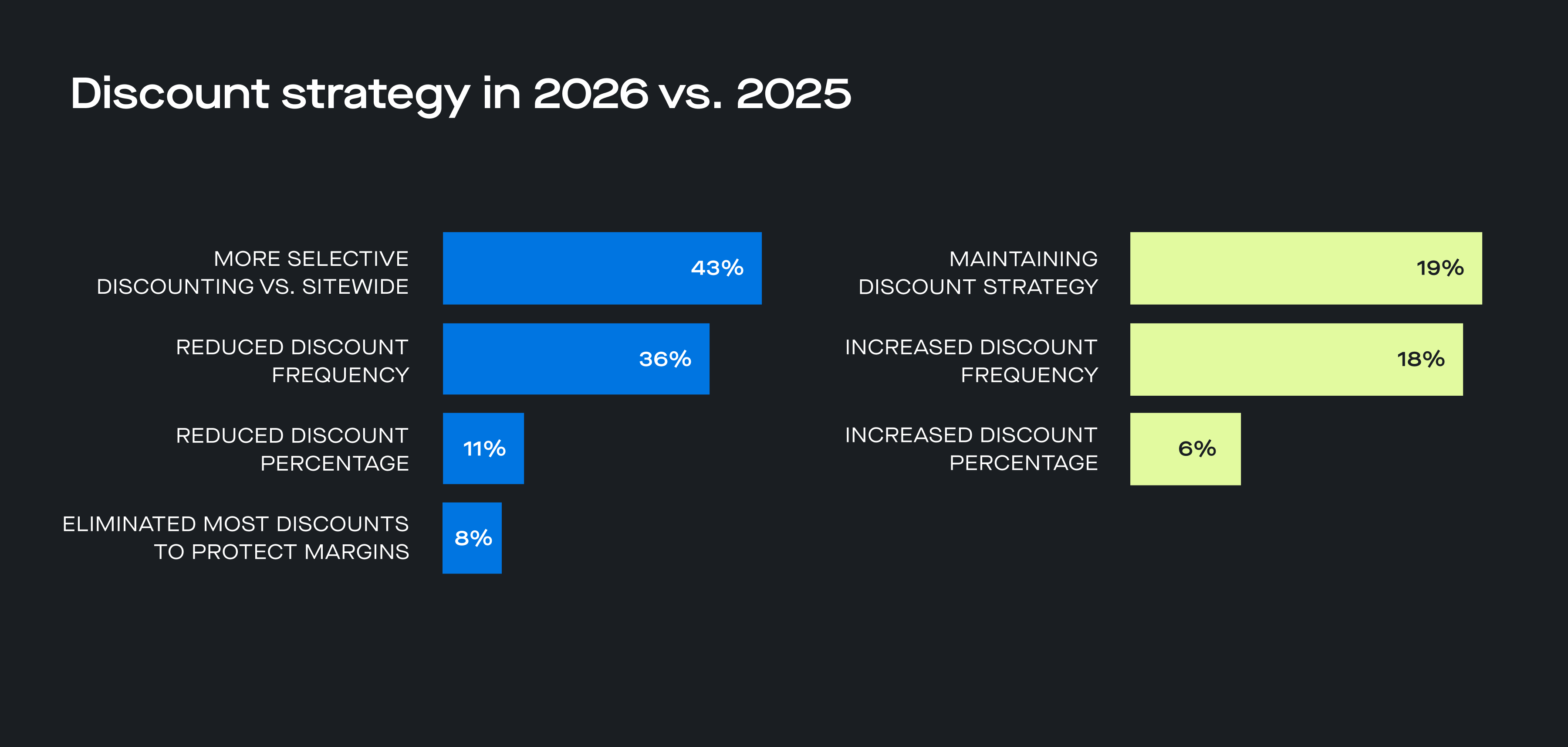
81% of brands have changed their discount strategy compared to last year.
The most popular updates:
- 43% are discounting more selectively vs. sitewide
- 36% say they have reduced discount frequency
This is more pronounced among brands prioritizing profitability. 42% are reducing discount frequency, compared with 31% of brands prioritizing market share.
The good news: Exclusivity wins out for returning customers. Our 2026 State of Loyalty & Retention report found that 41% of shoppers say VIP-exclusive discounts are the #1 type of offer that would keep them coming back—winning out over broad discounts available to everyone.
If your brand is trying to protect margins, selective discounting gives you more control over what you promote, who sees an offer, and what behavior you’re trying to drive. It also helps prevent lower prices from becoming a default expectation.
Alternatives to traditional discounts: Shipping, gifts, and threshold offers
Traditional blanket discounts are still the most popular incentive by a wide margin. After that, the strongest alternatives are free/expedited shipping, gifts with purchase, and threshold/tiered offers.
Among brands that didn’t select traditional blanket discounts, the most-cited alternatives are:
- Free/expedited shipping (35%)
- Gifts with purchase (32%)
- Threshold/tiered discounts (28%)
- Product bundles (26%)
- Loyalty pricing (26% each)
That’s a useful benchmark for brands trying to reduce discount dependence. These brands are shifting more toward value-add offers or structured deals that encourage higher cart values—which ultimately increase profitability.
Consumer preferences support that approach. 38% of shoppers say free or faster shipping is a top factor that will encourage them to buy a second time with a new brand.
And the top loyalty perks shoppers want for sticking with a brand are:
- Free/faster shipping (65%)
- Rewards points (59%)
- Free gifts (52%)
Take action: Protect margin without losing demand
If your brand is seeking to protect margin and keep demand high, you can refine how you discount to encourage purchases and higher AOV.
1. Lean into targeted offers and use blanket discounts more selectively.
Reserve sitewide promos for key acquisition moments like converting new subscribers in your welcome flow or during major calendar moments when you want to bring in new customers.
Then use more targeted offers to support specific products, activate low-intent shoppers, or reward loyal customers.
For example, you can discount a main product’s accessories if those typically have a lower conversion rate. Or promote just a new collection to past purchasers who haven’t shopped in awhile.
2. Use structured offers and value-adds when you want to protect margin.
Use offers that reward higher cart values like:
- Subscribe-and-save
- Bundles and bulk buys
- Buy-one-get-one
- Threshold-based deals
Layer in value-adds when you want to motivate action without reducing product margin directly:
- Free shipping
- Gifts
- Rewards points
3. Support higher prices with stronger value messaging.
As shoppers compare their options more carefully, make it easier for them to choose you:
- Frame products around practical value and outcomes.
- Emphasize quality through materials, ingredients, or production process.
- Surface reviews and comparisons.
- Reduce friction with clear information about warranties, shipping speed, and returns.
Messaging execution: Higher frequency and sharper targeting correlate with better performance
Messaging performance is moving in the right direction. 68% of marketers say their messaging program performance has improved since last year, another 21% say it’s stayed about the same.
When we look at message cadence and engagement tactics alongside messaging program performance (SMS, email, push and RCS), we see a clear pattern:
Higher performance programs send more frequent, more relevant messages.
Higher-performing brands send more messages per subscriber—but they have to be relevant
Nearly half of brands (46%) are sending more messages per subscriber year over year. 39% are holding steady and 15% are sending less.
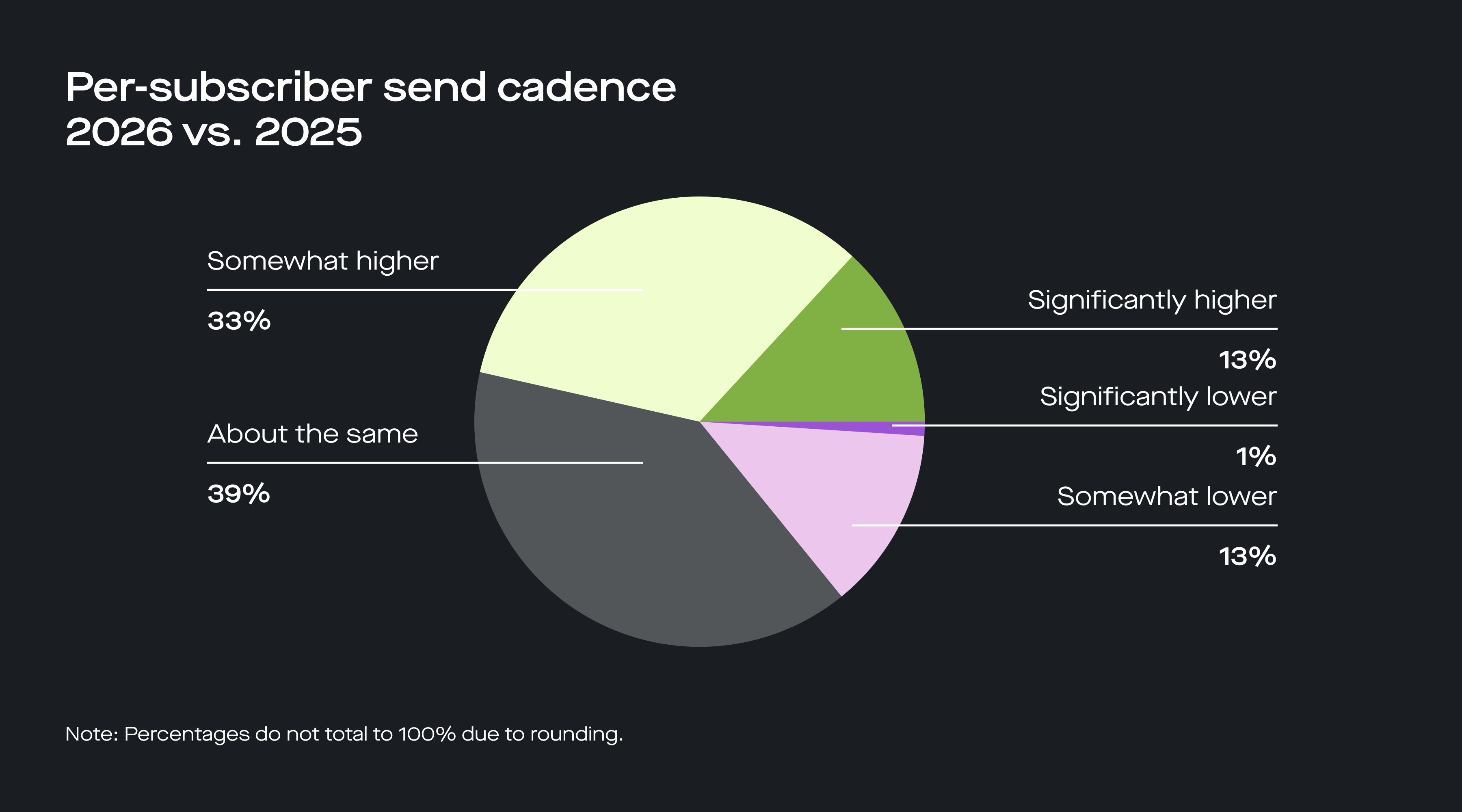
That higher sending cadence is largely represented by brands with better program performance: 56% of higher-performing brands are sending more, compared with 23% of brands whose performance stayed the same and 22% of those whose performance declined.
And message frequency isn’t just increasing because brands have more activity to promote, like launches and sales—as only 17% of marketers report. The top two factors are:
- Prioritizing growth on owned channels (33%)
- Using more journeys/behavioral flows (32%)
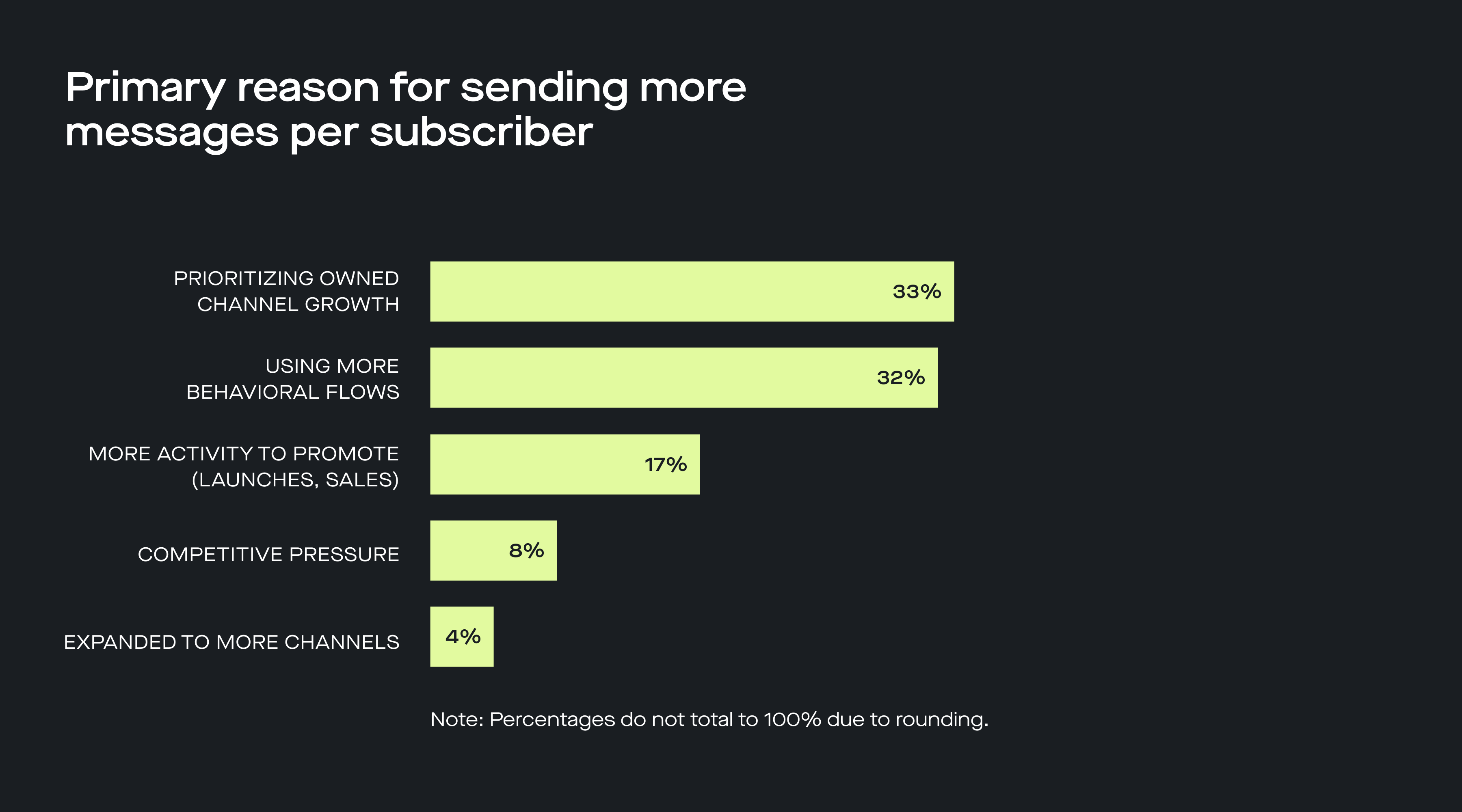
This suggests higher cadence can work, but it’s not just about volume. Data from our 2026 Personalization Trends report shows that shoppers have an appetite for higher cadence if the brand earns it:
65% of shoppers are open to receiving messages more often if they’re relevant.
Prepping for BFCM 2026: Ramp up your send volume now
Brands that send a higher, more consistent volume of emails from Q2 to Q4 before their BFCM push see significantly better results than those who save up their emails for a big spike during BFCM.
Brands that spiked their sends in Q4 2024 without that gradual ramp saw a 22% lower ROI than all other brands. So, start lifting your volume now—just keep relevance high through segmentation and behavioral triggers as you do.
Engagement gains come from targeting, behavioral triggers, and stronger content
These are the engagement levers marketers say improve engagement the most:
A couple of these tactics separate higher-performing programs from the rest: targeting and personalized content.
74% of brands whose performance improved say targeting/segmentation is effective for engagement, compared with 70% of those with unchanged performance and 61% of those whose performance declined.
Higher-performing brands are also more likely to cite personalized content as an effective lever (36% vs. 26% of brands whose performance declined).
The inverse is also telling: brands whose performance declined are more likely to say bigger offers and incentives drive engagement (26% vs. 18% of brands whose performance improved). This suggests that when offers are doing too much of the work, there may be an opportunity to strengthen personalization efforts.
Take action: Improve performance through relevance
1. Increase cadence and relevance together.
Higher-performing brands are sending more messages per subscriber—and now’s the time to start lifting send volume in preparation for BFCM. But shoppers want more frequent messages to feel relevant to them.
So pair higher frequency with stronger segmentation, behavioral triggers, and personalized content.
2. Let targeting and content do more of the work.
Higher-performing brands are more likely to lean on segmentation and personalized content to drive engagement—not bigger offers.
So if you find that discounts are doing too much of the work, it could be a sign that something else needs attention—whether that’s your audience strategy, positioning, or messaging strategy.
You might have an opportunity to refine your value proposition, clarify your target audience, or connect better to the underlying motivators of your customers.
Or you might benefit from increasing campaign relevance through better targeting, more behavioral triggers, and personalized content.
Personalization: Brands that personalize are 3.5x as likely to see performance gains—and AI makes it easier to scale
The performance gap between brands that personalize and those that don't is one of the starkest findings in this year's survey.
69% of brands that personalize their marketing saw improved messaging performance year over year. Among brands that don't personalize, that number drops to 20%.
That gap isn't surprising when you look at the shopper side. According to our 2026 Personalization Trends report:
- 93% of shoppers say they're more likely to keep buying from a brand that delivers personalized experiences.
- 80% of shoppers will ignore brands that send irrelevant messages.
- 53% say a brand remembering their preferences is a top driver of repeat purchases.
The question is: how to personalize more efficiently.
The foundation: Audience segmentation and journeys
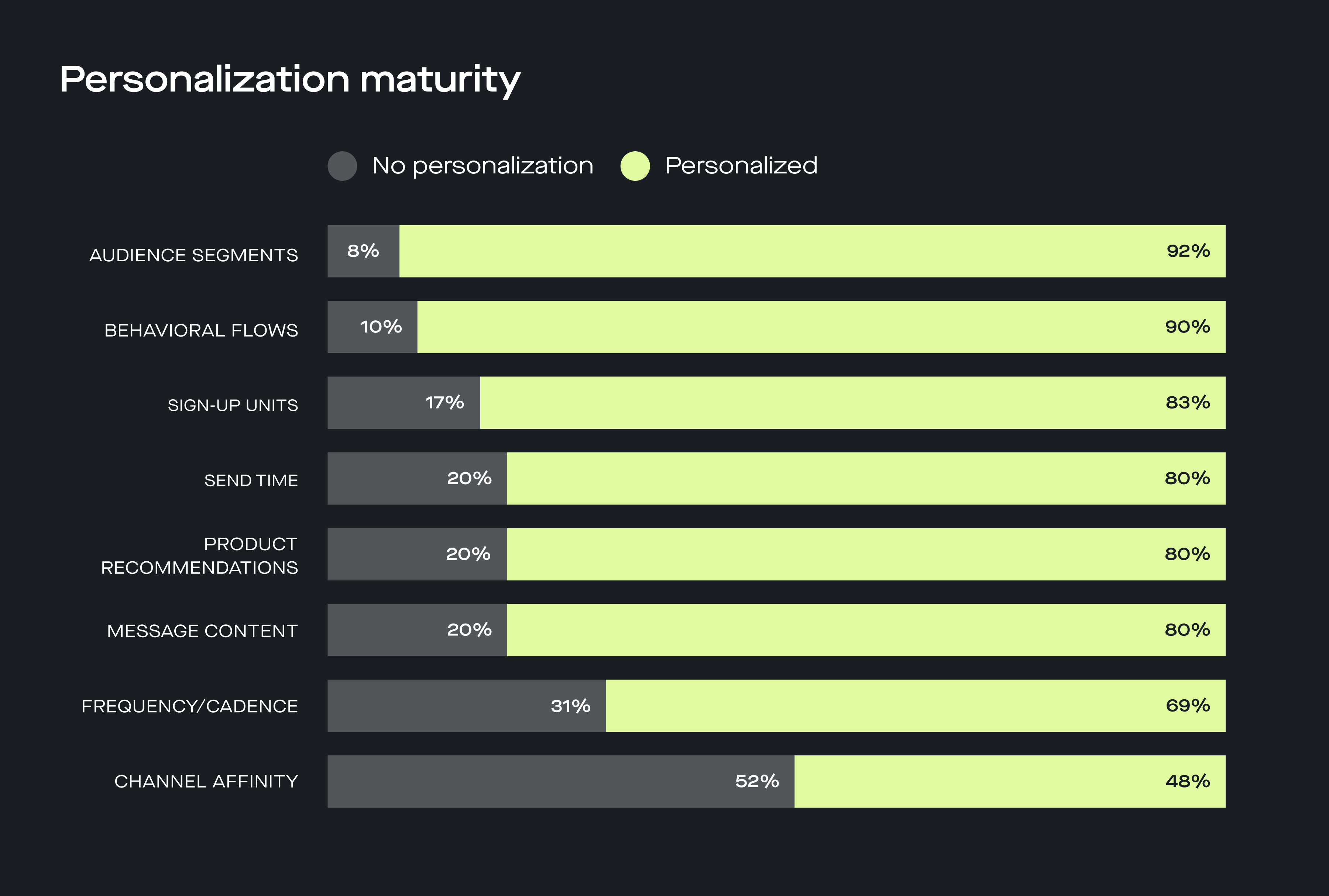
Personalization spans everything from how you grow your list to what you send, when you send it, and who gets it. The good news: most brands have the fundamentals in place.
- 92% use audience segments in their messaging program
- 90% use behavioral flows
- 83% personalize their sign-up units
- 80% personalize message content and send time
Behavioral triggers often do better than individual campaigns and give you automated revenue. So they’re worth doubling down on.
As J.R. Tomaszewski, Director of Digital Marketing at Elite Sportswear, puts it:
Triggered campaigns are the untapped conversion fountain. When you have the knowledge that the consumer is engaging with your brand, that is the prime time to ACT on that interest and intent before their eyes move to your competitors.
- J.R. Tomaszewski, Director of Digital Marketing, Elite Sportswear
Consumer data backs this up. 85% of shoppers are more likely to purchase after a sale or price-drop alert, 81% after a back-in-stock notification, and 62% after a reminder about something they meant to buy.
These connect directly to journeys you can set up.
AI delivers real results—time savings, revenue, and faster testing
The brands adopting AI are pulling ahead.
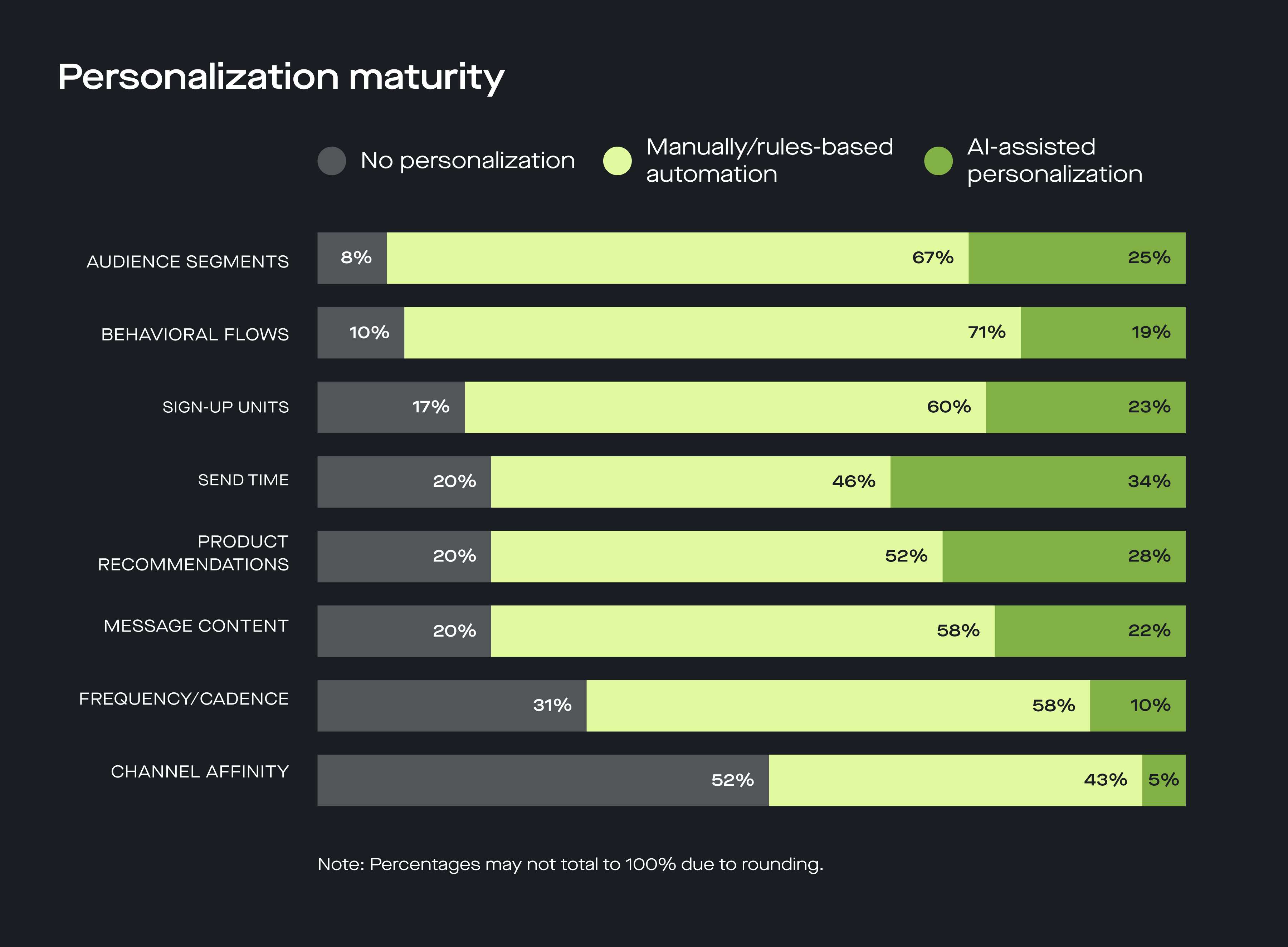
AI assistance is most common in:
- Send-time optimization (34%)
- Product recommendations (28%)
- Audience segments (25%)
- Sign-up units (23%)
Use cases like behavioral flows, frequency/cadence optimization, and channel affinity are earlier in adoption, so there's meaningful room to expand.
The payoff brands report from AI use:
That combination—efficiency and measurable commercial impact—is notable. Beyond reducing workload, AI is driving revenue gains for a meaningful share of brands, even before it's fully embedded across personalization use cases.
Anna Ridle, who leads lifecycle marketing at Aloha, emphasizes the impact using AI for segmentation has had on the brand’s SMS performance:
“Audiences AI enables us to scale SMS revenue without compromising the subscriber experience. By aligning sends with individual frequency preferences and intelligently expanding campaign reach, we’ve been able to double revenue on targeted campaigns while maintaining low unsubscribe rates.”
- Anna Ridle, Director of Lifecycle Marketing, Aloha
Take action: Do more with your customer data—then layer in AI
1. Audit your behavioral flows for gaps.
Most brands have the core flows (welcome, abandonment, post-purchase), but fewer have additional triggers that shoppers say move them: sale alerts, back-in-stock notifications, loyalty point reminders, and replenishment reminders.
Each of these is an opportunity to respond to real intent and earn more revenue in the process.
2. Segment beyond the basics.
If your audience logic relies mainly on purchase history and engagement status, you likely have room to get more specific.
Add in product category interest, lifecycle stage, and high-impact zero-party data—the details specific to your brand that will help with audiencing like gender, skin type, fitness goals, etc.—to make messages feel more relevant.
3. Use AI where it removes the most friction.
AI-powered send-times and segmentation are good starting points because they improve results without requiring significant workflow changes. Attentive AI Pro drives a 15% lift in text and email revenue—without adding to your team's workload.
From there, AI-powered list growth and journeys can expand what’s possible at scale. Attentive AI Grow earns 25% more subscribers from the same traffic by personalizing pop-up timing. And AI Journeys helps brands drive 100%+ more revenue by adapting each behavioral flow to the shopper’s context with your brand.
Cross-channel coordination: Connected programs see better results
Shoppers experience your brand as one relationship. Yet brands often interact with shoppers in channel silos, not as a connected experience—until they start coordinating their programs.
The gap between coordinated and uncoordinated programs shows up clearly in performance:
The more coordinated programs become across channels, the more likely a brand is to see year-over-year performance improvements.
Programs that personalize coordination are 1.8x as likely to see improved performance
Not all cross-channel programs are built the same. There’s a spectrum:
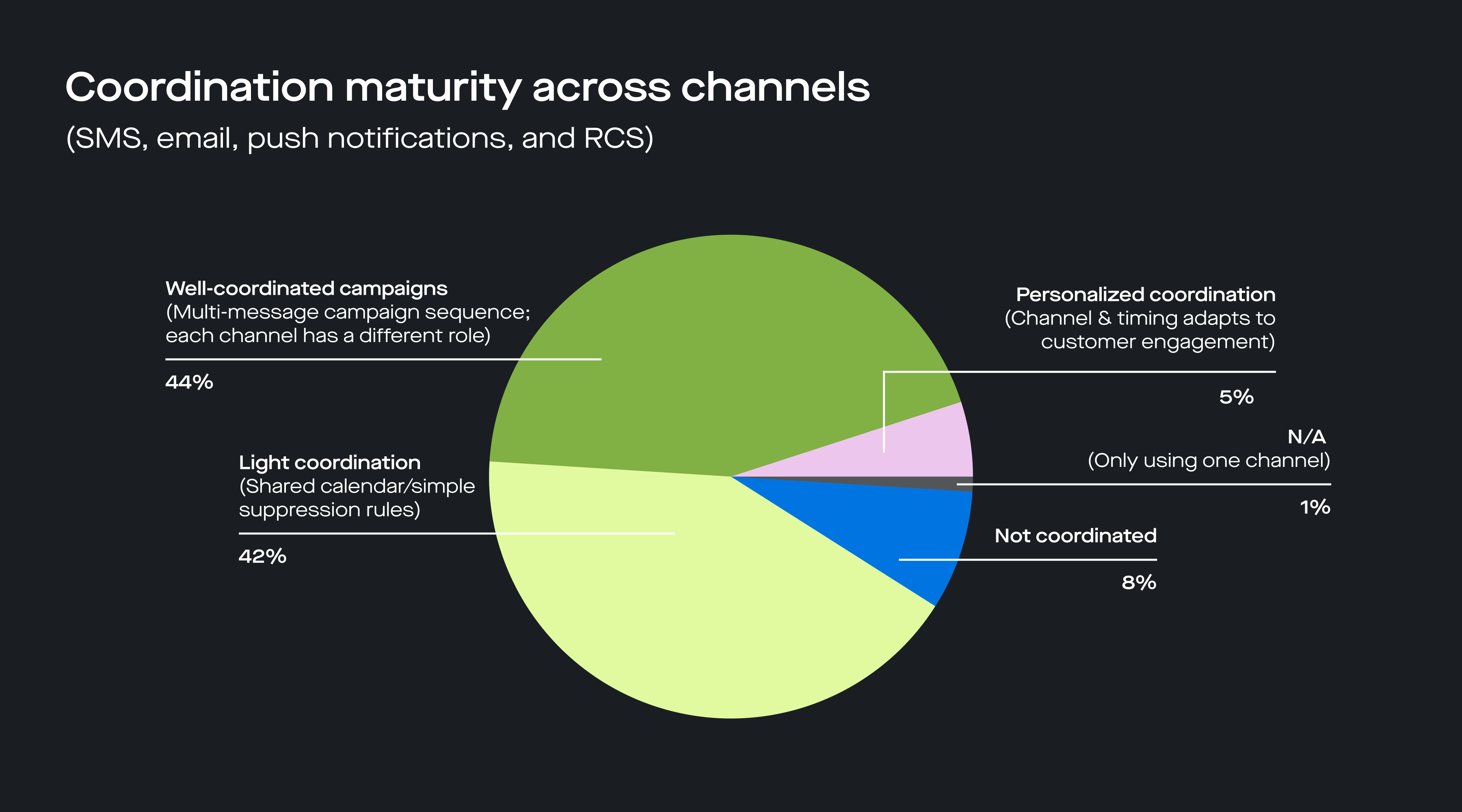
- 8% of brands have no channel coordination at all.
- 42% have light coordination—shared calendars or simple suppression rules.
- 44% run well-coordinated campaigns where each channel plays a distinct role.
- 5% have personalized coordination, where channel and timing adapt to each customer based on engagement.
(1% use only one channel.)
Most brands are present on multiple channels—but presence isn't the same as coordination.
The difference between multichannel (channels operating independently) and omnichannel (channels sharing data and informing each other) shows up directly in performance:
- No coordination: 50% report improved performance
- Light coordination: 58% report improved performance
- Well-coordinated: 78% report improved performance
- Personalized coordination: 90% report improved performance
That’s a fundamentally different outcome.
Shopper data from the 2026 Personalization Trends report reinforces this: 57% of shoppers are more likely to purchase when they see the same promotion across channels—but 73% want those follow-ups to add something new rather than repeating the same message.
So coordination works when each channel has a clear job to do and relates to the last message a customer received.
91% of brands are investing in better coordination
Nearly every brand surveyed (91%) is actively working to improve cross-channel coordination in 2026, regardless of where they’re starting from.
Their top priorities:
A few patterns worth noting:
- Brands with light coordination are focused mainly on improving shared plans across channels—but data integration is a higher-leverage move, and they’re underinvesting there.
- Brands without coordination are prioritizing clarifying channel roles second. That’s the right instinct: you can’t coordinate what you haven’t defined.
- Among the small group with personalized coordination, 50% are prioritizing subscriber recognition—which makes sense, since identifying the same customer across sessions and channels is what makes adaptive, personalized coordination possible.
Take action: Move up the coordination curve
1. Define your channel roles before anything else.
Coordination breaks down when channels duplicate each other. Start by assigning each channel a distinct purpose: SMS and RCS for immediacy and action, email for richer storytelling and detail, push for driving in-app behavior. Once roles are clear, campaign logic follows more naturally—and shoppers get a more coherent experience.
2. Connect your data so channels can inform each other.
Many coordination problems are data problems. If your channels don't share customer behavior in real time, you're operating in silos and may end up repeating yourself when a customer has already acted on a message in a different channel.
Consolidating SMS, email, push, and RCS onto a single platform removes the latency and manual overhead that comes from syncing across systems—and makes multi-channel behavioral flows significantly easier to manage.
Identity resolution: Customer recognition gives brands a performance lift—but most are underinvesting
Every personalization and coordination tactic in this report depends on one thing: knowing who you're talking to.
Identity resolution—the ability to recognize the same customer across devices, sessions, and channels—is what makes that possible.
But many brands' subscribers are showing up as anonymous visitors every day—and without the ability to recognize them, triggered flows don't fire and personalization becomes less accurate.
Wondering how to put this into action? Watch the webinar to find out how brands are using stronger identity to reach more customers and improve performance across messaging channels.
Identity resolution lines up with performance gains
The data shows brands that prioritize customer recognition perform better: 79% of brands actively investing in identity resolution report improved messaging performance year over year—versus 59% of brands that say identity isn't a priority in 2026.
That 20-point gap is meaningful on its own. But it's also worth noting the pattern: Identity-prioritizing brands are much more likely to say better targeting and segmentation (76% vs. 48% of those who aren’t prioritizing identity) and personalized content (40% vs. 21% of those who aren’t prioritizing identity) are effective engagement levers.
So higher-maturity teams are getting more out of their personalization efforts because of their investment in identity resolution.
The consumer side makes clear why this matters.
The average shopper engages with brands in four different ways—across platforms, devices, and in-store—and 53% are aware they've switched devices or sessions before completing a purchase.
Plus, 67% are more likely to unsubscribe if reminders keep coming after they have already bought a product. This is a direct result of poor identity resolution.
Some brands are under-investing in customer recognition
Most brands aren’t confident in their recognition capabilities:
- 16% of marketers say they're very confident in their ability to recognize the same customer across devices and sessions
- 48% are somewhat confident
- 31% are not very confident or not at all confident
Investment levels reflect that uncertainty—but not always in the right direction:
- 19% are actively investing in identity resolution
- 24% plan to invest this year
- 24% are still assessing whether it's a problem
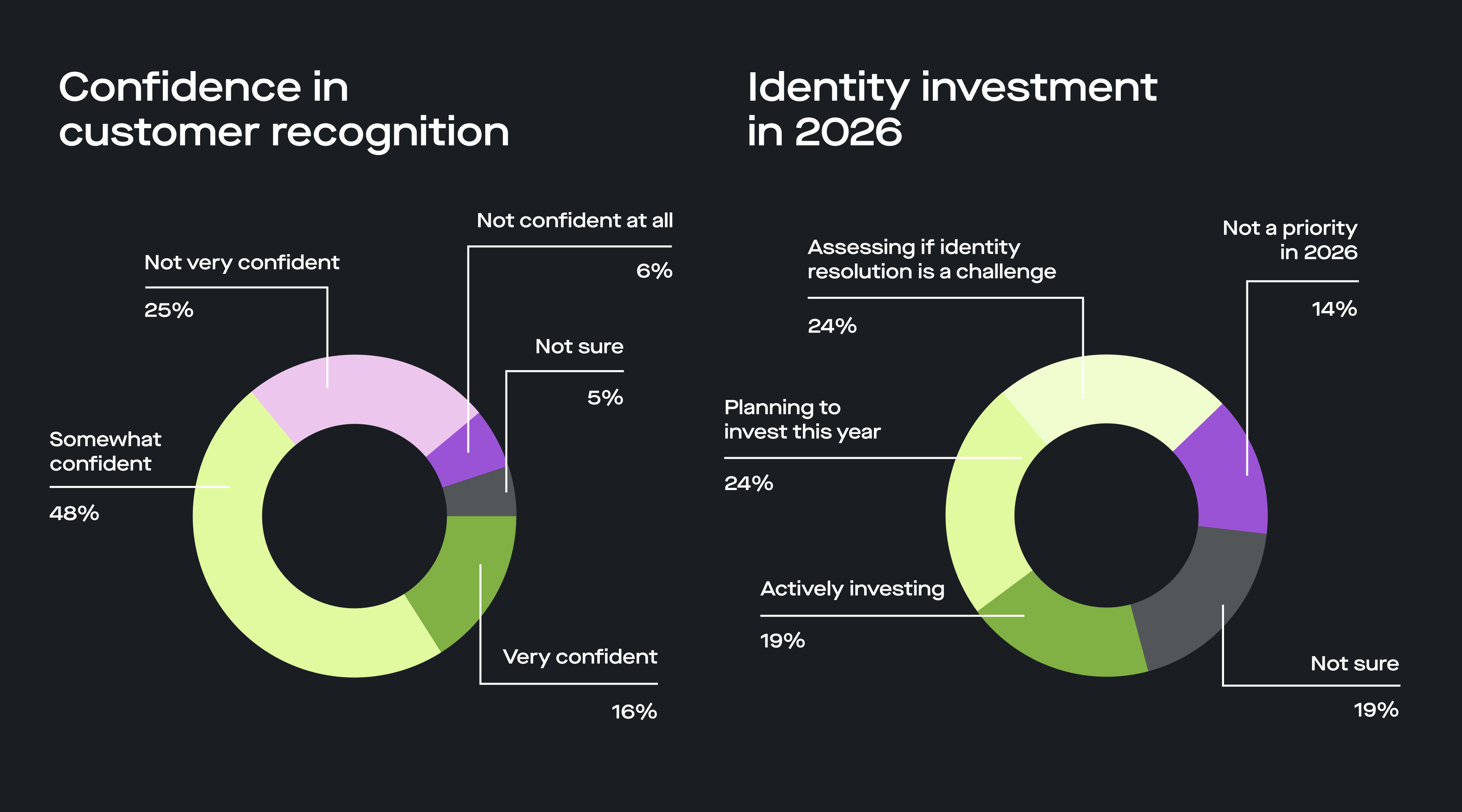
Among brands who are not very confident or not at all confident in their recognition capabilities, only 10% are actively investing in identity resolution. And 60% say it's not a priority at all, compared to just 6% of high-confidence brands. Some brands are aware of the gap but haven't connected it to a solution yet.
There's also a technical reason identity is often a challenge. Phone numbers are relatively stable identifiers—75% of shoppers have just one active cell phone number. Email is much noisier: 75% of shoppers have at least two active personal email addresses, and 32% use a separate email or proxy specifically for marketing sign-ups.
Brands built around email-centric identity are working inherently with a less reliable signal—and most legacy platforms are built exactly that way. So brands are fighting an uphill battle they don’t need to be fighting.
The brands that want better personalization but deprioritize identity are working against themselves
Here's the tension in the data: Brands that say identity is not a priority are actually more likely to list improving personalization as a top messaging goal (38% vs. 22% of identity-prioritizing brands), and more likely to cite personalizing across all customers as a key challenge (24% vs. 13%).
They want the outcome without the enabler. Identity resolution is where personalization starts—without it, you're duplicating messaging and missing opportunities to connect.
Take action: Close the recognition gap
1. Anchor identity to phone number where possible.
Phone-based identity is more durable than email-based identity. Encouraging SMS sign-ups or collecting phone numbers at checkout gives you a more stable profile to build on.
2. Invest in subscriber recognition to power personalization
You can't send the right message at the right time if you don't know who you're talking to. Many legacy platforms treat the same customer as multiple contacts depending on how they subscribed or what device they're on—which leads to over-messaging, suppression gaps, and coordination mishaps.
Attentive Signal takes a different approach: it anchors identity to a phone number—the most stable identifier a customer has—and links all of their identifiers back to one unified profile. Brands that resolve this see 20% higher conversion rates and 95% more triggered email revenue.
Staying visible in iOS26: Known Sender status protects SMS success
Apple’s iOS 26 introduced changes to how text messages are displayed in the iPhone Messages app. This update expands the iPhone’s “Screen Unknown Sender” functionality to filter messages from unsaved numbers out of users’ main inbox—silently routing them to an “Unknown Senders” folder with no lock screen notification, no badge alert, and no sound.
The setting is off by default, but Attentive research found that 55%+ of US consumers with Apple devices will have it enabled—and 70% don't regularly check their Unknown Senders inbox. For messages that land there, click-through rate and conversion rate drop by 30–40%, with text marketing revenue dropping in parallel.
The good news: 81% of marketers are already working on this—and there's a clear playbook for earning Known Sender status.
Known Sender status starts at sign-up
The most reliable path to Known Sender status is to have subscribers initiate the conversation.
This is why Attentive’s two-tap™ is the most widely used Known Sender tactic (56%).
Two-tap™ sign-up units require the subscriber to send the first message, classifying the brand as a “Known Sender” from day one, consistently delivering a brand’s message to the main inbox.
As a bonus, two-tap™ sign-up reduces friction, capturing 2x more subscribers than other sign-up units.
If you aren’t using two-tap™ everywhere, brands are also using these tactics to help close the gap:
- 43%: Send a contact card in the welcome flow to encourage subscribers to save the brand’s number.
- 20%: Text-to-Join keywords—a great tactic for off-site sign-ups at retail stores or on physical postcards.
- 14%: Send conversational messages that encourage a reply—once a subscriber replies three times, Apple will classify your brand as a known contact.
Each of these tactics works toward getting your messages in the main inbox.
Take action: Earn Known Sender status at every entry point
1. Audit your sign-up methods.
The sign-up method determines inbox placement. Two-tap™ is the most complete fix for new subscribers. If you’re not already using two-tap™ sign-up units, that’s the highest-leverage place to start.
2. Add a contact card to your welcome flow.
For subscribers who aren't acquired through two-tap, sending a contact card immediately after sign-up gives them the quickest path to saving your number. One tap, and future messages land in their main inbox.
3. Use conversational moments to build recognition.
Prompting replies—for example, through preference questions or to claim a welcome discount—creates the two-way interaction that signals Known Sender status. Once a subscriber sends your brand three messages, you’ll start showing up in their primary inbox.
As a bonus, these conversational moments are a natural way to gather zero-party data you can use for segmentation later.
AI is the breakout discovery channel of 2026: LLM playbooks are a priority as AI referrals drive higher-intent traffic
Shoppers are increasingly turning to AI assistants before they turn to search engines—and that shift is accelerating fast. According to the January 2026 Attentive Consumer Pulse, 70% of consumers used AI to help them shop in the previous three months.
Their top AI use cases—product-specific questions, comparing features, finding deals, and summarizing reviews—all point to the same thing: shoppers are using AI to do their research before they ever land on your site.
Adobe’s 2025 BFCM data reveals a compelling trend: Shoppers who land on a brand’s website from an AI chatbot conversation spend more time on the brand’s website and convert better than those not referred by an LLM. So once these high-intent shoppers land on your website, you can use your owned channels to convert that traffic faster
That makes AI discovery a real acquisition channel, and brands are paying attention. 83% of marketers are developing playbooks to improve their chances of showing up in AI assistant conversations. Only 17% aren't doing anything yet.
Most brands are starting with owned-site content—and that's the right instinct
The tactics brands are prioritizing map closely to what shoppers are asking AI assistants:
Brands are starting with what they own and control before investing in external placements or specialized tools. That's the right call.
AI assistants pull from structured, authoritative on-site content—the same content that also improves organic search. Investments here compound across channels.
Paid placements inside AI conversations are still very early. Only 11% of brands are currently running LLM ads—even though 51% said earlier in this survey that they're using or planning to use AI advertising this year.
The large majority of those who plan to invest haven't acted yet, which suggests this is a channel most brands are watching rather than actively funding.
Take action: Build for AI discovery
1. Treat your PDPs as AI answers, not just product listings.
AI tools are well-equipped to answer questions and surface your product when your PDPs have clear specs, thorough descriptions, and comparison content.
2. Create content that answers pre-purchase questions directly.
Buying guides, comparison pages, ingredient or material explainers, and use-case content all help AI-generated responses speak to your product accurately.
If a shopper asks an AI assistant which product is best for their specific situation, you want your site to have already answered that question.
3. Invest in reviews—and make them specific.
Shoppers use AI to summarize reviews before buying. A high volume of detailed, specific reviews gives AI assistants more to work with and gives shoppers more confidence when your brand comes up.
Incentivize reviews through your loyalty program and consider prompting for specifics like fit, use case, or results.
Invest in third-party content too, through review sites like Wirecutter or by partnering with influencers and creators that regularly review products—especially creators who publish LLM-scannable content like blog posts.
4. Treat LLM ads as a test budget item for now.
The organic opportunity—showing up in AI responses because your content is authoritative—is bigger and more durable than paid placements at this stage.
If you have budget to experiment, test it. But don't let it crowd out the content investments that will compound over time.
The bottom line: The highest-leverage opportunities are within reach
The brands improving their messaging performance in 2026 aren’t doing something radically different. They’re making more intentional decisions about the fundamentals:
- Protecting margin with selective offers instead of defaulting to sitewide discounts.
- Giving each channel a clear role, so messages build on each other.
- Sending more messages—but earning that spot in the inbox with more relevance.
- Sending triggered messages that respond to customer behavior.
- Building the identity infrastructure that makes personalization and coordination work.
- Staying on top of evolving shopper behavior in new inbox environments and AI-assisted shopping.
You can take advantage of these opportunities by asking where the gaps are in your program.
Pick your highest-leverage next step and build from there.
Ready to build a higher-performing omnichannel program?
Attentive helps brands identify more shoppers, personalize every touchpoint, and coordinate SMS, email, push, and RCS as one connected system—so every message builds on the last, and performance compounds over time.
Sign up for a demo to learn more.
Methodology
In March 2026, Attentive surveyed 208 users of the Attentive platform to find out how they’re shifting their marketing strategies and adapting to industry changes.
Respondents covered companies from less than $1M to more than $100M in revenue and across 11+ verticals.
.png)