How Cozy Earth, Roswell, and SHEFIT Put Attentive Reporting Agent to Work
Learn how 3 marketing teams use conversational reporting to spend less time gathering data and more time deciding what it means

One prompt
Cozy Earth replaces multiple report exports with just one conversation.
Benchmarks in minutes
Roswell puts campaign & journey performance in context quicker than ever before.
Deeper ongoing analysis
SHEFIT follows monthly comparisons into tests, list growth, and program changes.
With Attentive since
2020 & 2019
SHEFIT is a direct-to-consumer women's activewear brand best known for its adjustable, high-support sports bras; Roswell is a full-service e-commerce agency that manages retention and lifecycle marketing across a portfolio of consumer brands; and Cozy Earth is a DTC luxury home and apparel brand known for its temperature-regulating bamboo-based bedding, sheets, and loungewear.

Emily Clevenger, Austin Pratte, and Ryan Ellul
SHEFIT, Roswell, Cozy Earth
.svg)
.svg)
.svg)
.svg)
.svg)
The challenge
Reporting questions can take seconds to ask. Getting the right data together can take much longer.
For Cozy Earth, Roswell, and SHEFIT, recurring questions about email and SMS performance could mean moving between reports, setting date ranges, filtering campaigns, or exporting data before the analysis even started.
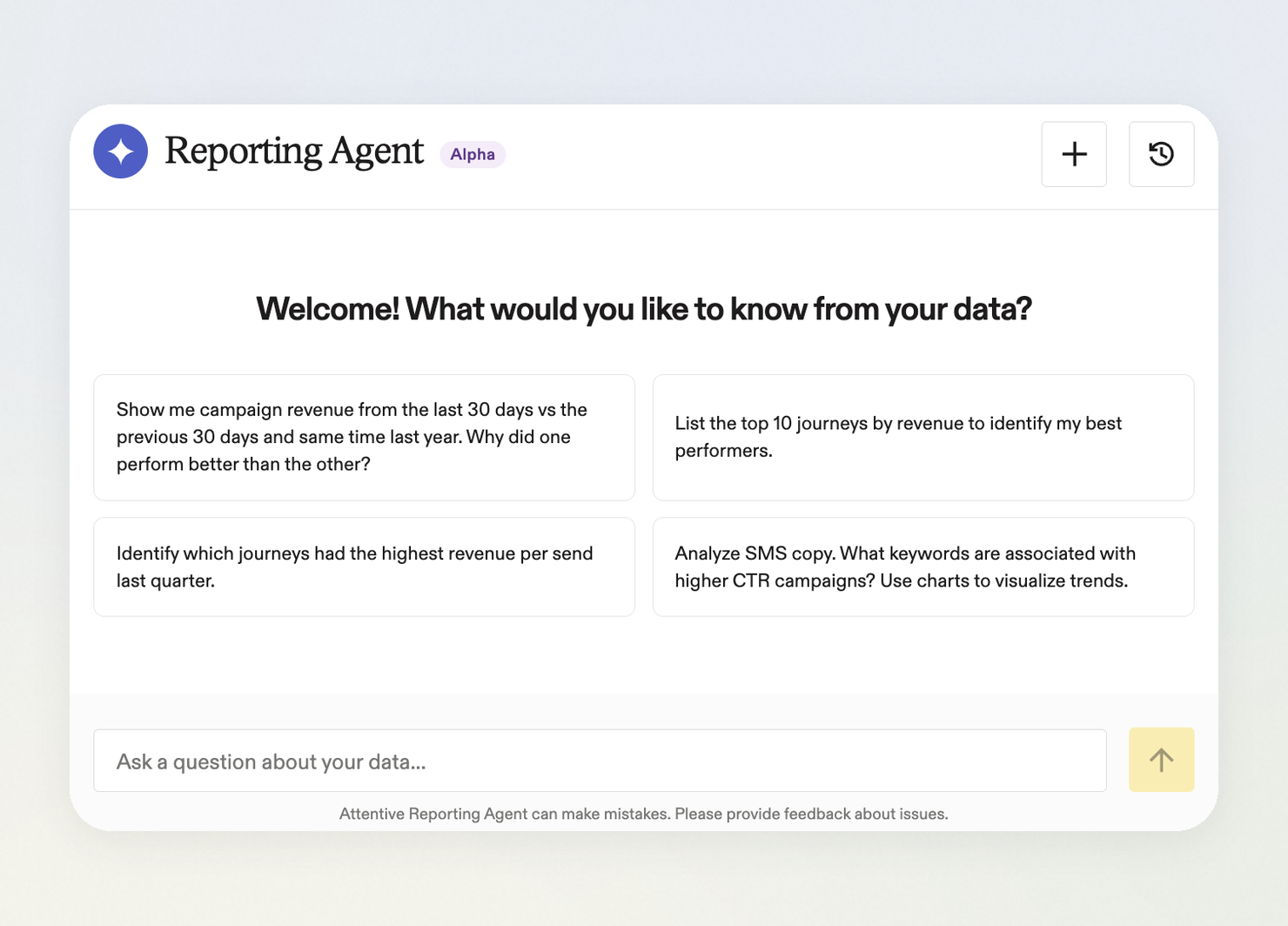
Reporting Agent lets those teams start with the question instead. In Attentive, marketers can ask in plain language, review the resulting data and charts, and keep digging from there.
The mechanics get shorter; the judgment doesn’t. Marketers still decide what matters, which comparisons are meaningful, and what should shape the next decision.
The solution
Cozy Earth keeps finding new questions to explore
For Austin Pratte, Retention Marketing Lead at Cozy Earth, reporting rarely stops at one question. A campaign question can lead to a product-level question, then to a closer look at an A/B test.
Before Reporting Agent, following those questions could mean moving between reports, adjusting filters, searching previous sends, and exporting data before the analysis could begin.
“Before the agent, a reporting task would look like going into the reports and finding the correct report to use and adjusting the filters and exporting multiple different reports to get all the data I need. Now I can do all that in one prompt."
— Austin Pratte, Retention Marketing Lead, Cozy Earth
Now, Austin can start with the question he has in the moment. He might pull data on a specific campaign type, examine product-level performance, or compare A/B test variants in more depth. When an answer points somewhere else, he can keep going.
“There's really infinite possibilities.”
— Austin Pratte, Retention Marketing Lead, Cozy Earth
For Austin, that flexibility is the point. Reporting Agent gives him a conversational way to keep following the questions that matter in his day-to-day work, instead of treating each reporting task as a separate path through the platform.
Roswell brings peer benchmarks into monthly reporting
At Roswell, a full-service e-commerce agency, Ryan Ellul, Associate Director of Retention Marketing, uses Reporting Agent to help his team assess performance across the brands they manage.
One recent example: Ryan asked Reporting Agent for peer median data to benchmark campaign and journey performance. It's data his team never had access to before, and it was delivered in minutes. That gives Roswell a way to judge whether a brand is actually performing well, not just performing differently than it did last quarter.
Ryan also uses it to narrow down what's worth analyzing. A recurring request pulls the five highest- and five lowest-performing email campaigns of the month, excluding sales and promotional sends. Those sends typically dominate the top of the list and don't tell his team much on their own, so filtering them out points his team straight to the campaigns actually worth digging into.
The biggest use case, though, is monthly ROI reporting, where Reporting Agent pulls together tables, graphs, metrics, and insights in a fraction of the time it used to take manually.
“The biggest shift for our team hasn't just been speed; it's been reallocating our time toward insights instead of data collection."
— Ryan Ellul, Associate Director of Retention Marketing, Roswell
For Roswell, collecting the numbers is only the first step. The team still has to explain what changed and where a brand may want to focus. Reporting Agent shifts more of the workflow toward that interpretation.
SHEFIT uses monthly comparisons to decide what to examine next
At SHEFIT, Emily Clevenger, Ecommerce Project Manager and Marketing Coordinator, regularly uses Reporting Agent to compare email and SMS performance with the previous month and the same month a year earlier.
Her recurring questions cover list growth, click-through rate, top-performing emails, and A/B test results. The point isn’t just to see which number moved; it’s to decide which campaign, test, or metric deserves follow-up.
Looking at both periods gives Emily two different signals: recent movement and year-over-year direction. A month can improve from the previous month while still trailing the same period a year earlier.
Emily treats the first comparison as a starting point. If click-through rate or list growth shifts, she can ask a more specific question before the team decides whether to adjust its strategy.
The team also uses Reporting Agent after program changes. When SHEFIT changed part of its sign-up setup, Emily used Reporting Agent to track performance and ask more specific questions about what followed.
“Being able to ask follow-up questions and dig into specific metrics makes it helpful for ongoing analysis, too.”
— Emily Clevenger, Digital Marketing Coordinator, SHEFIT
For SHEFIT, the monthly report isn’t the endpoint. It gives Emily a place to start digging into tests, list growth, and program changes.
The impact
Across all three teams, the first answer becomes the start of the analysis—not the end of it.
Cozy Earth can move from a campaign question to product-level and A/B test analysis without starting over each time. Roswell can bring peer benchmarks into focused campaign reviews. SHEFIT can move from monthly comparisons to the specific metric or program change it wants to understand.
The shared shift is from gathering inputs to interpreting them: what changed, why it matters for the business, and which question should come next.
Reporting Agent handles more of the path to the data. The marketer decides what deserves attention, what the comparison means, and what to do next.

Want to explore Reporting Agent for your team? Contact your Attentive team to learn more about Reporting Agent and availability.