

Brands with well-coordinated messaging programs are 56% more likely to see YoY performance gains. Learn how to move beyond channel silos to create unified customer experiences that convert better.
Shoppers experience a single relationship with your brand. But when marketing across channels isn't coordinated, that relationship can feel disconnected.
When cross-channel marketing is done well, brands create unified experiences that better retain and engage customers, leading to measurable impact:
- 57% of shoppers are more likely to buy when they see the same promo across channels (Attentive 2026 Personalization Trends report)
- 78% of brands with well-coordinated messaging programs saw YoY performance improvements—compared to 50% of brands whose channels run independently (2026 Attentive Marketer Pulse)
The more coordinated a brand’s marketing is across email, SMS, RCS, and push, the more likely they are to see performance gains.
So how do you move up the cross-channel marketing ladder?
This playbook unpacks how brands run a cross-channel marketing strategy on the Attentive omnichannel marketing platform. These tactics are backed up by the latest data from 600 US consumers about how they experience multichannel marketing.
You’ll learn:
- What shoppers find helpful—and annoying—about cross-channel marketing
- 6 tactics to improve cross-channel coordination for email, SMS, and push
- The foundation that makes cross-channel marketing possible
TL;DR: How to build a cross-channel marketing strategy
To move beyond channel silos and create unified customer experiences across channels:
- Define your channel roles. Use each channel's strengths to deliver the right message at the right moment—SMS for speed, email for depth, push for in-app action, and RCS for more interactive texting experiences.
- Give your messages room to land. Sending messages too close together could bury your whole campaign. Space them out so each send can resurface when shoppers might be ready to engage.
- Sequence messages like a conversation. Add new information throughout your campaigns and flows—a new reason to buy, a new piece of product context—so your messages move shoppers closer to purchase rather than repeating the same thing.
- Segment for relevance. Adjust promotions to shopper interest—using zero-party and behavioral data—so customers hear about things they actually care about.
- Match frequency to engagement. Some shoppers click every text, but ignore emails. Others are the opposite. Send more on the channels they engage with, less on the ones they don’t—and use AI to catch the engagement patterns you can't spot manually.
- Ensure suppression rules hold across channels. Most shoppers keep getting reminders after they’ve already bought something. Confirm your channels share customer behavior data so your suppression rules work.
- Build your identity foundation. Identifying your customers across channels, devices, and browsing sessions is essential for cross-channel coordination. Use a modern solution like Attentive Signal to recognize customers you’d otherwise miss—and capture the revenue that comes with it.
What is cross-channel marketing?
Cross-channel marketing is an integrated approach where brands unify customer data to coordinate across SMS, email, push, and beyond—so every channel works together as one system.
Many brands run these channels in silos, each one operating independently. Cross-channel orchestration connects them, creating coordinated customer journeys where interactions build on each other—deepening personalization and compounding returns over time.
1. Define your channel roles
When you understand the strengths of SMS, email, push, and RCS, you can craft campaigns and behavioral flows that effectively engage customers with the right message on the right channel.
For example, if you have customers subscribed to email and SMS, you can start a cart abandonment flow with a simple SMS reminder, then follow up later with an email that addresses common purchase hesitations.
Starting with the SMS lets you take advantage of the channel’s quick open times, while following up with email lets you go into more detail.
A quick primer on what each channel is best for:
Dive deeper: How SMS, Email, Push, and RCS Work Together to Drive Repeat Purchases
2. Give your messages room to land
The Attentive 2026 Personalization Trends Report shows that 57% of shoppers are more likely to purchase from a brand when they see the same promotion in multiple places—this goes up to 67% for shoppers who receive emails, texts, and push notifications.
But in our latest survey, 44% of shoppers who find cross-channel messaging annoying say it’s because messages are sent too close together.
This is something brands can fix.
The shoppers who find cross-channel marketing helpful reveal how:
- 59% say it’s because they’re more likely to notice a promo if they miss it elsewhere.
- 51% say it’s helpful because the follow-up message reminds them about something they’re interested in.
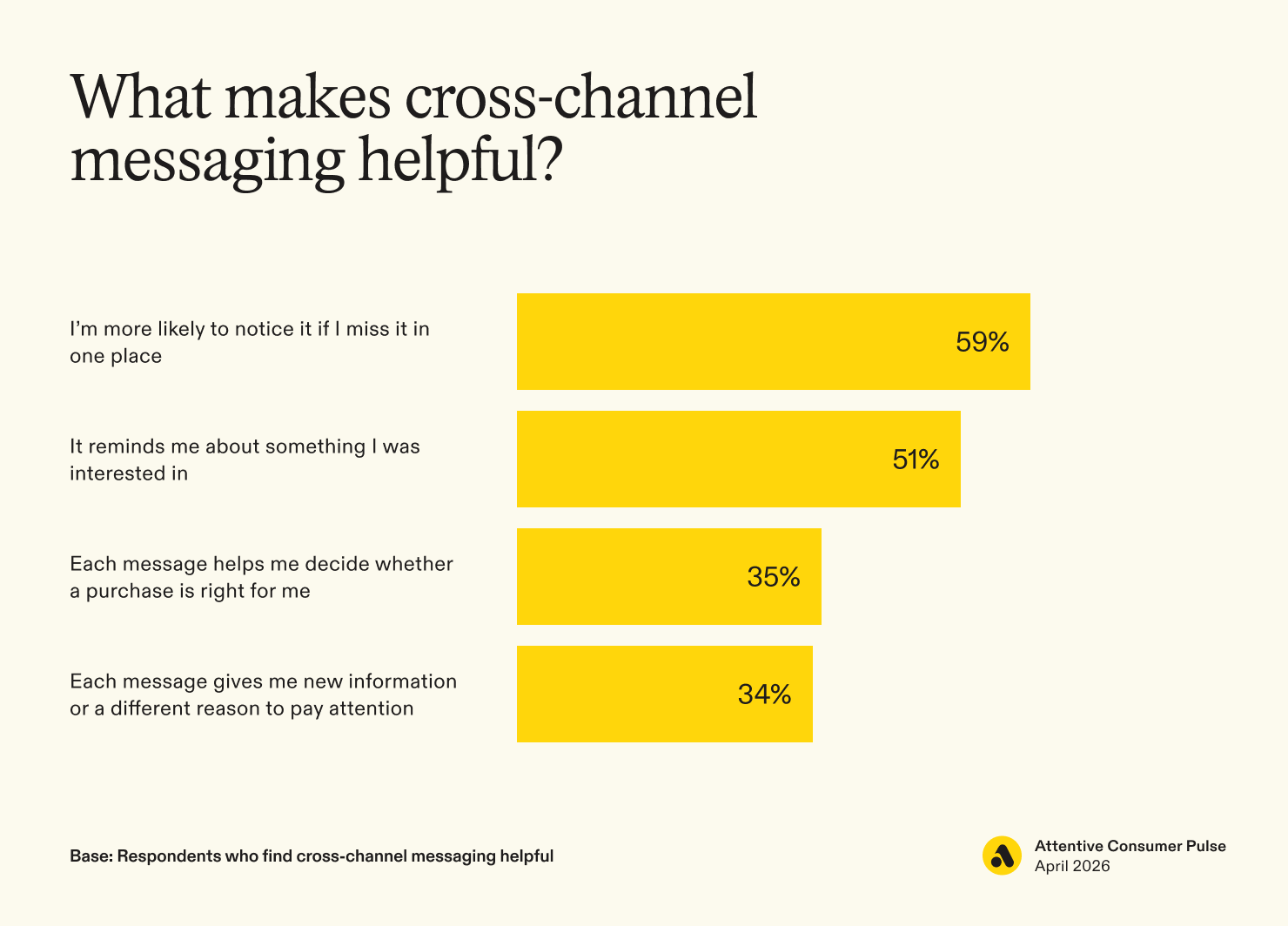
For shoppers missing promos, sending messages too close together could mean customers miss your whole campaign. When you space out messages so a reminder lands on another channel later, they may be more likely to see your follow-up messages.
For shoppers who appreciate being reminded about things they’re interested in, having additional space helps give them time to think about it.
While we recommend the first message or two in an abandonment sequence be soon after the shopper leaves your site, you can test how much space between each message in your flows and campaigns works best.
3. Sequence your messages like a conversation
After coordinating the timing of your campaigns and behavioral flows, the next step in making your email, SMS, and push program feel more like a conversation is crafting content that makes each message feel like a continuation of the last.
In our 2026 Personalization Trends Report, we found that 73% of shoppers prefer when follow-up messages add something new instead of repeating the same thing.
Our latest survey found that of shoppers who find cross-channel marketing annoying, 81% say it’s because messages feel repetitive. Furthermore, 51% of shoppers say messages feel uncoordinated when they get the same exact message too many times.
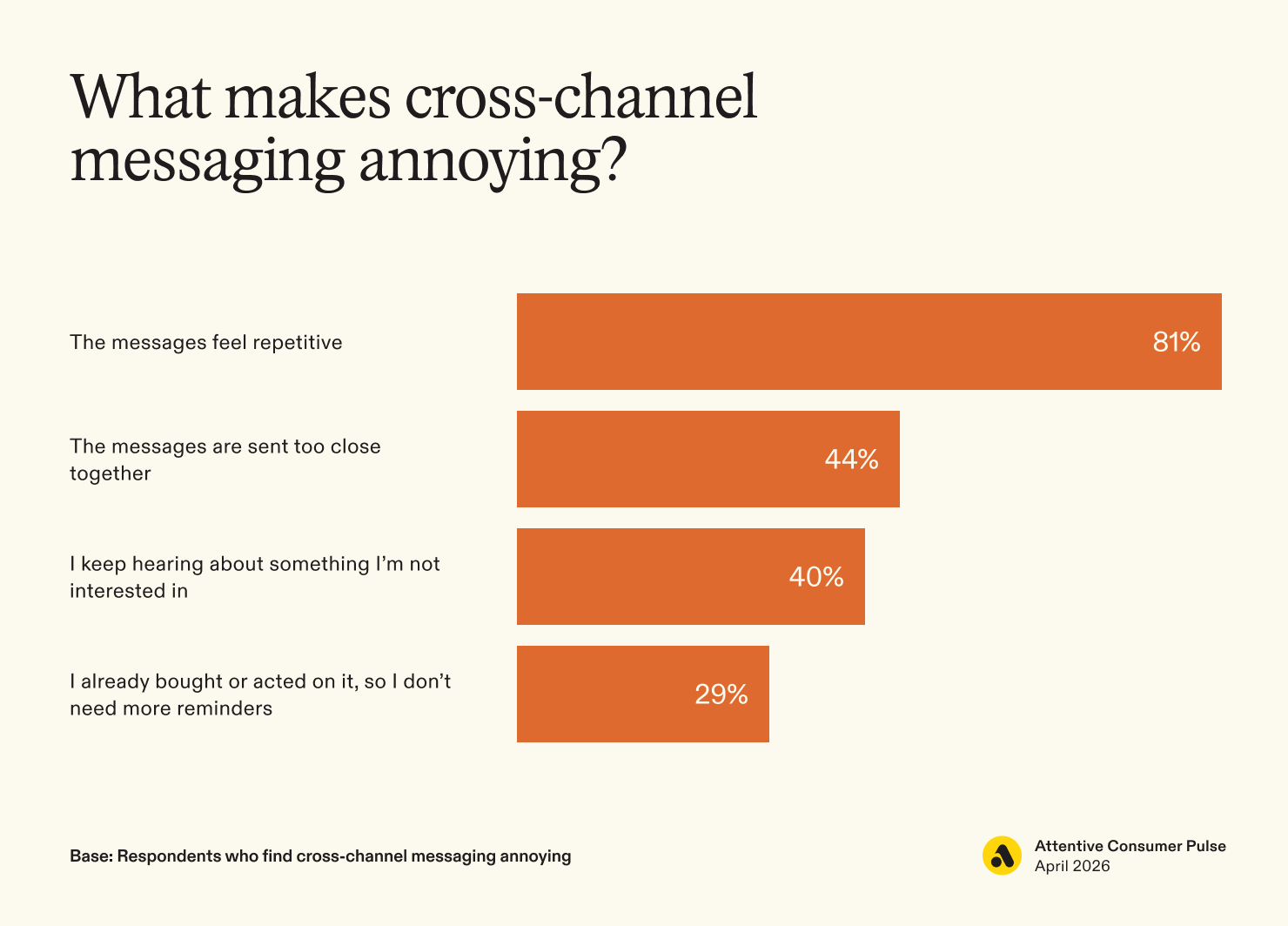
On the flip side, of shoppers who find cross-channel marketing helpful:
- 34% say it’s because each message gives them new information or a different reason to pay attention
- 35% say it’s because each message helps them decide whether a purchase is right for them
So make your cross-channel marketing campaigns and behavioral flows feel more like a conversation, adding new information with each message that ultimately helps shoppers move closer to purchase.
For a sale that could look like:
- Message 1: Announce the sale
- Message 2: Curate bestsellers, seasonal favorites, items that go together, or persona-based picks
- Message 3: Highlight specific products or collections to interest-based audience segments
- Message 4: Send a last call message when your sale is almost over
4. Align promotions to shopper interest
You’ve nailed your cadence and flow, but not every message should go to every shopper.
Recently, we found that:
- 80% of shoppers are more likely to ignore brands that send irrelevant messages (2026 Personalization Trends Report)
- 43% have unsubscribed because of message fatigue (2026 State of Loyalty & Retention)
The latest data reveals that 40% of shoppers who find cross-channel marketing annoying say it’s because they keep hearing about something they’re not interested in. But as we discovered earlier, 51% of shoppers who find cross-channel marketing helpful say it’s because these additional messages remind them about something they were interested in.
So segment your campaigns to ensure you’re messaging the right people in the first place. There are many ways to approach segmentation.
Some of the top ways we recommend segmenting for message relevance:
- Product/category fit using purchase, browse, and campaign engagement data
- Interest-based using zero-party data you’ve collected
- Geographic segments (e.g., by climate, region, or store proximity)
Word to the wise: According to the Attentive 2026 Personalization Trends Report, 65% of shoppers are open to receiving messages more frequently if they’re relevant.
The more relevant your marketing is, the more real estate you can take up in subscribers’ inboxes—and the more opportunities you have to encourage their next purchase.
Learn more: Email Marketing Segmentation: What it is, Types, and How to Improve it in 2026
How amika runs a cross-channel marketing campaign
Haircare brand amika has mastered the art of cross-channel marketing.
For their recent “love amika” sale, they structured a cross-channel marketing campaign that built over several days. In these campaigns, you’ll see how the brand intelligently built an omnichannel sale campaign with:
- Clear channel roles
- Intentional spacing between messages
- Sequential sends that build on each other
- Segmentation based on shopper interest
These are just a few of the standout campaigns as part of amika’s sequence.
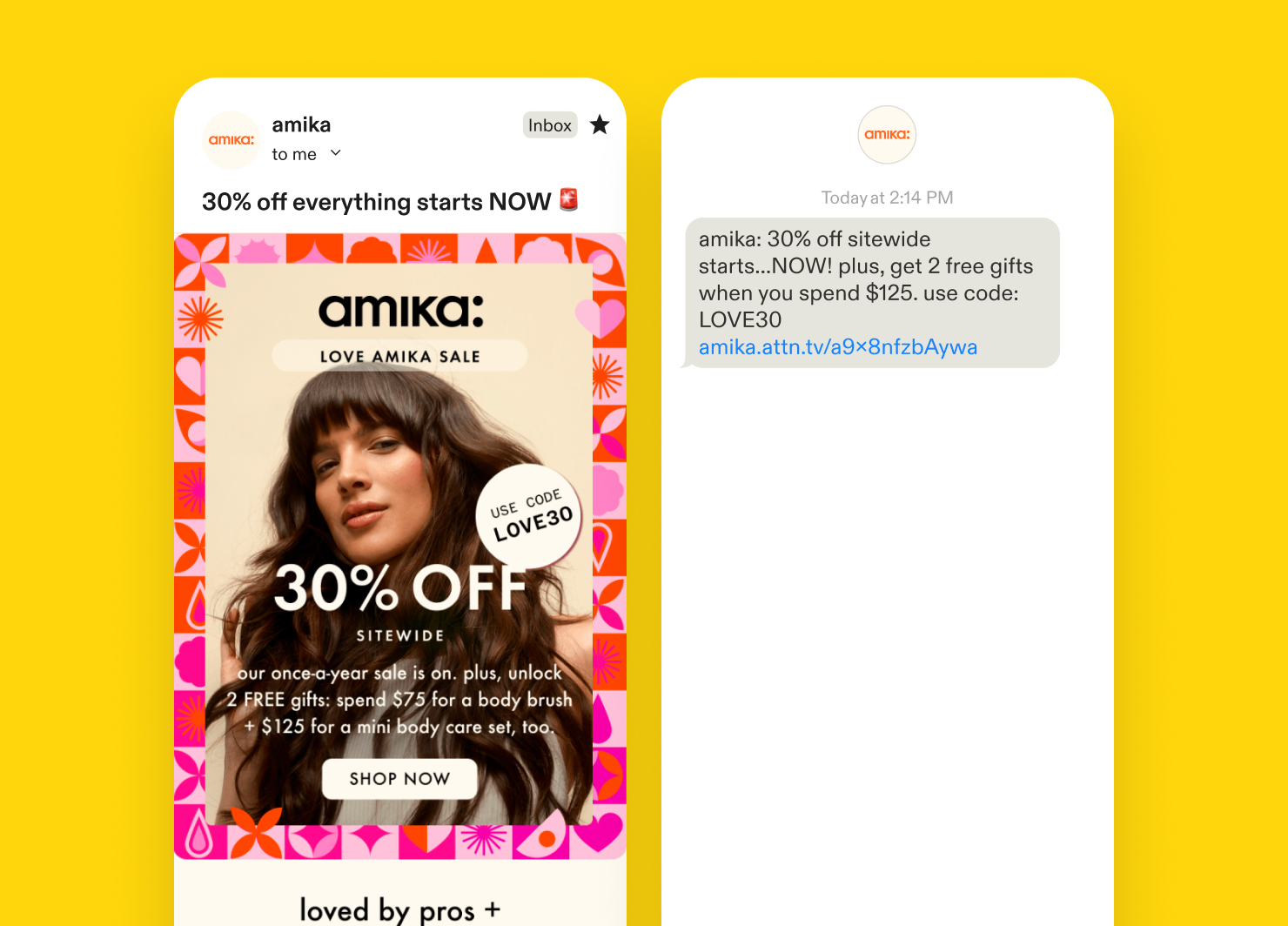
Announce the sale
Amika announced the sale first by email, then by SMS a few hours later. Sending on two channels—several hours apart—lets them reach shoppers again if they missed the first campaign.
Highlight bestsellers
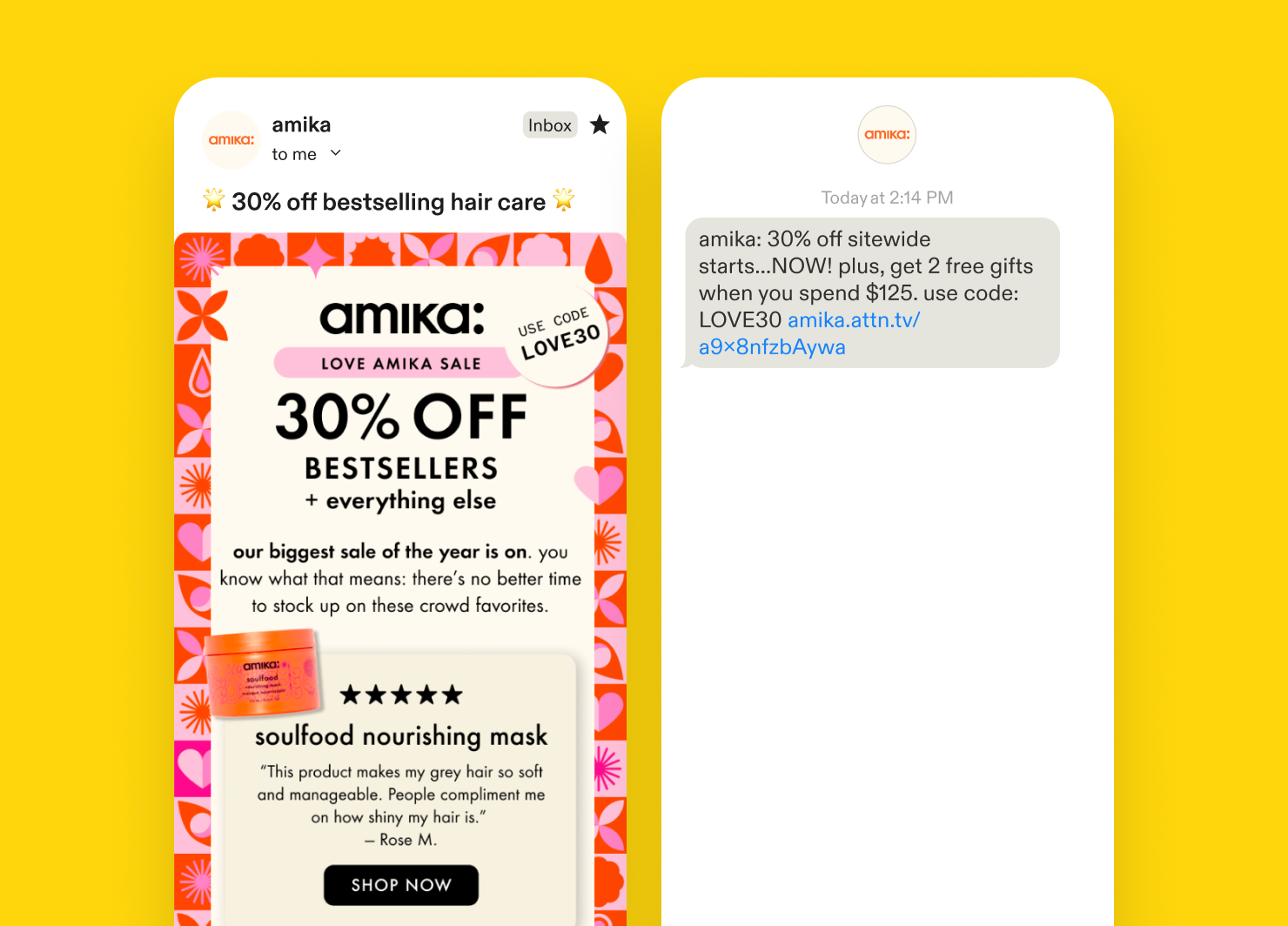
A couple days later, amika sent a campaign featuring bestselling products with customer reviews to pique shoppers’ interest. Using both email and SMS helps the brand reach shoppers wherever they’re most likely to see the campaign.
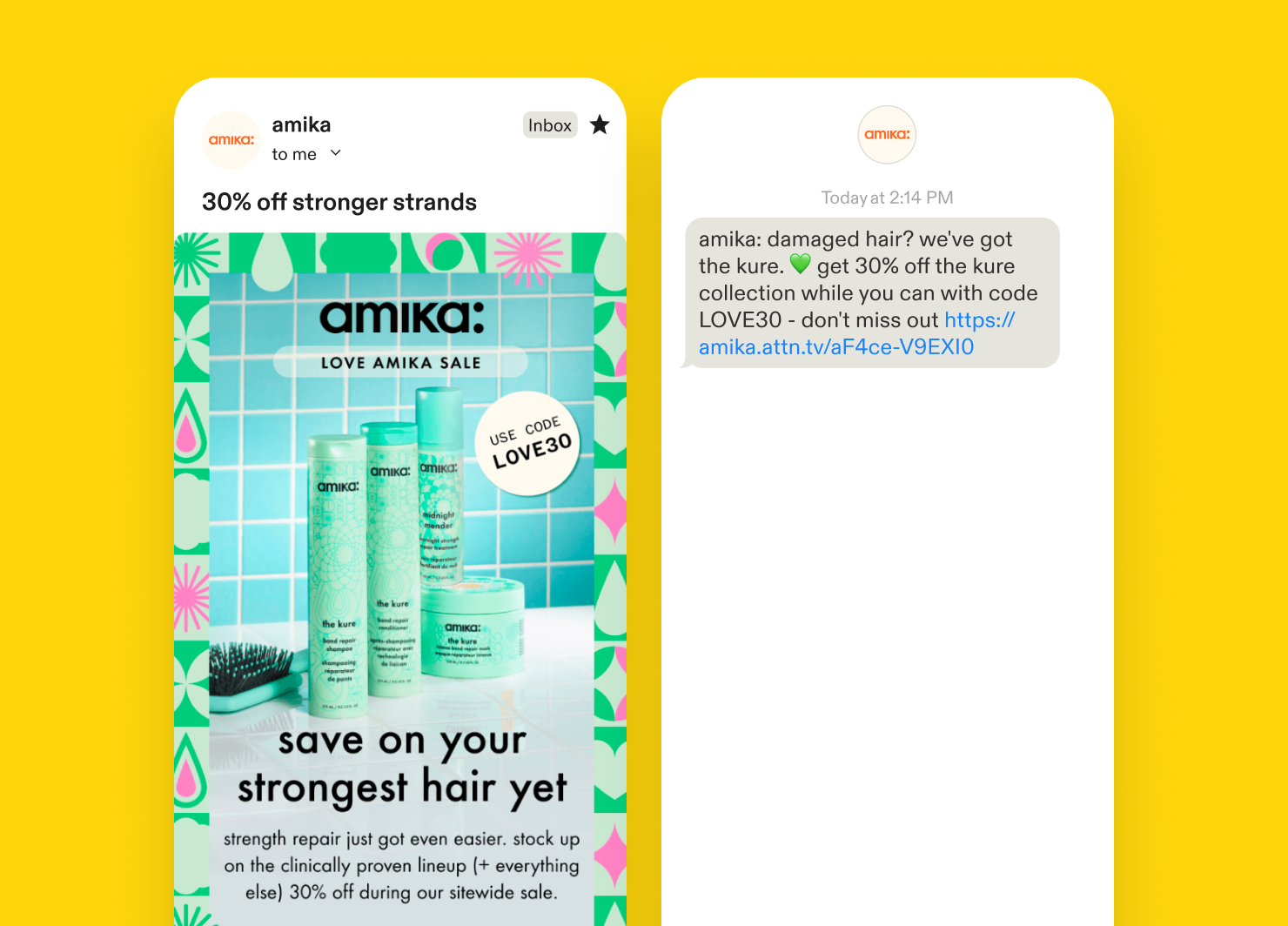
Send dedicated product messages to relevant segments
Later, the brand sent messages featuring a specific product or collection to subscribers who’d shown interest in those items before.
This reframed the sale through the lens of something those customers were likely to buy.
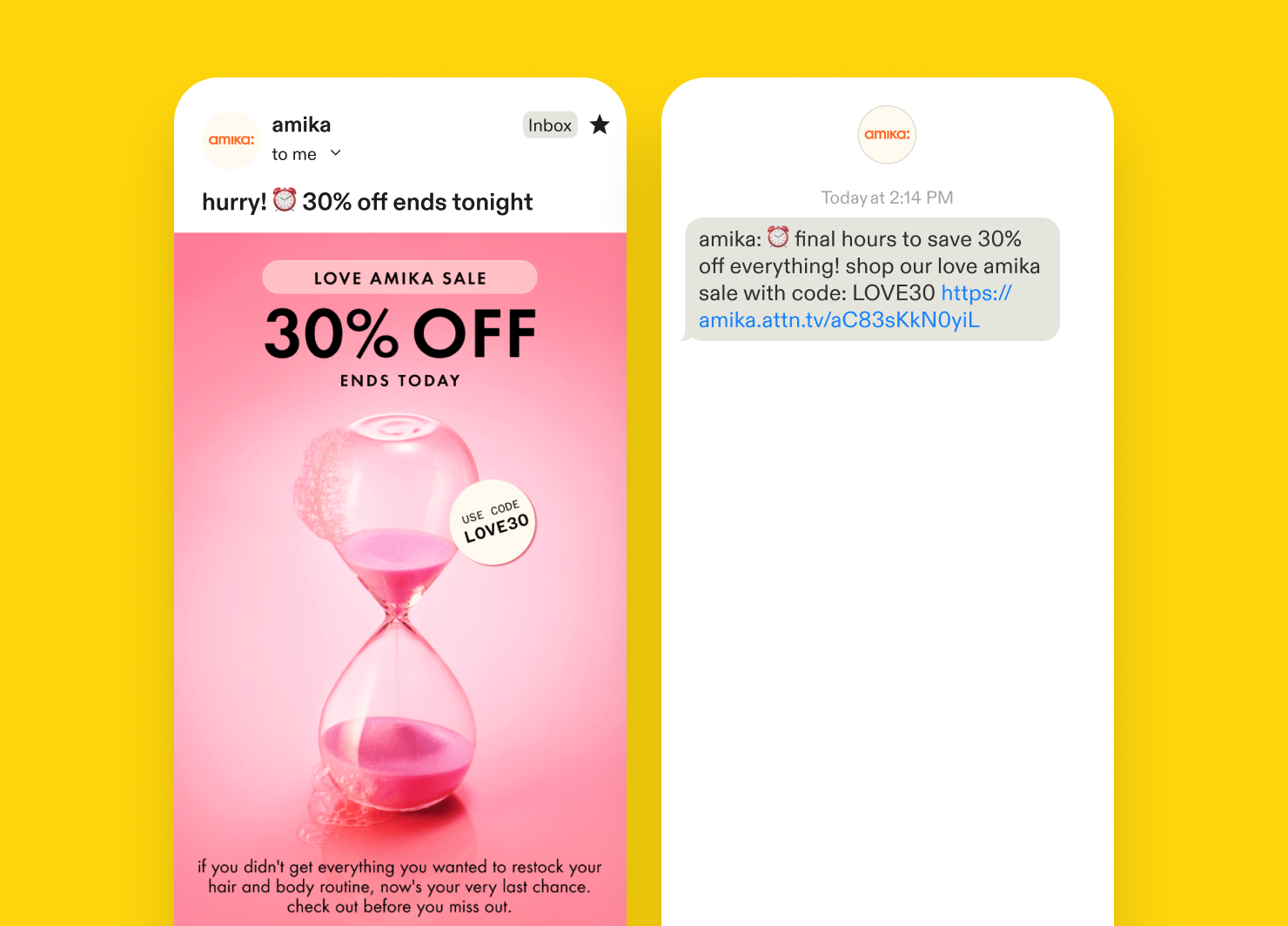
Remind subscribers in the final hours
On the last day of the sale, amika sent a couple of final reminders to capture any lingering interest.
5. Match channel and frequency to engagement
75% of shoppers want brands to adjust how frequently they’re messaged based on their engagement. But there’s no clear pattern in shoppers’ ideal frequency. Some shoppers are open to hearing from a brand every day, while others would like a few times per week.
Shopper preferences for message frequency by channel:
With no one-size-fits-all frequency, brands can meet shoppers where they are by matching frequency to engagement on each channel.
For example, if a shopper rarely clicks on an email, but engages with every text, you might skip lower-impact emails—saving those for more critical moments like big sales or a relevant product launch—and consider sending text messages more frequently.
The 2026 Attentive Marketer Pulse backs up this approach. 90% of brands who personalize channel and timing to customer engagement saw improved performance YoY, compared to 78% of brands with well-coordinated, but unpersonalized, cross-channel messaging.
Use AI to tune in to the right frequency
Rule-based segmentation is a great place to start, but it has limitations. You could miss shoppers who are likely to buy if they don’t fit your predefined criteria—or send campaigns to subscribers who aren’t actually in shopping mode.
Audiences AI, part of Attentive AI™ Pro, identifies hidden patterns in your customer data. Then it adds or removes subscribers from campaign sends based on their likelihood to purchase.
Attentive brands using Audiences AI see up to a 15% increase in multichannel campaign revenue across email and SMS.
6. Ensure suppression rules hold across channels
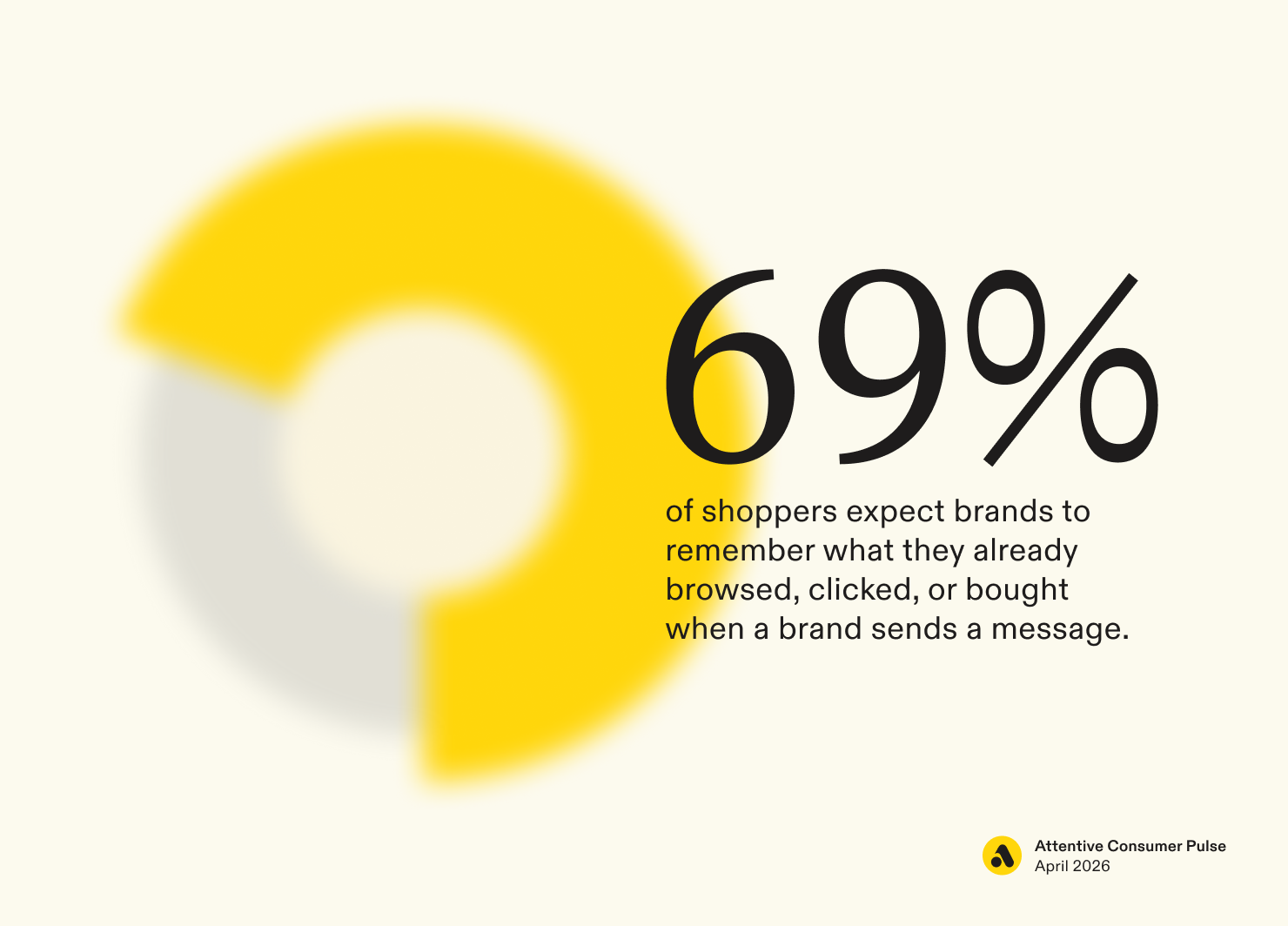
69% of shoppers expect brands to remember what they already browsed, clicked, or bought. Yet 54% say they regularly get reminded to buy something they already purchased—and according to our 2026 Personalization Trends Report, that follow-through problem makes 67% of shoppers more likely to unsubscribe.
Most brands already have suppression rules in place, so what’s happening here?
The disconnect is a customer recognition problem.
If you can’t recognize that the person who clicked on an email is the same person who later purchased after clicking on a text, your abandonment flows will keep triggering.
Traditional email and SMS platforms rely on browser cookies to track behavior and treat each email address as a separate shopper. But cookies expire faster now, shoppers move across devices, and 75% have multiple email addresses.
The result: disconnected customer profiles with missing behavioral data, causing campaign misfires across channels.
This can be solved by establishing a strong identity foundation with a modern solution like Attentive Signal—one that recognizes the same customer across channels, devices, and sessions.
Customer recognition makes cross-channel marketing possible
Shoppers interact with your brand in numerous ways. Your best customer might browse on their phone at lunch, switch to their laptop at home, come back through an ad later—and your analytics may log those visits as three anonymous visitors instead of one loyal subscriber.
A modern identity solution closes that gap by building an identity graph—linking every piece of identification you collect from a customer into a single unified profile:
- Phone number
- Email addresses
- Device information
- Location
- Browsers
- IP addresses
- Integrations identifiers like their loyalty ID
When any one of these identifiers shows up, you can connect it back to the customer—even when individual signals disappear (they switch devices, cookies expire, or email addresses change).
That recognition lets you coordinate smoothly across email, SMS, push, and RCS and:
- Personalize with the full picture of a customer’s relationship with your brand
- Trigger behavioral flows you’d otherwise miss
- Suppress redundant messages when a customer buys from a different channel
- Adjust frequency based on engagement across channels
And the impact is measurable:
Brands actively investing in identity resolution are 34% more likely to report YoY performance improvements than brands who aren’t. And those who use Attentive Signal see 20% higher conversion rates and 95% more triggered email revenue.
Want to go deeper on the foundation behind cross-channel marketing? Read Why Identity Resolution is Your Biggest Revenue Opportunity in a Privacy-First World to learn why the brands solving for recognition are pulling ahead.
Methodology
This survey was conducted online via Pollfish among 600 US adults from April 10–15, 2026. The study was designed to analyze results evenly across four generations: Baby Boomers, Gen X, Millennials, and Gen Z. Because younger respondents were harder to recruit in field, final results were weighted only by generation so that each one contributed equally to the overall analysis. No other post-stratification adjustments were applied.


.png)