.png)

The strongest segmentation programs use the right customer signals for each decision, creating more intentional audience strategies across the customer lifecycle.
Most segmentation strategies begin with a question about reach. Who subscribed? Who clicked? Who bought something last month?
Those questions are worth asking, and they're easy to answer. But they describe a moment that already passed. As a program matures, the questions get harder and more useful: Where is this customer in their relationship with us? How much are they worth investing in? What are they interested in right now?
That shift is what separates a team that builds audiences from a team that makes decisions. This post breaks down the four-stage curve most programs move along, and where lifecycle, value, and interest signals come in.
Why traditional customer segmentation runs out of room
Marketers have more customer data available than at any point in the past decade. Most segmentation strategies still lean on a short list of inputs:
- Subscription status
- Basic demographics
- Recent clicks or opens
- One-time purchase events
- Manually maintained audience rules
Each of these is legitimate. Together they do a good job of answering the question of what happened. What they can't tell you is what to do next.
A customer who clicked a serum email in March and a customer who has bought serum every six weeks for two years can both land in the same “engaged with skincare” audience. They shouldn't get the same message. The rule that grouped them can't see the difference.
The maturity model below is a way to evaluate how well your program turns customer signals into marketing decisions, and where the gaps are.
The four stages of segmentation maturity
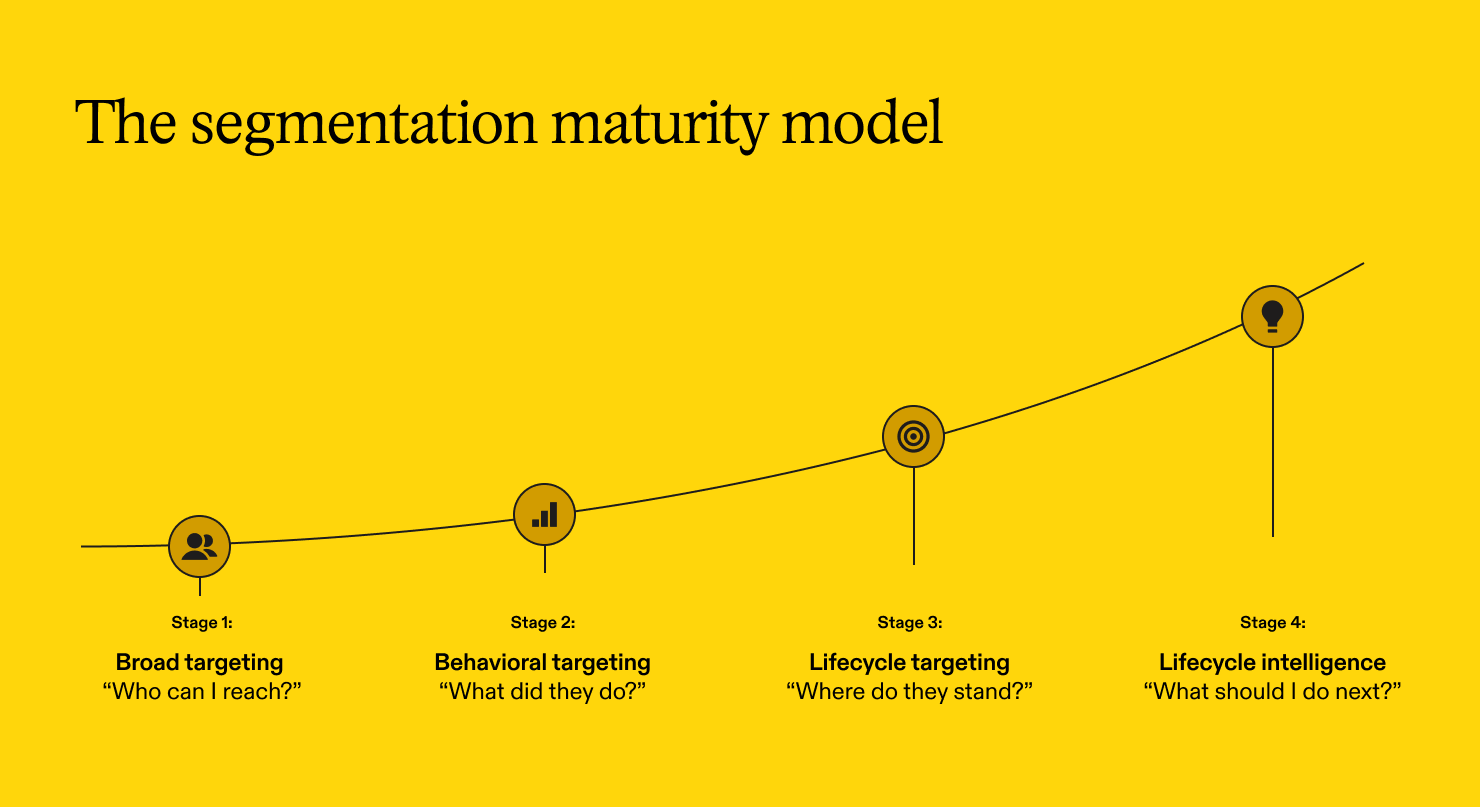
Stage 1: Broad targeting gets you reach
Nearly every program starts here:
- Sending a promotion to the full SMS list
- Sending a product launch to all email subscribers
- Separating purchasers from non-purchasers
What it does well: It's fast to execute and it maximizes reach. When you have a message that genuinely applies to everyone, breadth is the right call.
Where it falls short: It treats customers with very different relationships and very different interests as one audience. Your best customer and someone who subscribed yesterday get the same email.
As volume grows, most teams start looking for ways to add context.
Stage 2: Behavioral targeting adds context
At this stage, marketers start using observable actions to improve relevance:
- Targeting recent purchasers
- Reengaging customers who haven't purchased in 90 days
- Promoting a category to people who clicked it before
- Triggering a journey from a browse or cart event
What it does well: It responds to something the customer actually did, which is a real improvement over sending to everyone.
Where it falls short: A single action is a narrow piece of evidence, and it goes stale. A click doesn't tell you how valuable someone is, where they stand in their relationship with your brand, or whether they still care about that category three months later.
Pro tip: Behavioral targeting is where a shift happens: from events to signals. An event is a thing that happened once. A signal is a read on the customer that updates as they keep interacting with you.
Stage 3: Lifecycle targeting asks where the customer stands
At Stage 3, marketers stop looking at purchases as independent events and start looking at the relationship those purchases add up to. Two signals do most of the work here.
RFM tells you about the relationship
What is RFM?
RFM stands for recency, frequency, and monetary value: how recently a customer bought, how often they buy, and how much they spend. Scoring those together sorts your list into lifecycle groups like Champions, Promising, and At Risk, which tells you the direction a relationship is heading.
Now you can ask a better question: should I reward this customer, grow the relationship, or try to bring them back?
Consider two customers who have each spent a few hundred dollars with you over two years. One bought last week. The other hasn't bought since last spring. A single “past purchaser” audience puts them side by side. RFM separates them, because they need genuinely different retention strategies.
Customer lifetime value (LTV) tells you about the value
What is customer lifetime value?
Customer lifetime value (LTV) measures what a customer is worth to your brand across the whole relationship. It draws on historical spend, time-bound spend, and predicted future value, which makes it a more reliable guide than any single purchase when you're deciding where to invest.
Historical spend, time-bound spend, and predicted future value add a second decision lens. The question here is about investment: how much is this customer worth putting resources behind?
That opens up decisions that are hard to make otherwise:
- Identifying high spenders for VIP treatment
- Finding last year's high-value holiday shoppers before this year's holiday season
- Putting more retention budget behind the customers with the most future value
- Holding back discounts for customers who are likely to buy without one
That last one tends to get overlooked. Knowing who doesn't need an incentive protects margin, and it's only possible when you can see value.
Stage 4: Lifecycle intelligence turns signals into decisions
At the highest level of maturity, the question changes. Instead of asking how to segment an audience, marketers start with the decision they're trying to make and work backward to the signal that answers it.
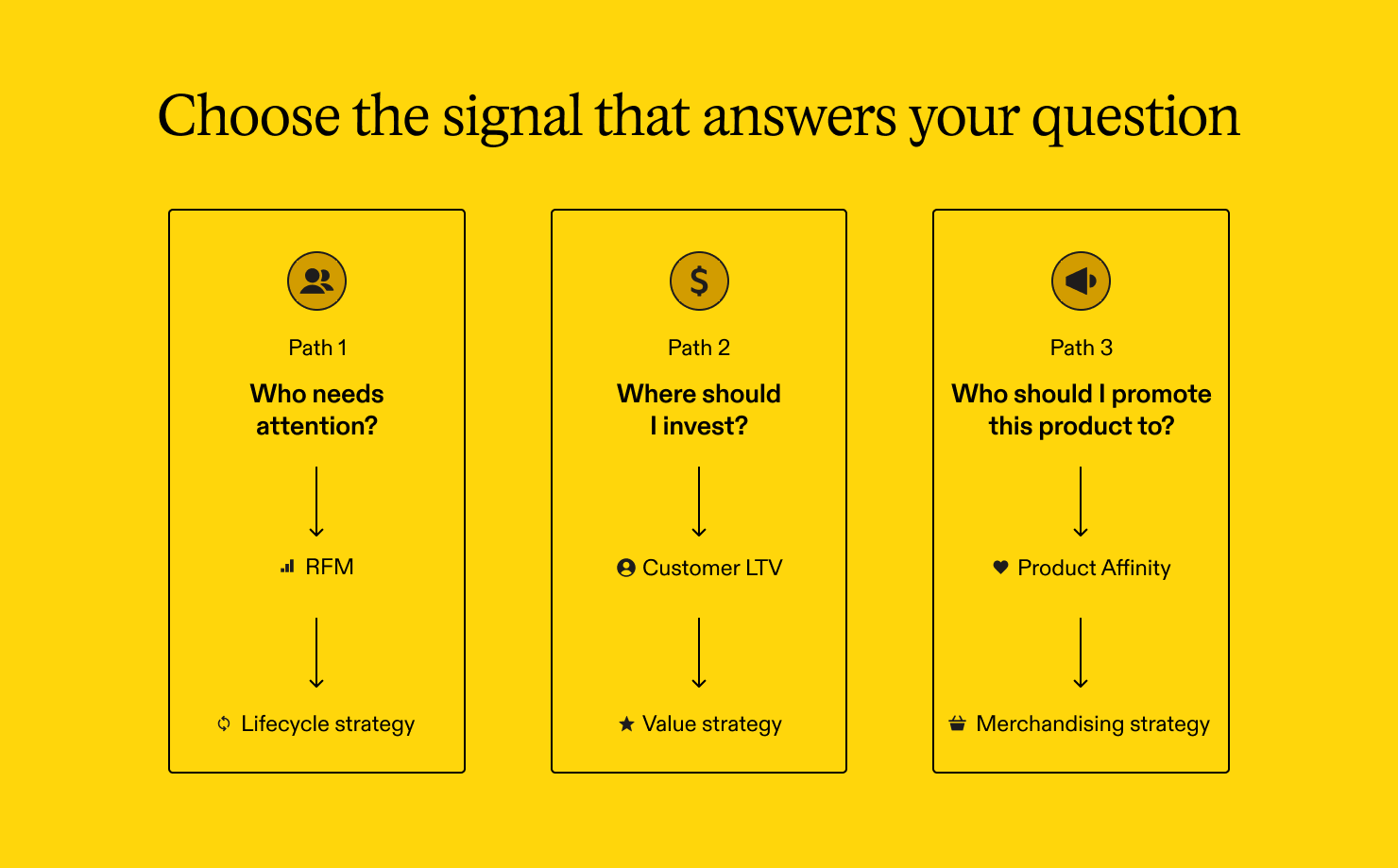
- Who needs my attention? Use lifecycle signals like RFM.
- Who deserves greater investment? Use customer value signals like LTV.
- Who should I promote this product to? Use Product Affinity to read changing product and category interest.
This is the move from segment creation to audience decisioning, and it comes with a release valve worth naming: these signals don't need to be combined. There's a common instinct to build the one perfect audience that layers lifecycle stage, value tier, and category interest into a single definition. That audience is usually small, hard to maintain, and hard to learn from.
Each signal can power the strategy it's suited to, running in parallel. Your winback program can run on RFM while your category campaigns run on affinity, and neither one has to wait for the other.
Product Affinity: from customer engagement to interest
What is Product Affinity?
Product Affinity identifies how strongly a shopper is drawn to a product or category, based on signals like browsing, purchases, and engagement. Because affinity updates as behavior changes, an audience built on it keeps pace with shifting interest rather than depending on a rule someone wrote last quarter.
Product Affinity deserves its own section, because the difference between it and behavioral targeting is subtle and it matters.
The behavioral approach: send the serum campaign to people who clicked a serum email.
The affinity approach: build a dynamic audience of shoppers who are demonstrating interest in serums.
The first is a record of one action. The second is a read on interest that updates as shoppers keep browsing, buying, and engaging. Affinity answers a question a click can't: which shoppers care about this product or category right now?
.png)
Because affinity moves as interest moves, the audience evolves with your customers instead of depending on a rule someone wrote last quarter. A shopper who was buying cleanser in January and looking at SPF by June shows up in the right audience both times, without anyone updating a filter.
Where this tends to earn its keep:
- Category promotions
- Product launches
- Recurring merchandising campaigns
- Journey triggers and branching
- Adjusting reach, using broader affinity for discovery and higher affinity for conversion
What mature customer segmentation looks like in practice
The framework only matters if it changes what you actually send. Here's how five common goals look at each end of the maturity curve.
How to build a more mature customer segmentation strategy
None of this requires rebuilding your segmentation strategy. The most reliable way to move up a stage is to start with one decision you're currently making on instinct.
Three questions worth sitting with:
- Which customers am I struggling to prioritize?
- Where am I spending without knowing which customers justify it?
- Which campaigns underperform because I don't know what shoppers want?
Then pick the signal that answers the question you landed on.
If it's a retention problem, start with RFM. Pull your Champions, Promising, and At Risk audiences and run differentiated strategies against each. The gap between how those three groups respond is usually the most convincing case for the whole approach.
If it's an investment problem, start with LTV. Look at where customer value should be changing your incentives, your channel mix, or your retention spend.
If it's a relevance problem, start with Product Affinity. Take one major category campaign, build an affinity audience alongside your usual audience, and compare them with segment-level reporting.
One decision, one signal, one campaign. That's a real test, and it gives you something to point at when you make the case for doing more.
Better segmentation is better decisioning
Segmentation maturity isn't a measure of how many conditions you can stack into an audience definition. It's a measure of how well your customer signals help you decide what to do next.
The questions that got most programs started, who subscribed, who clicked, who purchased, still have answers worth knowing. Lifecycle, customer value, and product interest give you the rest of the picture: who needs attention, where your investment goes furthest, and what each audience actually cares about right now.
The three signals in this post are ones you can put to work now. Attentive gives marketers RFM scoring, Customer LTV, and Product Affinity as live signals, so your audiences keep pace with customer relationships and interests instead of waiting on someone to rewrite a rule.
Pick the one decision you'd most like to make with better information, and start there.
Explore lifecycle intelligence: Request a personalized demo of AI Pro.